
"Our integration with the Google Nest smart thermostats through Aidoo Pro represents an unprecedented leap forward for our industry."
- Antonio Mediato, founder and CEO of Airzone.
In earlier years, businesses could afford slower decision cycles.
Monthly reports were enough. Quarterly reviews worked.
That is no longer the case.
Markets shift quickly. Customer behavior changes faster. Operations face constant pressure.
A delay in insight today does not just slow the business. It creates risk.
Leaders are now asking a different question.
Not “do we have data?” but “how fast can we act on it?”
"Our integration with the Google Nest smart thermostats through Aidoo Pro represents an unprecedented leap forward for our industry."
- Antonio Mediato, founder and CEO of Airzone.
Most enterprises have strong systems in place.
They have ERP systems, CRM platforms, analytics tools, and dashboards.
But there is still a gap.
Data moves through layers.
Each layer adds time.
Each delay reduces value.
By the time insight reaches leadership, it often reflects the past, not the present.
This gap is what AI/ML Development Services are designed to close.
"By analyzing the data from our connected lights, devices and systems, our goal is to create additional value for our customers through data-enabled services that unlock new capabilities and experiences."
- Harsh Chitale, leader of Philips Lighting’s Professional Business.
Many articles describe AI and machine learning as advanced technologies.
That is true. But for enterprise leaders, the value is simpler.
AI and ML help systems think faster.
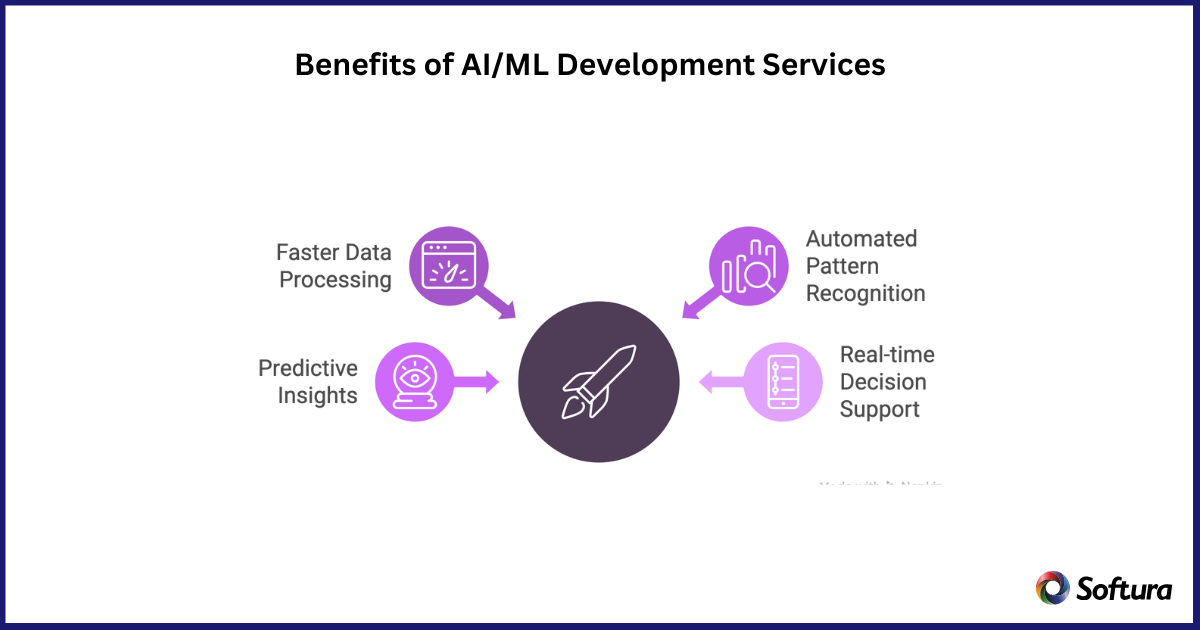
They process large volumes of data in real time. They identify patterns that are not visible through manual analysis. They highlight what matters most.
In practical terms, AI/ML Development Services deliver:
The result is not just better analysis. It is faster action.
Traditional analytics tools are useful. But they depend heavily on human effort.
Analysts pull data. They clean it. They build reports. They interpret trends.
This takes time.
And time is the one resource leaders cannot afford to lose.
Another limitation is scale.
As data grows, manual analysis becomes harder.
Patterns are missed. Signals are delayed.
AI and ML address both issues.
They reduce manual effort and improve speed.
From a leadership standpoint, the focus is not on technology.
It is on outcomes.
Executives are looking for:
AI/ML initiatives succeed when they are tied to these outcomes.
Not when they are treated as experiments.
AI systems can process data as it is generated.
This removes the delay between data collection and analysis.
For example, instead of waiting for daily reports, leaders can see updates instantly.
This allows faster responses to issues.
Machine learning models can predict outcomes based on historical data.
This shifts decision making from reactive to proactive.
Instead of asking “what happened,” leaders can ask “what is likely to happen next.”
This reduces uncertainty.
AI can detect unusual patterns in data.
This is critical for identifying risks early.
For example:
Early detection leads to faster action.
Modern AI systems allow users to ask questions in simple language.
This removes the need for technical skills.
Leaders can access insights directly without waiting for reports.
Despite the potential, many AI projects do not deliver expected results.
The issue is not the technology.
It is the approach.
Common challenges include:
This is where AI/ML Development Services play a critical role.
They bring structure and direction to AI initiatives.
AI is not a plug and play solution.
It requires planning, design, and alignment with business goals.
Consulting helps organizations:
This ensures that AI delivers measurable value.
AI/ML Development Services are being used across sectors.
These applications show how AI reduces time to insight in practical ways.
Traditional analytics is like using a printed map.
It shows where things are.
But it does not adapt in real time.
AI is like a navigation system.
It updates continuously. It suggests better routes. It responds to changes instantly.
This is the shift enterprises are making.
This is one of the two sections where bullet points improve clarity.
These benefits are not theoretical. They are measurable.
AI is only as good as the data it uses.
Poor data leads to poor insights.
This is why data preparation is a critical step.
Organizations must focus on:
Without this foundation, AI efforts struggle.
AI does not operate in isolation.
It must connect with existing systems.
This includes ERP, CRM, and data platforms.
Integration ensures that insights are actionable.
Not just theoretical.
Cloud platforms support AI by providing scalable infrastructure.
They allow organizations to process large volumes of data efficiently.
They also support continuous improvement of models.
This makes AI more accessible and flexible.
Leaders need clear metrics to evaluate AI success.
Key metrics include
These metrics help justify investment in AI.
This is the second and final bullet section.
This approach reduces risk and improves outcomes.
Softura supports enterprises in building practical AI solutions.
This includes:
This combination ensures that AI delivers real business impact.
Industry research highlights the growing value of AI in business operations.
Source credit: PwC AI Business Survey
Organizations using AI report improved efficiency and faster decision making.
This aligns with what is seen in real world implementations.
The challenge for enterprise leaders is not access to data.
It is the speed of understanding. AI/ML Development Services address this challenge directly.
They reduce delays. They improve accuracy. They support faster decisions.
As business environments become more dynamic, the ability to act quickly will define success.
And that ability depends on how fast insights are generated.
If your organization is still waiting days or weeks for insights, it may be time to rethink your approach. Connect with Softura to explore AI/ML Development Services tailored to your business needs.