
"Our integration with the Google Nest smart thermostats through Aidoo Pro represents an unprecedented leap forward for our industry."
- Antonio Mediato, founder and CEO of Airzone.
Organizations today operate in environments that generate enormous amounts of data. Customer interactions, operational systems, digital platforms, and connected devices all produce information every second.
The challenge is not collecting data. The challenge is turning that data into useful insight.
Traditional analytics tools can only go so far. They often require manual analysis and static reporting. Artificial intelligence changes this by allowing systems to learn from data automatically and generate predictions or recommendations.
A retail company may use machine learning models to forecast demand for specific products. A logistics organization may analyze delivery patterns to improve route planning. A healthcare provider may identify patient risk patterns earlier through intelligent data analysis.
In each case, AI & ML Development Services help design systems that convert raw information into meaningful guidance.
For CIOs and CTOs, the real value lies in improved decision making. When leaders gain access to accurate predictions and real time insights, they can respond faster to changing market conditions.
"Our integration with the Google Nest smart thermostats through Aidoo Pro represents an unprecedented leap forward for our industry."
- Antonio Mediato, founder and CEO of Airzone.
Many organizations assume AI development simply involves building algorithms. In reality, successful AI initiatives require a broader technology ecosystem.
Professional AI & ML Development Services typically cover several important areas that support the full lifecycle of intelligent systems.
Machine learning models depend on high quality data. Development teams help organizations collect, clean, and organize data so that models can learn effectively.
Data scientists design machine learning models that analyze patterns and generate predictions based on business objectives.
Models are integrated into business applications such as customer service platforms, analytics dashboards, and automated workflows.
AI tools must connect with enterprise systems such as ERP platforms, CRM databases, and operational software.
Machine learning models require monitoring and improvement over time to ensure accuracy as data evolves.
Through this structured approach, AI & ML Development Services transform experimental ideas into scalable enterprise solutions.
"By analyzing the data from our connected lights, devices and systems, our goal is to create additional value for our customers through data-enabled services that unlock new capabilities and experiences."
- Harsh Chitale, leader of Philips Lighting’s Professional Business.
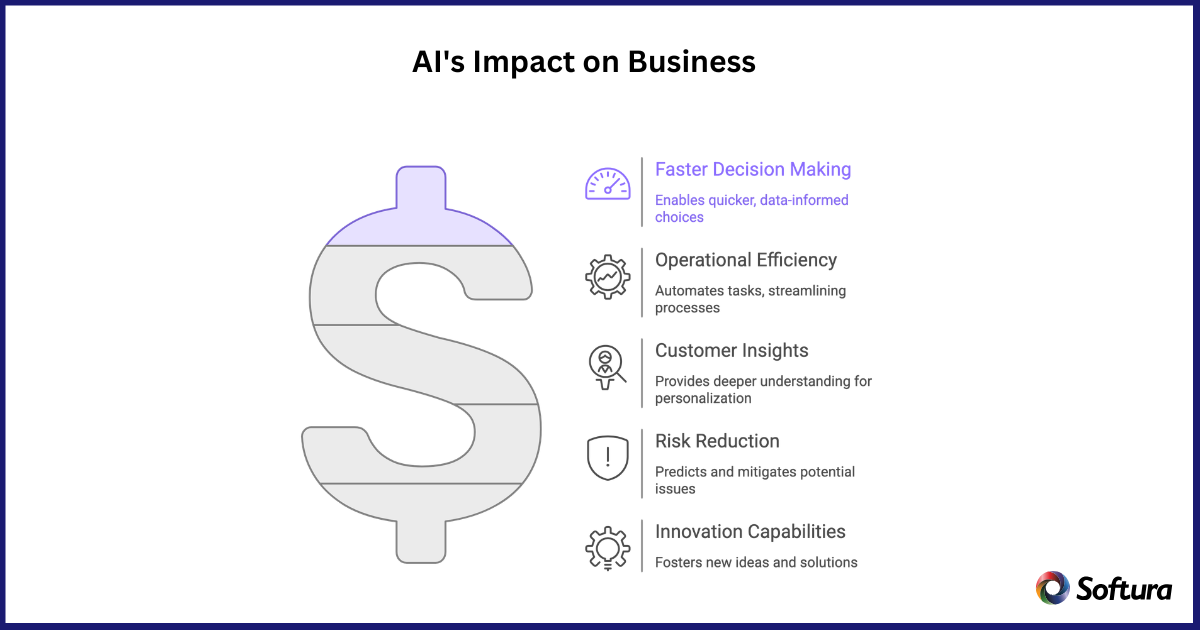
Organizations investing in intelligent technologies often experience improvements across several operational areas.
These benefits appear when AI initiatives align with clear business goals.
Many executives note that the most successful AI programs begin with a simple question: what business challenge needs to be solved.
Technology becomes valuable only when it addresses real problems.
Different industries use AI and machine learning in different ways. However the goal remains consistent. Organizations want to understand patterns in their data and use that insight to improve performance.
Manufacturing companies often rely on predictive maintenance systems that identify equipment issues before they cause downtime.
Financial institutions use machine learning models to detect unusual transaction patterns and reduce fraud risk.
Retail companies analyze purchasing behavior to personalize product recommendations.
Logistics organizations use AI powered forecasting models to improve delivery planning and inventory management.
Behind each of these applications are carefully designed systems developed through AI & ML Development Services.
These services help organizations move from isolated analytics tools to intelligent platforms that support daily operations.
For IT leaders, AI is no longer simply another technology trend. It is becoming a foundation for modern digital strategy.
Many CIOs now evaluate technology investments based on how well they support intelligent decision systems.
One senior technology executive in the manufacturing sector once explained that AI projects initially began as small experiments inside the analytics team. Over time, leadership realized that the insights generated by those experiments could influence supply chain planning, product design, and customer service strategies.
As a result, AI moved from a technical initiative to a strategic capability.
This shift is happening across many industries.
Organizations are discovering that AI & ML Development Services can help build technology frameworks that support innovation across multiple departments.
Despite the excitement surrounding artificial intelligence, many organizations face challenges during implementation.
Data fragmentation is one of the most common issues. When information is stored across disconnected systems, machine learning models struggle to generate reliable insights.
Another challenge involves skills. AI development requires expertise in data science, engineering, and system architecture. Many organizations do not yet have these capabilities internally.
Scalability also presents difficulties. Pilot projects may demonstrate strong results, yet scaling those models across the enterprise requires strong infrastructure and governance.
This is why many organizations partner with experienced providers of AI & ML Development Services who understand both the technical and operational aspects of AI deployment.
Forward thinking IT leaders approach AI with a clear strategy rather than isolated experiments.
A strong strategy usually includes several key elements.
When these elements work together, organizations move beyond experimentation and begin to realize the full value of artificial intelligence.
As AI systems become more influential in decision making, responsible use becomes increasingly important.
Organizations must ensure that AI systems operate transparently and fairly. Data privacy, security, and bias prevention must be considered throughout the development process.
Experienced AI & ML Development Services teams design systems that follow ethical guidelines while maintaining strong performance.
Responsible AI not only protects organizations from risk but also builds trust with customers and employees.
Looking ahead to 2026 and beyond, artificial intelligence will likely become embedded in nearly every business system.
Applications will become more intelligent. Automation will handle repetitive tasks. Decision systems will combine historical data with predictive analysis.
This does not mean technology will replace human expertise. Instead it will support better decisions by providing deeper insights.
Organizations that invest early in strong AI capabilities will likely gain advantages in speed, innovation, and operational efficiency.
For many enterprises, partnering with specialists in AI & ML Development Services will be the most practical path to building these capabilities.
Many enterprises work with Softura because of its experience delivering advanced technology solutions for complex environments.
Softura collaborates closely with business leaders to understand operational challenges and identify where intelligent systems can create real value.
The development team designs AI powered platforms that integrate with existing enterprise systems while supporting scalability and security.
By combining strategic consulting with technical expertise, Softura helps organizations transform data into actionable insights that support smarter decision making.
Artificial intelligence and machine learning are reshaping how organizations analyze information, automate processes, and make decisions.
For forward thinking IT leaders, the challenge is no longer whether to adopt AI but how to implement it effectively.
Through carefully designed solutions and strong data foundations, AI & ML Development Services allow enterprises to transform complex information into meaningful insights.
Organizations that embrace these technologies strategically will be better prepared to adapt to future changes in the digital economy.
Contact Softura to learn how Retail Software Development Services can help your organization create personalized retail experiences that strengthen customer relationships and drive growth.