
"Our integration with the Google Nest smart thermostats through Aidoo Pro represents an unprecedented leap forward for our industry."
- Antonio Mediato, founder and CEO of Airzone.
Software development has always evolved with tools. From punch cards to IDEs, from manual testing to automation. What is different now is the pace of change.
In 2026, AI will no longer sit on the side of software teams. It will be part of daily work. Quietly shaping how code is written, tested, secured, and delivered.
I have spent more than two decades working with development teams across industries. What I see today feels similar to the early days of agile adoption. Some teams are ahead. Many are unsure. Almost everyone knows change is unavoidable.
This blog breaks down 45 clear statistics and trends that explain where AI powered software development is heading in 2026, what leaders should pay attention to, and how companies like Softura help teams move forward without breaking what already works.
AI is not replacing developers. It is absorbing friction.
Teams are under pressure to ship faster, maintain quality, manage security, and support constant change. AI steps in where humans lose time.
"Our integration with the Google Nest smart thermostats through Aidoo Pro represents an unprecedented leap forward for our industry."
- Antonio Mediato, founder and CEO of Airzone.
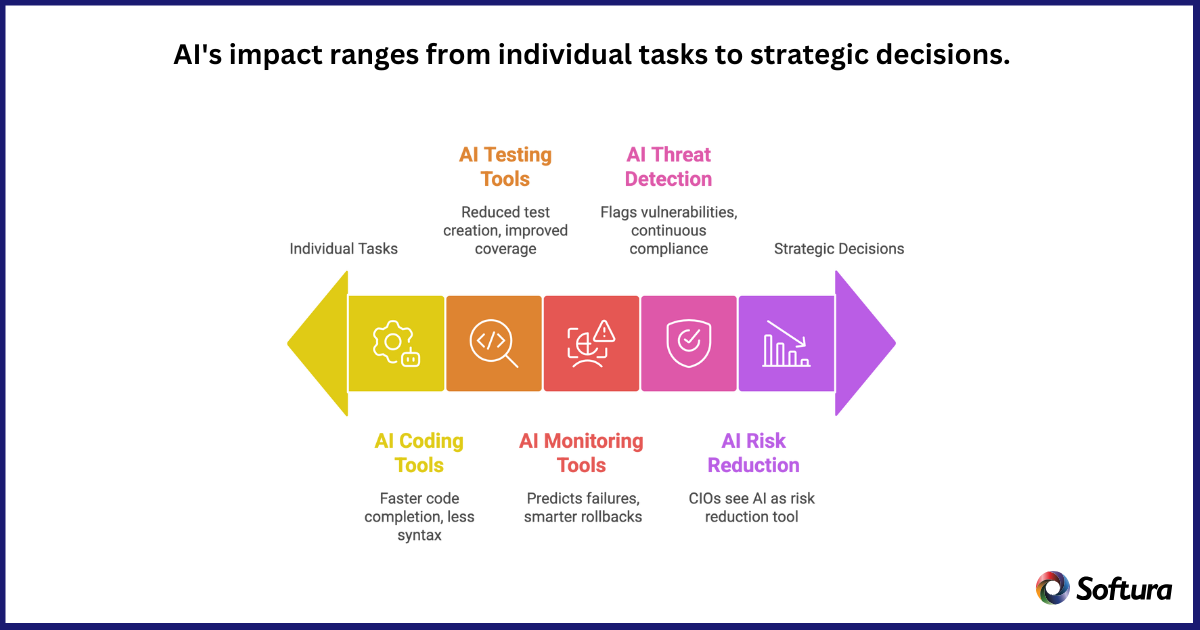
These trends show how AI is reshaping day to day development work.
"By analyzing the data from our connected lights, devices and systems, our goal is to create additional value for our customers through data-enabled services that unlock new capabilities and experiences."
- Harsh Chitale, leader of Philips Lighting’s Professional Business.
In 2026, writing code feels more like editing than typing.
Developers describe it as working with a helpful assistant that understands context. AI suggests functions, explains unfamiliar code, and flags issues early.
This does not remove responsibility. It shifts effort toward decisions that matter.
Quality has always been a bottleneck. AI makes it more predictable.
At Softura, we often see QA teams overloaded. AI helps restore balance without cutting corners.
DevOps teams live in dashboards. AI helps them see signals instead of noise.
AI driven monitoring tools predict failures before they happen. Deployment risks become visible earlier. Rollbacks become smarter, not reactive.
Security and speed no longer fight each other.
AI changes how teams feel about their work.
Developers talk about reduced frustration. Managers talk about clearer timelines. Leaders talk about predictability.
This matters more than speed alone.
These trends show how AI affects decisions beyond code.
Many blogs focus only on numbers.
What they miss is context.
AI succeeds when teams trust it. When workflows stay human centered. When leaders invest in foundations, not shortcuts.
This is where many AI initiatives fail quietly.
Softura works with organizations that want progress without disruption.
That means modernizing legacy systems so AI can work properly. Integrating AI into existing development workflows. Supporting teams through change, not forcing it.
AI is not a layer you bolt on. It is something you weave into how software is built.
If you lead a software organization, focus on three things.
AI powered software development in 2026 is not about speed alone.
It is about clarity. Confidence. Sustainability.
Teams that embrace AI thoughtfully will build better software and healthier teams.
The future of development is not human versus machine. It is human supported by machine.
Want to see how AI can fit into your software development process without disrupting your teams? Connect with Softura to explore practical AI driven development strategies built for real world teams.