
"Our integration with the Google Nest smart thermostats through Aidoo Pro represents an unprecedented leap forward for our industry."
- Antonio Mediato, founder and CEO of Airzone.
Retail used to grow through expansion.
More stores. More products. More locations.
That model still works, but it is no longer enough.
Customers expect seamless experiences across online and offline channels. They expect fast service, accurate inventory, and relevant recommendations.
Meeting these expectations requires systems that work together.
This is where software becomes critical.
"Our integration with the Google Nest smart thermostats through Aidoo Pro represents an unprecedented leap forward for our industry."
- Antonio Mediato, founder and CEO of Airzone.
In many retail organizations, software started as a support function.
It handled billing, inventory, and reporting.
Today, it plays a much larger role.
It influences:
This shift has changed how leaders view Retail Software Development Services.
They are no longer seen as cost centers. They are seen as growth enablers.
"By analyzing the data from our connected lights, devices and systems, our goal is to create additional value for our customers through data-enabled services that unlock new capabilities and experiences."
- Harsh Chitale, leader of Philips Lighting’s Professional Business.
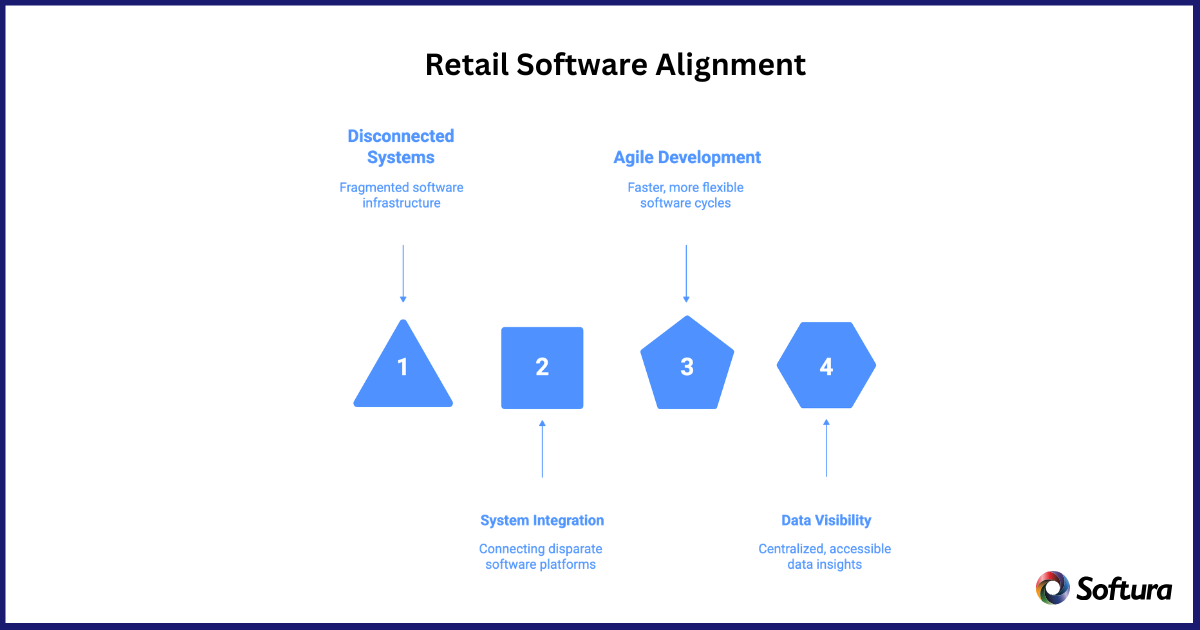
While the importance of software is clear, alignment is not always easy.
Many retail businesses struggle with:
These issues create friction.
They slow down innovation and impact growth.
Alignment is often misunderstood.
It is not about building more software.
It is about building the right software.
Software that supports business goals such as:
When software aligns with these goals, it creates measurable impact.
C level leaders do not think in terms of features.
They think in terms of outcomes.
For example:
Instead of asking for a new mobile app, they ask how mobile can increase conversion.
Instead of requesting analytics dashboards, they ask how insights can improve decisions.
This mindset shifts the focus from technology to value.
Retail software development, when done right, supports growth in multiple ways.
Customer experience is a key driver of growth.
Retailers must provide consistent experiences across stores, websites, and mobile apps.
Custom software enables:
This improves satisfaction and increases repeat purchases.
Inventory issues can impact both sales and costs.
Too much inventory increases storage costs. Too little leads to missed sales.
Retail Software Development Services help by:
This leads to better balance and higher efficiency.
Retail generates large volumes of data.
But data alone does not create value.
Insights do.
Custom software solutions help process data and present it in a usable form.
This allows leaders to make faster and better decisions.
Retail trends change quickly.
Businesses need to adapt.
Custom software allows retailers to:
This flexibility supports growth.
Despite the benefits, alignment often fails due to common mistakes.
Without defined goals, software projects lose direction.
Focusing only on tools without understanding business needs leads to poor outcomes.
If systems are hard to use, adoption drops.
Poor integration
Disconnected systems reduce efficiency and visibility.
Successful organizations follow a structured approach.
Key steps include
This is one of the two sections where bullet points are used.
This approach ensures that software supports growth.
Data is central to modern retail.
It provides insights into customer behavior, sales trends, and operations.
Retail Software Development Services help transform raw data into actionable insights.
This enables better planning and execution.
As retail businesses grow, their systems must scale.
Custom software solutions are designed to grow with the business.
They can handle increased data, users, and transactions.
This ensures long term sustainability.
Retail businesses often have multiple systems in place.
Integration is critical for alignment.
It ensures that data flows smoothly and systems work together.
This improves efficiency and reduces errors.
Cloud platforms provide flexibility and scalability.
They allow retailers to deploy and update systems quickly.
They also support advanced capabilities like analytics and AI.
This enhances overall performance.
Consider a retail chain struggling with inventory issues.
The result is better sales and lower costs.
This is the second and final bullet section.
These benefits contribute directly to business growth.
Softura helps retailers align technology with business goals.
This includes:
This approach ensures that technology delivers measurable value.
Industry insights highlight the growing importance of digital transformation in retail.
Source credit: PwC Retail Insights
Retailers investing in technology are better positioned for growth.
Retail growth today depends on more than expansion.
It depends on how well systems support the business.
C level leaders understand this. They are aligning Retail Software Development Services with growth goals to stay competitive.
This alignment ensures that technology drives value, not just operations.
If your retail systems are not aligned with your growth goals, it may be time to take a new approach. Connect with Softura to explore Retail Software Development Services tailored to your business needs.