
"Our integration with the Google Nest smart thermostats through Aidoo Pro represents an unprecedented leap forward for our industry."
- Antonio Mediato, founder and CEO of Airzone.
Digital transformation is no longer a technology initiative—it has become a core business strategy that directly impacts growth, efficiency, and long-term competitiveness. By 2026, most organizations have already invested in cloud, automation, and even AI. Yet, a large number of these initiatives fail to deliver meaningful business value.
The reason is not a lack of tools. It is a lack of alignment—between technology and business outcomes, between strategy and execution, and most importantly, between leadership expectations and operational reality.
For C-level leaders, the real challenge is not whether to invest in transformation, but how to choose the right digital transformation consulting services partner who can turn that investment into measurable results.
This guide provides a clear, connected, and practical framework to help you make that decision with confidence.
The nature of digital transformation has significantly evolved over the past few years. Earlier, organizations focused on adopting individual technologies such as cloud migration or automation tools. Today, transformation is more holistic—it requires rethinking how the entire business operates.
Artificial intelligence is now embedded into business workflows, not just experimental pilots. Cloud adoption has matured, but cost optimization and performance efficiency are becoming equally important. Legacy systems continue to limit scalability, while cybersecurity and regulatory compliance have moved from IT concerns to board-level priorities.
Despite these advancements, many organizations still struggle to achieve expected outcomes. Transformation initiatives often stall because they lack a clear roadmap, fail to integrate systems effectively, or do not gain adoption across teams.
This is where digital transformation consulting services become critical. A strong consulting partner brings structured thinking, industry experience, and execution capability. They help organizations connect strategy with implementation, ensuring that transformation efforts are not just technically successful, but also commercially impactful.
"Our integration with the Google Nest smart thermostats through Aidoo Pro represents an unprecedented leap forward for our industry."
- Antonio Mediato, founder and CEO of Airzone.
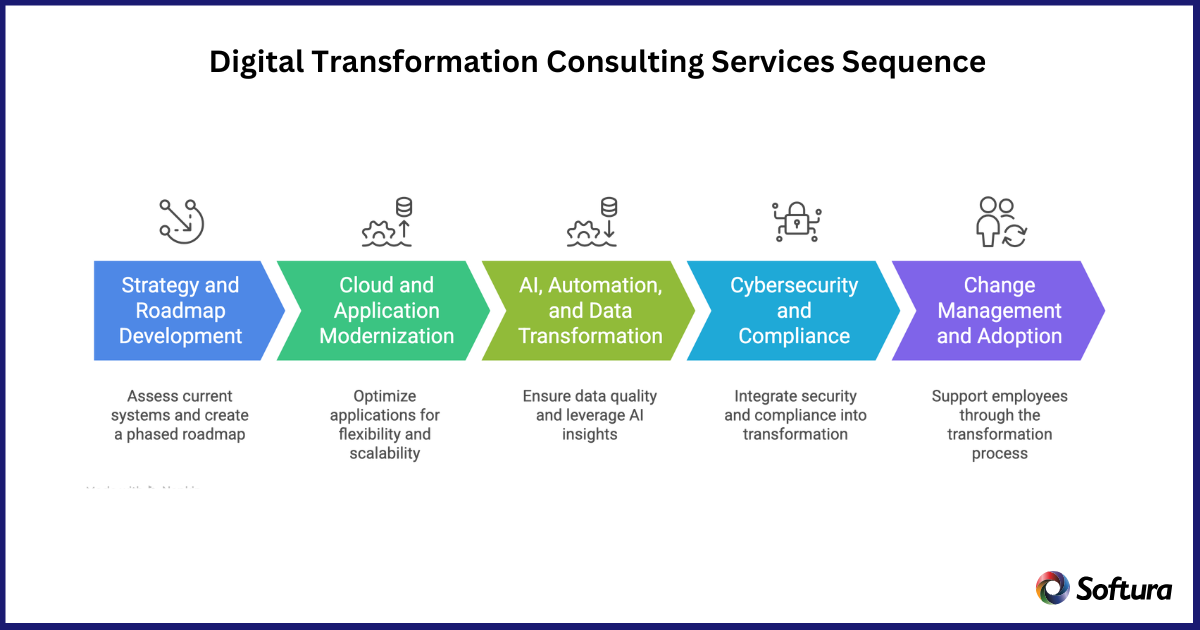
Before selecting a consulting partner, it is important to understand the full scope of what digital transformation consulting services should deliver. Many organizations underestimate this and focus only on technology implementation, which often leads to incomplete outcomes.
Every successful transformation begins with clarity. A consulting partner should assess your current systems, processes, and business objectives to identify gaps and opportunities. This assessment leads to a structured roadmap that prioritizes initiatives based on business impact, risk, and feasibility.
Instead of attempting large-scale changes all at once, the roadmap should define phased execution, allowing organizations to validate outcomes and scale gradually.
Modern businesses require flexible and scalable systems. This involves not just migrating to the cloud, but optimizing how applications are built, integrated, and maintained. Legacy systems often create bottlenecks, making it difficult to introduce new capabilities or respond quickly to market changes.
A consulting partner should help modernize these systems in a way that minimizes disruption while improving performance and scalability.
AI and automation are no longer optional—they are essential for driving efficiency and improving decision-making. However, their effectiveness depends on the quality and accessibility of data.
A strong consulting partner ensures that data is unified, accessible, and reliable, enabling organizations to leverage AI-driven insights and automate key processes without introducing complexity.
As organizations become more digital, they also become more exposed to risks. Cybersecurity is not just about protecting systems—it is about ensuring business continuity and maintaining trust.
Consulting partners must integrate security and compliance into every stage of transformation, ensuring that systems are resilient and aligned with regulatory requirements.
Even the most advanced systems will fail if employees do not adopt them effectively. Transformation changes workflows, responsibilities, and decision-making processes.
A consulting partner should support organizations with structured change management, ensuring that employees are trained, engaged, and aligned with the new way of working.
Selecting the right partner requires more than evaluating capabilities—it requires understanding how those capabilities translate into business outcomes. The following checklist provides a structured way to evaluate potential partners.
Experience in your industry is one of the strongest indicators of success. A consulting partner who understands your operational challenges, regulatory requirements, and market dynamics can deliver solutions that are both practical and effective.
Rather than focusing only on years of experience, look for evidence of outcomes. Case studies, client references, and measurable results provide a clearer picture of a partner’s ability to deliver.
Digital transformation is not a single initiative—it is a combination of multiple interconnected efforts. Strategy, development, integration, data management, and optimization must all work together.
Working with multiple vendors often creates gaps in accountability and slows down execution. A partner with end-to-end capabilities ensures continuity, reduces complexity, and improves overall efficiency.
No two organizations are the same. Your systems, processes, and goals are unique, which means your transformation strategy must be tailored accordingly.
A strong consulting partner takes the time to understand your environment and designs solutions that fit your specific needs. At the same time, they ensure that these solutions can scale as your business grows.
While technology is not the end goal, it plays a critical role in enabling transformation. A consulting partner should have deep expertise in modern technologies, but more importantly, they should know how to apply them effectively.
The focus should always remain on solving business problems, not simply implementing new tools. This requires a balance between innovation and practicality.
Many organizations underestimate the complexity of integrating systems and managing data. Disconnected systems create inefficiencies and limit visibility, making it difficult to make informed decisions.
A strong partner addresses these challenges by creating a unified data ecosystem, modernizing legacy systems, and ensuring seamless integration across platforms.
Transformation initiatives must be tied to measurable outcomes. Without clear KPIs, it becomes difficult to assess progress or justify investments.
A reliable partner defines success from the beginning, aligns initiatives with business goals, and tracks performance throughout the transformation journey.
In today’s environment, governance is just as important as innovation. Organizations must ensure that their systems are secure, compliant, and aligned with evolving regulations.
This includes not only traditional cybersecurity measures, but also responsible use of AI, data governance, and risk management.
Transformation requires people to adapt to new systems and processes. Without proper support, resistance can slow down or even derail initiatives.
A strong consulting partner provides structured change management, ensuring that employees are prepared, supported, and engaged throughout the process.
Transformation does not end with implementation. Continuous improvement is essential to maintain performance and adapt to changing business needs.
Look for partners who provide ongoing support, monitor system performance, and continuously optimize solutions to maximize value.
Looking for Offshore Dedicated Developers?
Our skilled experts are ready to help. Let's discuss your automation needs.
"By analyzing the data from our connected lights, devices and systems, our goal is to create additional value for our customers through data-enabled services that unlock new capabilities and experiences."
- Harsh Chitale, leader of Philips Lighting’s Professional Business.
While evaluating consulting partners, it is equally important to identify potential risks. Some firms may present strong proposals but lack the depth required for execution.
Be cautious if you notice a lack of clarity in their approach, overemphasis on specific tools, or limited focus on business outcomes. These are often signs that the partner may struggle to deliver long-term value.
"By analyzing the data from our connected lights, devices and systems, our goal is to create additional value for our customers through data-enabled services that unlock new capabilities and experiences."
- Harsh Chitale, leader of Philips Lighting’s Professional Business.
For C-level leaders, ROI is the most important factor in any transformation initiative. However, measuring ROI requires a broader perspective than just cost savings.
Transformation should deliver value across multiple dimensions, including operational efficiency, customer experience, and revenue growth. This requires defining clear metrics, tracking performance consistently, and adjusting strategies as needed.
A strong consulting partner helps establish this framework and ensures that transformation efforts remain aligned with business objectives.
"By analyzing the data from our connected lights, devices and systems, our goal is to create additional value for our customers through data-enabled services that unlock new capabilities and experiences."
- Harsh Chitale, leader of Philips Lighting’s Professional Business.
Softura brings decades of experience in delivering digital transformation initiatives that go beyond technology implementation. The focus is always on aligning transformation with business goals and ensuring measurable outcomes.
By combining strategic thinking with execution expertise, Softura helps organizations navigate complex transformation journeys with confidence.
Softura’s approach is built on a combination of deep industry understanding, end-to-end capabilities, and a strong focus on scalability and security. This ensures that solutions are not only effective in the short term, but also sustainable in the long run.
A manufacturing organization partnered with Softura to modernize its legacy systems and implement data-driven decision-making capabilities. By integrating systems and improving data visibility, the organization was able to enhance operational efficiency and make faster, more informed decisions.
"By analyzing the data from our connected lights, devices and systems, our goal is to create additional value for our customers through data-enabled services that unlock new capabilities and experiences."
- Harsh Chitale, leader of Philips Lighting’s Professional Business.
Choosing the right digital transformation consulting services partner is one of the most important decisions for any organization. The right partner will not only guide your strategy but also ensure successful execution and long-term value creation.
By focusing on expertise, scalability, governance, and measurable outcomes, C-level leaders can confidently select a partner who aligns with their business vision and drives meaningful transformation.
"By analyzing the data from our connected lights, devices and systems, our goal is to create additional value for our customers through data-enabled services that unlock new capabilities and experiences."
- Harsh Chitale, leader of Philips Lighting’s Professional Business.
Are you ready for your next project?
Unlock your company's full potential with our comprehensive Offshore development services. Contact our experts today to discuss how we can drive your success together.