
"Our integration with the Google Nest smart thermostats through Aidoo Pro represents an unprecedented leap forward for our industry."
- Antonio Mediato, founder and CEO of Airzone.
Before building a custom mobile app in 2026, enterprises need clarity on several critical decisions — what to build, how the application will integrate with existing systems, which development approach fits long-term business goals, what factors influence cost, and how to ensure scalability, security, and adoption.
As mobile becomes central to enterprise operations, custom mobile app development is increasingly viewed as a strategic business investment rather than simply a technology initiative. This guide explores the key trends, technology choices, planning considerations, and decision-making factors enterprise leaders should evaluate before building a mobile app in 2026.
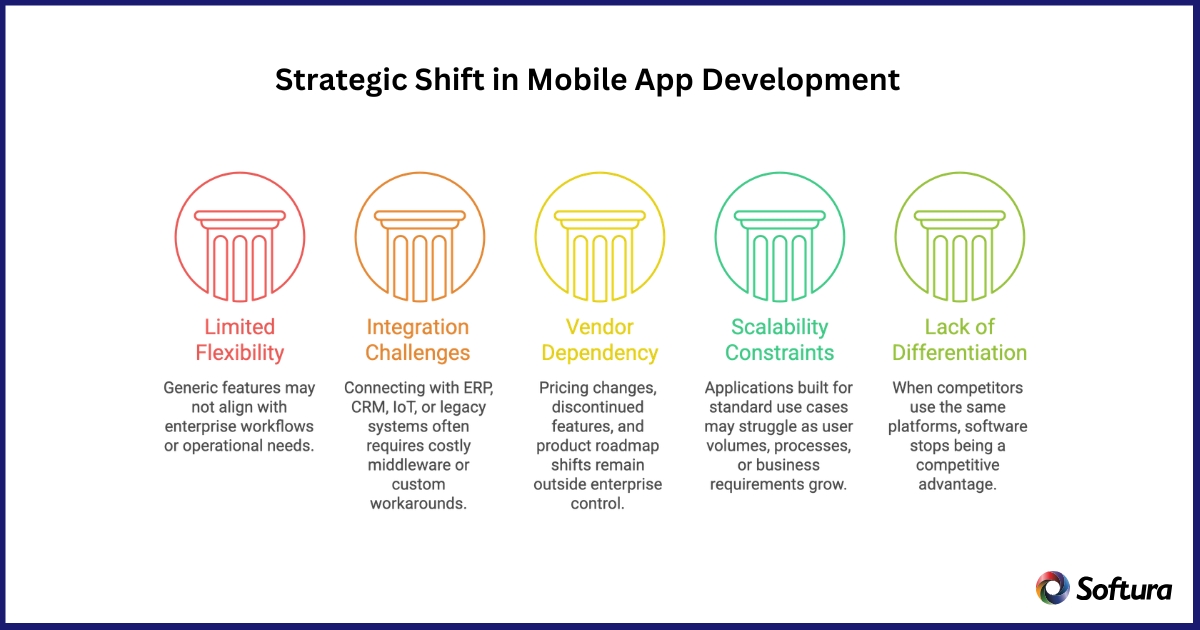
For years, enterprises followed a simple rule: buy before building. Off-the-shelf mobile applications offered faster deployment, lower upfront costs, and vendor-managed maintenance. While these advantages still matter for standard workflows, growing enterprises often outgrow the limitations of packaged software.
In 2026, enterprise leaders are increasingly choosing custom mobile app development because competitive advantage depends on how teams work, how systems integrate, and how customers experience the business.
Common limitations of off-the-shelf mobile applications include:
The strategic question for enterprise leaders is shifting from:
“What does it cost to build a custom mobile app?”
to
“What is the long-term cost of relying on software that was not built for our business?”
"Our integration with the Google Nest smart thermostats through Aidoo Pro represents an unprecedented leap forward for our industry."
- Antonio Mediato, founder and CEO of Airzone.
Enterprise mobile app development has evolved significantly in the last two years. Organizations evaluating mobile investments today face very different expectations around AI, security, scalability, and integration than those that shaped earlier decisions. Understanding these shifts is critical before investing in a custom mobile app.
AI is no longer considered a premium add-on for enterprise mobile applications. Organizations increasingly expect mobile apps to support intelligent workflows, predictive recommendations, automated actions, and conversational experiences.
For enterprise leaders, the implication is clear: AI should be considered at the architecture stage rather than introduced later as a feature enhancement. Applications built without room for intelligence may struggle to meet future business expectations.
The native-versus-cross-platform debate has shifted considerably. Frameworks such as Flutter and React Native now enable near-native performance for most enterprise use cases while reducing development effort across iOS and Android.
Enterprises increasingly choose cross-platform development when priorities include:
Native development still remains the preferred choice for hardware-intensive, performance-critical, or highly specialized mobile experiences.
As enterprise mobile apps increasingly manage sensitive operational, employee, and customer data, security is no longer something addressed during testing or after launch.
Modern enterprise applications are expected to include:
For CTOs and CIOs, security-by-design is becoming a foundational requirement rather than a technical enhancement.
Low-code platforms can accelerate development for standard workflows and internal productivity tools. However, they often become restrictive when applications require deep ERP integration, complex workflows, high user volumes, or long-term customization.
For enterprise-grade applications, low-code may support experimentation — but custom mobile app development remains the preferred path for scalability, flexibility, and long-term control.
Learn more about evolving enterprise mobile app development strategies for scalable mobile experiences.
"By analyzing the data from our connected lights, devices and systems, our goal is to create additional value for our customers through data-enabled services that unlock new capabilities and experiences."
- Harsh Chitale, leader of Philips Lighting’s Professional Business.
Most enterprise mobile initiatives do not fail because of poor technical execution. They underperform because of decisions made — or delayed — before development begins.
The following five decisions often determine whether a mobile app becomes a long-term business asset or an expensive rebuild.
The platform decision directly affects cost, performance, maintenance effort, and time-to-market. The right choice depends on business goals, user needs, and technical complexity.
For many enterprise applications — internal tools, field force apps, customer portals, and workflow automation — cross-platform frameworks such as Flutter and React Native provide the right balance between speed, cost, and performance.
Native development is typically preferred when applications require:
The biggest mistake enterprises make is selecting an approach too early without evaluating long-term integration and scalability requirements.
A mobile app should not operate in isolation.
Enterprise applications increasingly depend on seamless connectivity with CRM, ERP, IoT, analytics, and legacy systems. Without a clear integration strategy, mobile apps often become disconnected front ends that create additional operational complexity.
Before development begins, enterprise leaders should evaluate:
Strong API-driven architecture is often what separates enterprise mobile apps that improve productivity from those that increase IT overhead. Building Security and ComplianceFromDay One
Security should not be treated as a post-launch activity.
Enterprise mobile applications often manage customer records, financial information, employee data, and operational workflows. Security gaps discovered after deployment are significantly more expensive to resolve.
Enterprise mobile apps increasingly require:
For regulated industries, security is not simply risk management — it is a business requirement.
Enterprise mobile apps are expected to grow with the business.
An application designed for a few hundred users may struggle when deployed across departments, geographies, or customer ecosystems. Rebuilding architecture after launch often becomes a costly second-phase investment.
Cloud-native platforms such as Microsoft Azure help enterprises scale applications more efficiently through flexible infrastructure and evolving workload support.
The right question is not:
“Will this app scale today?”
It is:
“Will this app scale with where the business is going?”
Even technically strong mobile applications fail if employees or customers do not use them.
Successful enterprise mobile initiatives include adoption planning from the beginning through user research, intuitive UX, training, and change management.
Organizations that prioritize usability and onboarding early are more likely to achieve the ROI expectations that justified the investment.
Across executive teams, priorities may differ — CIOs focus on scalability, CTOs on integration, CFOs on long-term value, and CMOs on customer experience. Successful enterprise mobile applications balance all four priorities through thoughtful planning and the right development approach.
Planning an Enterprise Mobile App?
Get expert guidance on the right approach, integrations, and scalability considerations for your business.
Successful enterprise mobile initiatives begin with clear planning. Before development starts, leadership teams should align on the following questions to reduce risk and improve long-term outcomes.
Enterprise mobile projects succeed when these questions are answered before development begins — not during delivery.
Enterprise mobile application development costs vary significantly depending on business requirements, integration complexity, security expectations, and long-term scalability needs. For many organizations, cost uncertainty becomes a challenge because production-grade applications require more than front-end design and development — they involve architecture planning, enterprise integrations, testing, security, and ongoing optimization.
The biggest factors influencing enterprise mobile application development cost include:
Beyond initial development, enterprise leaders should also account for ongoing investment areas such as maintenance, security updates, operating system compatibility, performance optimization, and feature enhancements.
The most important question is not:
“How much will a mobile app cost?”
It is:
“What level of investment is required to achieve the business outcome we expect?”
The right enterprise mobile app development partner should offer more than technical expertise. Enterprise leaders should evaluate a partner’s experience with system integrations, security and compliance, delivery governance, scalability, and long-term support capabilities. The goal is not simply to build an app, but to choose a partner capable of aligning technology decisions with long-term business outcomes.
Before selecting a development partner, evaluate the following:
Enterprise mobile applications depend on seamless connectivity with ERP, CRM, analytics, and legacy systems.
Look for experience with platforms such as:
Relevant integration expertise reduces implementation risk and improves scalability.
For regulated industries, security should be a core evaluation factor.
Assess whether the partner has experience supporting:
Strong process maturity often translates to more predictable enterprise delivery.
If AI is part of the roadmap, validate whether the partner has production-level experience with:
Enterprise mobile applications continue evolving after launch. Evaluate how the partner manages milestones, scope changes, risks, stakeholder communication, and ongoing optimization.
The strongest partners operate as long-term advisors — helping enterprises scale and modernize mobile experiences as business needs evolve.
For more than 28 years, Softura has helped enterprises build secure, scalable mobile applications aligned to business goals, enterprise systems, and long-term growth. With expertise across enterprise integration, Microsoft technologies, and secure delivery, Softura supports organizations from strategy and architecture to deployment and optimization.
Building a successful enterprise mobile app starts long before development begins. The strongest outcomes come from clear business objectives, scalable architecture, thoughtful integration planning, and the right delivery approach.
As enterprise expectations continue to evolve, mobile applications are becoming essential for improving operational efficiency, enabling real-time decision-making, and creating better customer and employee experiences.
For enterprise leaders, the next step is not simply deciding whether to build — it is determining what to build, how it should integrate, and what long-term business outcomes it should deliver.