
"Our integration with the Google Nest smart thermostats through Aidoo Pro represents an unprecedented leap forward for our industry."
- Antonio Mediato, founder and CEO of Airzone.
Data security in custom software application development means protecting sensitive business and customer data across the full software development lifecycle. In 2026, this requires secure architecture, secure coding, encryption, access control, API protection, DevSecOps, compliance planning, and continuous monitoring.
This is not only a technical issue. A weak application security model can create downtime, penalties, customer loss, reputational damage, and higher recovery costs. A secure application protects trust while supporting growth.
Data security in custom software application development is the process of designing, building, testing, and maintaining applications so sensitive data is protected from unauthorized access, misuse, leakage, or loss.
Unlike off-the-shelf software, custom applications are built around unique workflows. A healthcare portal, financial dashboard, manufacturing system, or enterprise reporting application will each handle different users, data types, integrations, and compliance obligations.
"Our integration with the Google Nest smart thermostats through Aidoo Pro represents an unprecedented leap forward for our industry."
- Antonio Mediato, founder and CEO of Airzone.
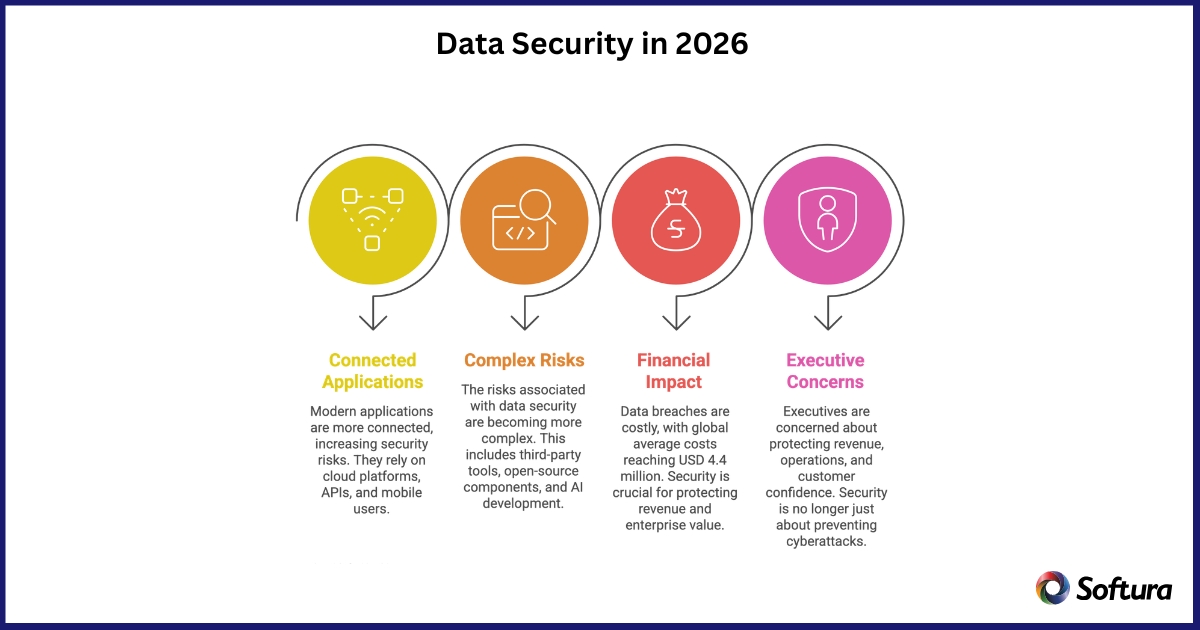
Data security matters more in 2026 because applications are more connected and risks are more complex. Modern custom applications rely on cloud platforms, APIs, mobile users, third-party tools, open-source components, and AI-assisted development.
IBM’s 2025 Cost of a Data Breach Report placed the global average breach cost at USD 4.4 million. For executives, security is no longer only about preventing cyberattacks. It is about protecting revenue, operations, customer confidence, and enterprise value.
"By analyzing the data from our connected lights, devices and systems, our goal is to create additional value for our customers through data-enabled services that unlock new capabilities and experiences."
- Harsh Chitale, leader of Philips Lighting’s Professional Business.
Security should begin during discovery, before design or coding starts. The first step is to identify what data the application will collect, where it will live, who can access it, how it will move between systems, and which regulations apply.
This is where threat modeling helps. It simply means asking: “How could someone misuse this application, and what controls would stop them?” This helps teams identify risks early across workflows, user roles, APIs, databases, and integrations.
A Secure Software Development Lifecycle, or Secure SDLC, builds security into every phase: planning, design, coding, testing, deployment, and maintenance.
For business leaders, the value is practical. Secure SDLC reduces late-stage surprises, improves delivery confidence, and makes the application easier to govern after launch.
DevSecOps takes this further by adding security checks into the delivery pipeline. Instead of waiting for a final review, teams continuously scan code, dependencies, secrets, containers, configurations, and APIs.
Secure coding protects the application from vulnerabilities that attackers commonly exploit, including SQL injection, cross-site scripting, weak session handling, and exposed secrets.
Developers should validate user inputs, use parameterized queries, encode outputs, avoid hard-coded passwords or API keys, and prevent error messages from exposing sensitive information.
In simple terms, the application should never automatically trust data coming from a user, device, integration, or external system. Every input should be checked, every sensitive action should be authorized, and every exception should be handled safely.
AI-assisted coding also needs governance. AI tools can accelerate development, but generated code must still go through human review, automated scanning, and security testing before production.
Encryption protects data by making it unreadable without the correct key. Custom applications should encrypt sensitive data at rest, such as databases and backups, and in transit, such as data moving between browsers, mobile apps, APIs, and servers.
Common methods include TLS for secure transmission, AES encryption for stored data, tokenization for sensitive fields, and data masking when users only need partial visibility. Encryption keys should be stored securely and restricted to authorized systems.
Access control decides who can see or change data. Role-based access control gives permissions based on job responsibility. Least privilege ensures users only get the access required for their work. Multi-factor authentication adds extra protection for sensitive roles.
APIs connect custom applications with CRM systems, ERP platforms, payment gateways, analytics tools, cloud services, and AI systems. They create business value, but they also expand the attack surface.
Secure API design should include authentication, authorization at every endpoint, rate limiting, input validation, monitoring, and an inventory of active APIs. A major API risk is broken object-level authorization, where a user accesses another user’s records by changing an ID.
Third-party integrations should also be reviewed carefully. A custom application may be secure internally but still exposed through an insecure external service.
Most custom software uses open-source libraries, third-party packages, frameworks, containers, and build tools. These components help teams build faster, but they can introduce vulnerabilities if outdated, misconfigured, or poorly maintained.
Businesses should scan dependencies, remove unused packages, protect build credentials, secure CI/CD pipelines, scan containers, and use trusted repositories. For critical applications, a software bill of materials can help teams respond faster.
Security testing should happen continuously before and after launch. Static application security testing reviews code. Dynamic application security testing checks the running application. Software composition analysis identifies vulnerable third-party components. Penetration testing finds real-world weaknesses.
After deployment, teams should continue vulnerability scanning, patching, log monitoring, backup testing, access reviews, and incident response planning. Application risk changes as new users, integrations, features, and vulnerabilities emerge.
Compliance should be designed into the application, not handled after development. GDPR, HIPAA, PCI DSS, SOC 2, ISO 27001, and industry-specific requirements can affect how data is collected, stored, accessed, logged, retained, and deleted.
A compliance-ready application should support audit trails, consent management where needed, data minimization, retention rules, secure reporting, and controlled access to regulated data. This reduces audit pressure and supports responsible data governance.
Softura helps organizations build secure, scalable, and business-aligned custom applications. Our approach brings together secure architecture, custom software application development, DevSecOps practices, cloud integration, access control, API protection, compliance awareness, and continuous improvement.
For C-level leaders, this means security is planned into the roadmap, delivery process, and long-term modernization strategy. The outcome is a secure digital platform that supports growth.
Data security in custom software application development is now a business priority. In 2026, secure applications must protect data across users, systems, APIs, cloud platforms, third-party tools, and AI-enabled workflows.
The right approach combines secure coding, encryption, access control, Secure SDLC, DevSecOps, API security, compliance planning, supply chain protection, and continuous monitoring. When these practices are built in from the start, organizations reduce risk, protect customer trust, and create applications that scale securely.
Turn Compliance Into a Competitive Advantage
From GDPR to HIPAA, ensure your applications meet global security standards.