
"Our integration with the Google Nest smart thermostats through Aidoo Pro represents an unprecedented leap forward for our industry."
- Antonio Mediato, founder and CEO of Airzone.
A digital transformation strategy is a long term plan that helps an organization use technology to improve how it operates, delivers value, and competes in the market.
It touches many parts of the enterprise including customer experience, internal operations, supply chains, data management, and employee collaboration.
When executives discuss transformation during leadership meetings, the conversation rarely focuses only on technology platforms. Instead, the discussion centers on questions such as how to improve service delivery, how to respond faster to customers, and how to make better decisions using data.
Technology becomes the enabler that supports those business outcomes.
Many CIOs explain transformation using a simple analogy. Traditional systems operate like fixed roads. They support movement but cannot change easily. Digital systems operate more like adaptive routes that adjust based on traffic and demand.
That flexibility is what modern enterprises need.
"Our integration with the Google Nest smart thermostats through Aidoo Pro represents an unprecedented leap forward for our industry."
- Antonio Mediato, founder and CEO of Airzone.
Several forces are driving enterprises to invest heavily in digital transformation strategy initiatives.
Customers increasingly expect digital services that are fast and personalized. Employees want tools that support remote collaboration and efficient workflows. Business leaders want deeper insights into performance and operations.
Without modern digital platforms, delivering these capabilities becomes difficult.
Executives who lead successful transformation programs often highlight one common insight. Digital transformation is not about replacing systems for the sake of modernization. It is about removing operational friction.
When processes become faster and data becomes easier to access, the entire organization becomes more agile.
"By analyzing the data from our connected lights, devices and systems, our goal is to create additional value for our customers through data-enabled services that unlock new capabilities and experiences."
- Harsh Chitale, leader of Philips Lighting’s Professional Business.
Many organizations start exploring transformation after recognizing common operational problems.
Typical warning signs include:
When several of these challenges appear together, leadership often begins developing a structured digital transformation strategy.
Enterprise transformation programs succeed when they focus on several key pillars rather than isolated technology projects.
Technology investments should support clear business objectives. Transformation initiatives that lack direct business value often struggle to gain executive support.
Leadership teams usually begin by defining the outcomes they want to achieve such as improving customer experience, increasing operational efficiency, or expanding digital revenue channels.
Data plays a central role in any digital transformation strategy. Modern organizations rely on data to understand customer behavior, measure operational performance, and guide strategic decisions.
Enterprises that build strong data platforms gain deeper visibility into their operations and market opportunities.
Transformation often requires updating core systems so they can integrate with modern tools and cloud environments.
Flexible technology platforms allow organizations to develop new services, automate processes, and connect different business systems.
One of the most underestimated elements of transformation is culture. Employees must adopt new ways of working and feel comfortable using digital tools.
Executives who lead successful programs often invest in training, communication, and collaboration initiatives that support cultural adoption.
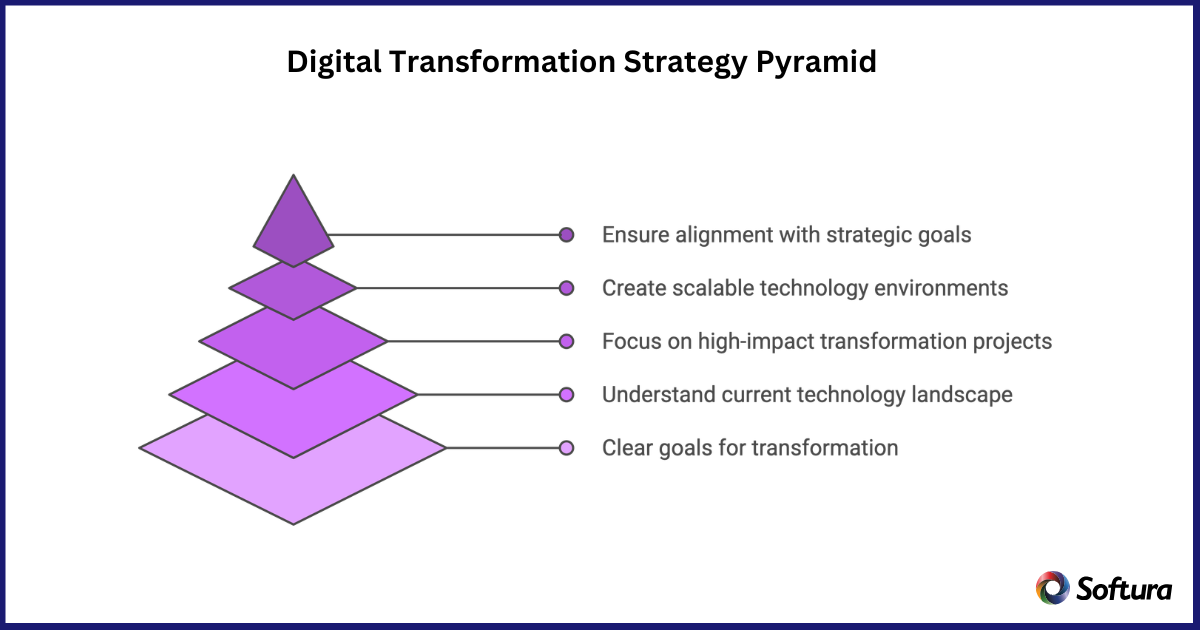
Building a strong digital transformation strategy requires thoughtful planning and cross organizational collaboration.
Technology leaders usually approach this process through several structured stages.
Every transformation program should begin with clear goals. Leaders must identify what outcomes the organization wants to achieve.
Examples might include improving customer engagement, reducing operational costs, accelerating product development, or expanding digital channels.
Defining measurable objectives ensures that transformation efforts remain focused on real business value.
Before designing a future state architecture, organizations must understand their current systems.
Technology teams often conduct detailed assessments of applications, infrastructure, data systems, and integration frameworks.
This evaluation helps identify gaps that must be addressed during the digital transformation strategy.
Large enterprises cannot transform every system at once. Successful strategies prioritize initiatives that deliver meaningful business impact early in the program.
Early success builds confidence among executives and employees.
Transformation initiatives should focus on creating technology environments that support future innovation.
Cloud platforms, modern integration frameworks, and scalable data systems often play key roles in this architecture.
Strong governance ensures that transformation initiatives remain aligned with strategic goals.
Many organizations create cross functional transformation teams that include technology leaders, operations managers, and business stakeholders.
This collaborative structure helps maintain focus across the entire program.
Several technologies commonly support enterprise transformation programs.
These platforms allow organizations to modernize operations and deliver better digital experiences.
When combined within a strong digital transformation strategy, these technologies enable organizations to operate more efficiently and innovate faster.
Transformation programs often succeed or fail based on leadership involvement.
CIOs, CTOs, and business executives must actively guide transformation initiatives. Their role extends beyond approving technology budgets.
Leaders set the vision, communicate the purpose of transformation, and ensure that teams remain aligned with strategic goals.
In many enterprises, successful transformation begins with leadership recognizing that technology is now a central driver of business strategy.
Even well planned transformation initiatives encounter obstacles. Recognizing these challenges early helps organizations prepare effectively.
Legacy systems can limit integration capabilities. Data quality issues sometimes appear when consolidating information from multiple sources.
Cultural resistance may also slow adoption when employees feel uncertain about new digital tools.
Experienced executives often address these challenges through clear communication, phased implementation, and strong training programs.
Organizations that invest in a structured digital transformation strategy often discover benefits beyond operational efficiency.
Digital platforms create new opportunities for innovation. Data driven insights support faster decision making. Modern systems enable organizations to experiment with new services and business models.
For example, manufacturing companies use digital platforms to monitor production performance in real time. Retail organizations use analytics to personalize customer experiences. Financial institutions use automation to improve compliance monitoring.
Each of these examples demonstrates how digital capabilities expand business possibilities.
Conversations with technology executives across industries reveal several lessons about successful transformation programs.
One common insight involves pacing. Transformation should move quickly enough to deliver value but slowly enough to maintain operational stability.
Another lesson focuses on collaboration. Technology teams alone cannot drive transformation. Business leaders must participate actively in shaping digital initiatives.
Finally, many executives emphasize the importance of measurable results. Clear performance indicators allow organizations to track progress and refine strategy over time.
Before launching transformation initiatives, leadership teams often reflect on several guiding principles.
Keeping these principles in focus helps organizations design a digital transformation strategy that delivers sustainable results.
Digital transformation represents one of the most significant shifts modern enterprises face. It requires organizations to rethink how they operate, how they serve customers, and how they use technology to support growth.
Enterprises that approach transformation strategically often create environments where innovation becomes continuous rather than occasional.
A well designed digital transformation strategy provides the roadmap that connects business vision with modern technology capabilities.
Organizations that invest in this journey today are positioning themselves to operate faster, respond to change more effectively, and compete confidently in an increasingly digital economy.
Ready to build a digital transformation strategy that aligns technology with business growth? Connect with Softura to explore practical enterprise transformation solutions tailored to your organization.