
"Our integration with the Google Nest smart thermostats through Aidoo Pro represents an unprecedented leap forward for our industry."
- Antonio Mediato, founder and CEO of Airzone.
"Our integration with the Google Nest smart thermostats through Aidoo Pro represents an unprecedented leap forward for our industry."
- Antonio Mediato, founder and CEO of Airzone.
Enterprises outsource software development in 2026 because the skills required to execute modern technology roadmaps; cloud architecture, AI/ML engineering, cybersecurity, and platform modernization; cannot be hired quickly enough through traditional recruiting.
While outsourcing is often framed as a cost decision, the bigger driver today is capability access. Technology priorities are accelerating, permanent headcount remains constrained, and specialized engineering talent continues to be scarce.
What has changed is what enterprises expect from outsourcing. The shift from “we need extra developers” to “we need a team that can architect and deliver strategic technology initiatives” is largely complete. Organizations using outsourcing to build capability are moving faster than those treating it as temporary staff augmentation.
Three forces are driving this shift:
"By analyzing the data from our connected lights, devices and systems, our goal is to create additional value for our customers through data-enabled services that unlock new capabilities and experiences."
- Harsh Chitale, leader of Philips Lighting’s Professional Business.
Software development outsourcing makes sense when an organization needs specialized expertise, faster execution, or additional delivery capacity that would take too long to build internally.
However, outsourcing is not the right fit for every situation. Successful engagements depend as much on organizational readiness as vendor capability.
Outsourcing typically works best when:
Outsourcing may not be the right fit when:
One of the biggest misconceptions is that outsourcing failures are primarily vendor problems. In reality, outcomes often depend on how clearly expectations, governance, and ownership are established before work begins.
"By analyzing the data from our connected lights, devices and systems, our goal is to create additional value for our customers through data-enabled services that unlock new capabilities and experiences."
- Harsh Chitale, leader of Philips Lighting’s Professional Business.
Choosing between nearshore and offshore software development depends less on cost and more on collaboration needs, project complexity, and governance maturity.
In general, nearshore development works best for complex transformation initiatives that require real-time collaboration, while offshore models are better suited for stable, clearly defined work where cost efficiency matters more than speed of interaction.
The common assumption that “offshore is cheaper, nearshore is better” oversimplifies the decision. The better question is: How much collaboration does this project require, and how effectively can your organization manage distributed delivery?
For enterprises evaluating nearshore, offshore, or hybrid approaches, choosing the right engagement model can significantly affect delivery outcomes, governance complexity, and long-term scalability.
Choosing between nearshore and offshore software development depends less on cost and more on collaboration needs, project complexity, and governance maturity.
In general, nearshore development works best for complex transformation initiatives that require real-time collaboration, while offshore models are better suited for stable, clearly defined work where cost efficiency matters more than speed of interaction.
The common assumption that “offshore is cheaper, nearshore is better” oversimplifies the decision. The better question is: How much collaboration does this project require, and how effectively can your organization manage distributed delivery?
For enterprises evaluating nearshore, offshore, or hybrid approaches, choosing the right engagement model can significantly affect delivery outcomes, governance complexity, and long-term scalability.
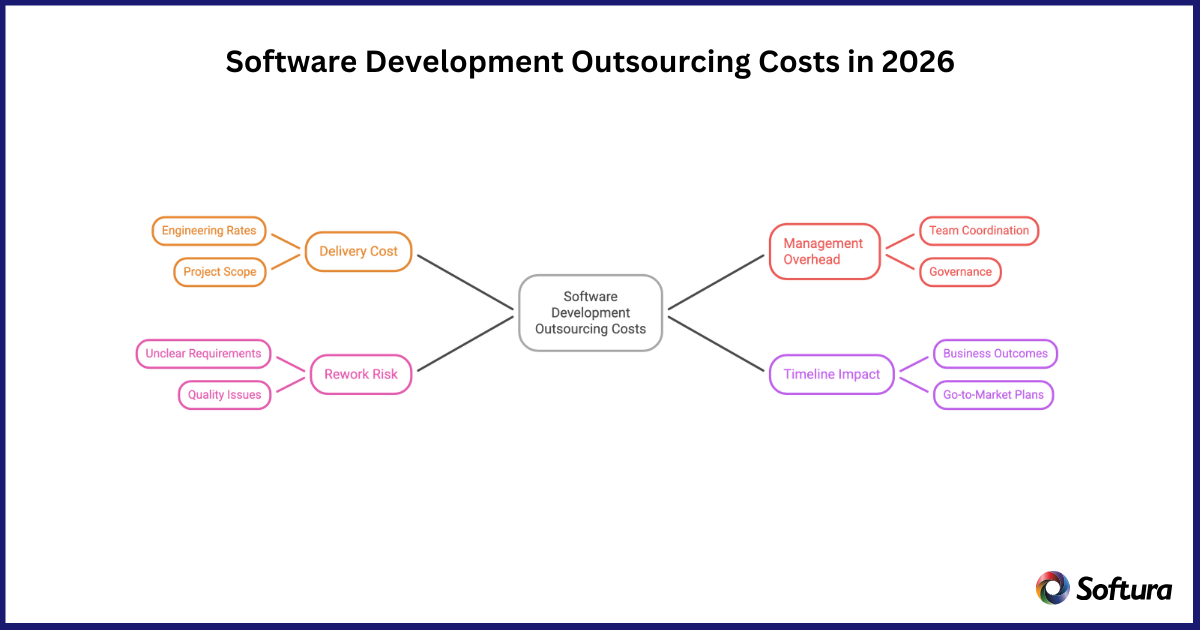
The real cost of software development outsourcing goes beyond hourly rates. Total cost includes communication overhead, management effort, rework, onboarding time, and the business impact of delays.
This is where many outsourcing decisions fail. A lower hourly rate can still result in a higher total engagement cost if poor collaboration leads to missed deadlines, repeated revisions, or additional supervision.
When evaluating outsourcing costs, enterprise leaders should consider:
For transformation initiatives such as cloud migration, platform modernization, or AI implementation, a higher-cost delivery model may sometimes produce better overall outcomes through faster ramp-up, fewer revisions, and stronger collaboration.
The better question is not “Which vendor is cheapest?” but “Which delivery model creates the strongest outcome at the lowest total cost?”
Choosing the right outsourcing partner requires evaluating capability, governance, and long-term fit, not just cost.
One of the most common mistakes enterprises make is prioritizing hourly rates over technical expertise. A lower-cost vendor without the right architectural depth or compliance experience often creates higher costs later through delays, rework, and quality issues.
When evaluating software development partners, focus on four areas:
Assess experience in your technology stack, architecture requirements, and industry domain. Look for comparable case studies, delivery methodologies, quality assurance practices, and security standards relevant to your environment.
Evaluate whether the vendor can realistically support your timelines and growth plans. Team stability, delivery maturity, and the ability to scale resources matter as much as technical skills.
Strong outsourcing relationships depend on clear communication structures, escalation paths, and defined ownership. Enterprises should understand how decisions are made, how blockers are handled, and how progress is measured.
Cost matters, but it should be evaluated in the context of capability, delivery quality, and business outcomes, not hourly rates alone.
Before signing a contract, verify claims through technical documentation, relevant case studies, and customer references. For regulated industries, require evidence of prior compliance experience rather than general familiarity with security or regulatory standards.
A structured vendor evaluation process — including technical reviews, stakeholder alignment, and clear success criteria — reduces risk and helps surface capability gaps before delivery begins.
The biggest risk in software development outsourcing is not vendor incompetence, it is misalignment early in the engagement. Many projects struggle because expectations, ownership, and success criteria are not clearly defined before delivery begins.
Most outsourcing risks are predictable and preventable when governance is established early.
A vendor may have strong technical skills but limited experience in your domain, architecture, or compliance environment. These gaps often surface late, after significant time and investment.
How to reduce the risk: Request relevant case studies, technical documentation, and proof of experience in projects similar to yours before signing a contract.
Over time, knowledge can become concentrated within the vendor team, reducing internal visibility into architecture and engineering decisions.
How to reduce the risk: Make documentation, knowledge transfer, and regular architecture reviews part of the engagement from the start.
Without clear ownership, communication structures, and measurable success metrics, outsourcing engagements can drift off course.
How to reduce the risk: Define governance before the first sprint. Establish escalation paths, reporting expectations, and clear accountability across teams.
For regulated industries, compliance requirements cannot be treated as an afterthought. Security, privacy, and regulatory considerations must be addressed early in the design process.
How to reduce the risk: Work with partners that can demonstrate experience in regulated environments and maintain internal ownership of compliance decisions.
Staff turnover or unstable delivery teams can affect timelines and project quality.
How to reduce the risk:
Ask about team retention, backup plans for key roles, and continuity processes before onboarding begins.
The strongest outsourcing relationships are built on transparency, governance, and shared expectations; not assumptions.
Successful software development outsourcing depends as much on governance as technical execution. Vendor selection is only the starting point, the biggest risks often emerge after contracts are signed and delivery begins.
Strong governance starts early, with alignment on requirements, ownership, communication, and success metrics before development begins.
Effective outsourcing governance typically includes:
Define responsibilities early. Enterprises should establish clear boundaries around what internal teams own versus what the outsourcing partner manages.
Create structured communication rhythms involving business stakeholders, technical leaders, and vendor teams. Regular check-ins help surface blockers, monitor progress, and reduce delivery risk.
Agree on documentation expectations, testing standards, security requirements, and delivery milestones upfront. Clear expectations reduce rework and improve consistency.
Measure outcomes rather than activity. Focus on indicators such as delivery timelines, quality, defect trends, and responsiveness — not simply hours worked.
Knowledge transfer should be treated as a core deliverable, not an afterthought. Require architecture documentation, technical walkthroughs, and ongoing collaboration between internal and vendor teams to maintain long-term ownership.
The goal of governance is simple: your organization should retain control of the systems being built, even when execution is outsourced.
The ROI of software development outsourcing depends on more than lower engineering costs. For most enterprises, the value comes from faster delivery, access to specialized expertise, and the flexibility to scale without expanding permanent headcount.
When evaluating ROI, enterprise leaders should consider:
However, outsourcing ROI depends heavily on governance. Poor communication, unclear requirements, and weak oversight can increase rework and delay outcomes.
The strongest ROI comes from selecting the right partner, establishing clear ownership, and maintaining governance throughout the engagement — not simply choosing the lowest-cost vendor.
Not all outsourcing models serve the same purpose. Some engagements solve short-term delivery gaps, while others help organizations build long-term capabilities.
Tactical outsourcing is typically used to add temporary capacity for defined work such as maintenance, testing, or feature delivery.
Strategic outsourcing focuses on building capabilities the organization lacks internally — such as cloud modernization, AI/ML engineering, platform development, or large-scale transformation.
Not all outsourcing models serve the same purpose. Some engagements solve short-term delivery gaps, while others help organizations build long-term capabilities.
Tactical outsourcing is typically used to add temporary capacity for defined work such as maintenance, testing, or feature delivery.
Strategic outsourcing focuses on building capabilities the organization lacks internally — such as cloud modernization, AI/ML engineering, platform development, or large-scale transformation.
Software development outsourcing in 2026 is becoming more specialized, outcome-driven, and AI-enabled. Enterprises are no longer evaluating vendors based only on cost, they are assessing execution capability, domain expertise, and long-term business impact.
Several outsourcing trends are shaping enterprise outsourcing decisions:
Leading vendors are increasingly using AI-assisted development, automated testing, and intelligent documentation to improve productivity and delivery speed. As a result, enterprises are evaluating vendors based on outcomes and engineering efficiency, not team size alone.
More organizations are moving beyond hourly billing toward contracts tied to milestones, business outcomes, or delivery performance. This creates stronger alignment between vendor incentives and enterprise goals.
Generalist vendors are losing ground to partners with deep expertise in areas such as cloud modernization, AI/ML, cybersecurity, data engineering, and regulated industries.
Security certifications, compliance readiness, and documented delivery processes are increasingly becoming baseline requirements in enterprise vendor evaluation.
The biggest shift is this: outsourcing is moving from a cost-control tactic to a capability strategy. Enterprises are selecting partners based on the ability to accelerate transformation, reduce risk, and deliver measurable outcomes.
Most outsourcing failures are not caused by poor vendors — they happen because engagements are set up without clear expectations, governance, or alignment.
The good news: most outsourcing risks are predictable and preventable.
Software development outsourcing in 2026 is no longer just a cost-saving tactic; it has become a strategic way for enterprises to access specialized expertise, accelerate delivery, and scale transformation initiatives.
The organizations seeing the strongest outcomes are treating outsourcing as a capability strategy rather than a staffing solution. They select partners based on technical expertise, invest in governance early, measure outcomes consistently, and make knowledge transfer a core requirement.
Most outsourcing failures are predictable. Projects struggle when expectations are unclear, governance is weak, or vendor capabilities are not properly validated before delivery begins.
The key question for enterprise leaders is no longer whether to outsource software development, but how to structure outsourcing relationships that deliver long-term business value while maintaining operational control.
Enterprises evaluating software development outsourcing for cloud modernization, AI initiatives, platform engineering, or broader enterprise innovation initiatives often benefit from a structured partner evaluation process.
Softura helps organizations accelerate complex technology programs through governance-led delivery, specialized engineering expertise, and scalable engagement models designed for enterprise outcomes.