
"Our integration with the Google Nest smart thermostats through Aidoo Pro represents an unprecedented leap forward for our industry."
- Antonio Mediato, founder and CEO of Airzone.
A common pattern across enterprises today is this: strategy moves fast, but execution struggles to keep up.
Leadership teams define ambitious digital goals—new platforms, improved customer experiences, data-driven capabilities—but translating those goals into working software often takes longer than expected. Timelines stretch, priorities shift midway, and by the time solutions reach the market, the business context has already evolved.
This disconnect is not typically caused by a lack of investment or talent. More often, it stems from how software delivery is structured and managed within the Software Development Life Cycle (SDLC).
This is where the Scrum framework becomes relevant—not as a technical practice, but as an execution model that brings discipline, visibility, and adaptability into how work gets done.
Rather than relying on long planning cycles followed by delayed outcomes, Scrum enables organizations to break execution into smaller, controlled increments, continuously validate progress, and adjust direction based on real feedback.
For C-level leaders, the significance of Scrum is straightforward:
It closes the gap between strategy and execution by making software delivery faster, more predictable, and directly aligned with business priorities.
To understand Scrum’s role, it is important to first clarify its relationship with the SDLC.
The Software Development Life Cycle (SDLC) represents the complete journey of building and maintaining software—from initial planning and design to development, testing, deployment, and ongoing improvements.
Scrum, on the other hand, operates within this lifecycle. It does not replace the SDLC—it enhances how work is executed inside it.
A simple way to understand this distinction:
Instead of delivering software in one large release cycle, Scrum introduces short, iterative cycles called sprints, typically lasting 2–4 weeks. Each sprint produces a usable outcome that can be evaluated, tested, and refined.
This shift—from large, infrequent releases to continuous incremental delivery—has a direct business impact. It allows organizations to validate ideas early, reduce wasted effort, and respond faster to market changes.
"Our integration with the Google Nest smart thermostats through Aidoo Pro represents an unprecedented leap forward for our industry."
- Antonio Mediato, founder and CEO of Airzone.

Traditional SDLC approaches are often linear. Teams complete one phase before moving to the next—requirements, design, development, testing, and deployment. While structured, this model delays feedback and increases the risk of misalignment.
Scrum fundamentally changes this dynamic by introducing continuous feedback loops throughout the SDLC.
Instead of waiting until the end of a project to validate results, Scrum ensures that validation happens at every stage:
This creates a cycle where learning, adaptation, and improvement happen continuously—not just at the end of a project.
For leadership, this translates into greater control over outcomes, improved visibility into progress, and reduced uncertainty in delivery timelines.
"By analyzing the data from our connected lights, devices and systems, our goal is to create additional value for our customers through data-enabled services that unlock new capabilities and experiences."
- Harsh Chitale, leader of Philips Lighting’s Professional Business.
Onboard dedicated Offshore App Developers
Develop Mobile application and integrate it into your business processes with Softura's dedicated offshore mobile app developers!
Scrum operates through a structured system of roles, events, and artifacts. While these may appear operational at first glance, they are designed to solve key business challenges such as accountability, alignment, and transparency.
Scrum defines three essential roles, each with a clear purpose:
From an executive perspective, this structure eliminates ambiguity. Every decision, priority, and outcome has clear ownership.
Scrum introduces a series of structured events that establish a consistent operating rhythm:
These events are not just meetings—they are mechanisms for ensuring continuous alignment, transparency, and accountability across teams.
Scrum also relies on key artifacts to maintain clarity and visibility:
Together, these elements provide leadership with real-time insight into what is being built, why it matters, and how progress is being measured.

"By analyzing the data from our connected lights, devices and systems, our goal is to create additional value for our customers through data-enabled services that unlock new capabilities and experiences."
- Harsh Chitale, leader of Philips Lighting’s Professional Business.
While the framework provides structure, its real value becomes clear when viewed as a continuous workflow.
The process begins with defining business priorities. These priorities are translated into a product backlog, which acts as a living document that evolves as business needs change.
From there, teams move into sprint planning, where they select a subset of high-priority work to complete within a fixed timeframe. This ensures that efforts remain focused and achievable.
During the sprint, teams execute development work while maintaining constant communication. Daily check-ins help identify risks early and ensure that progress remains aligned with objectives.
At the end of the sprint, outcomes are reviewed with stakeholders. This step is critical—it ensures that what has been built actually delivers value and meets expectations.
Finally, teams reflect on their performance and identify opportunities for improvement before starting the next cycle.
This continuous loop creates a system where execution is constantly refined, and business value is delivered incrementally rather than delayed.
"By analyzing the data from our connected lights, devices and systems, our goal is to create additional value for our customers through data-enabled services that unlock new capabilities and experiences."
- Harsh Chitale, leader of Philips Lighting’s Professional Business.
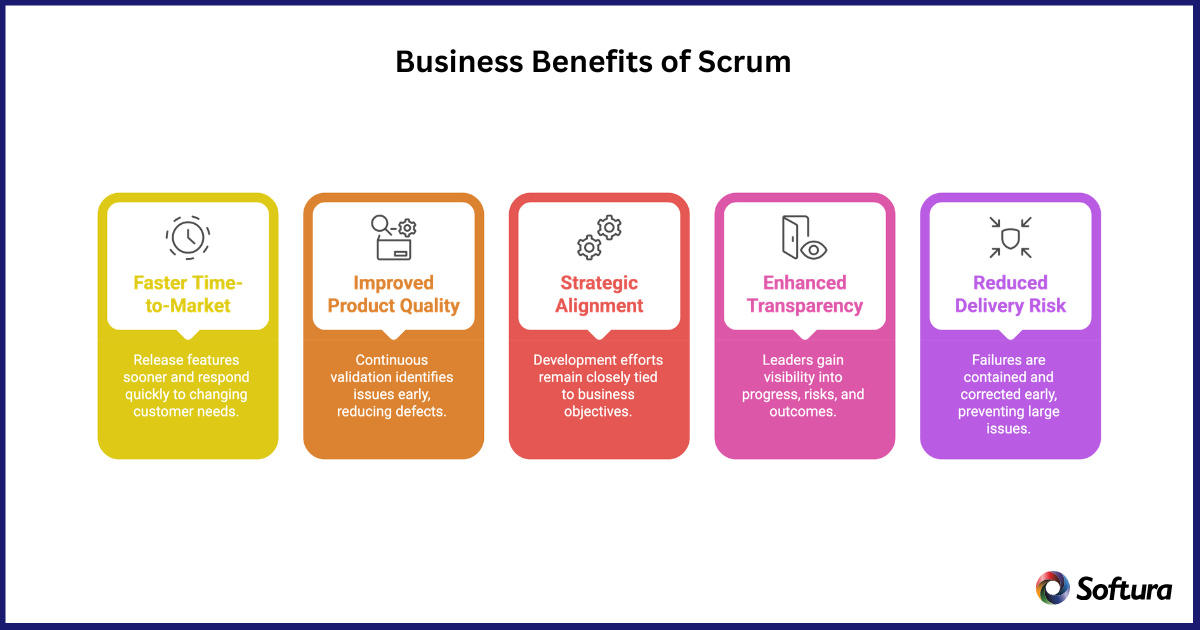
When implemented effectively, Scrum delivers measurable advantages that extend beyond development teams.
One of the most immediate benefits is faster time-to-market. By breaking work into smaller increments, organizations can release features sooner and respond quickly to changing customer needs.
Scrum also improves product quality. Continuous validation ensures that issues are identified early, reducing the likelihood of major defects during final release stages.
Another key advantage is strategic alignment. Because priorities are continuously refined, development efforts remain closely tied to business objectives rather than drifting over time.
Scrum also enhances transparency and decision-making. Leaders gain visibility into progress, risks, and outcomes, enabling more informed and timely decisions.
Perhaps most importantly, Scrum reduces delivery risk. Smaller, iterative cycles mean that failures are contained and corrected early, rather than escalating into large-scale project issues.
Despite its strengths, Scrum is not a guaranteed solution. Many organizations adopt Scrum practices without achieving the expected results.
In most cases, the issue is not the framework itself, but how it is implemented.
Common challenges include unclear priorities, ineffective backlog management, and treating Scrum as a series of meetings rather than a delivery system. Without strong business involvement, teams may deliver outputs that are technically correct but strategically irrelevant.
Another challenge is scaling. While Scrum works well at the team level, larger organizations often struggle to maintain alignment across multiple teams and departments.
These challenges highlight an important point: Scrum succeeds when it is integrated into a broader organizational strategy, not when it is applied in isolation.
The environment in which Scrum operates has evolved significantly in recent years.
Today, software development is shaped by emerging technologies, automation, and increasing expectations for speed and reliability.
One of the most significant changes is the rise of AI-driven development tools. These tools are accelerating coding, testing, and documentation processes. However, they also introduce new challenges around accuracy, governance, and trust.
At the same time, DevOps practices have become essential. Continuous integration and deployment pipelines are now standard, enabling faster and more reliable releases. Scrum teams must align closely with these practices to achieve their full potential.
Organizations are also becoming more data-driven in their decision-making. Metrics such as lead time, deployment frequency, and failure rates are increasingly used to evaluate performance.
In this context, Scrum remains highly relevant—but only when it evolves alongside these changes. The most successful organizations are those that combine Scrum with modern engineering practices, rather than relying on it in isolation.
For executives, successful Scrum adoption requires a shift in both mindset and execution.
It begins with clear business ownership of priorities. Without strong leadership involvement, teams lack direction and focus.
Organizations must also build cross-functional teams that can operate independently and make decisions quickly. This reduces dependencies and accelerates delivery.
Equally important is the integration of DevOps and automation tools, which enable continuous delivery and improve efficiency.
Finally, leadership must foster a culture of continuous improvement. Scrum is not a one-time transformation—it is an ongoing process of learning, adapting, and optimizing.
When these elements are in place, Scrum becomes more than a framework—it becomes a core capability for driving business performance.
Scrum is often introduced as a development methodology, but it's true value lies in its ability to align execution with business strategy.
Within the SDLC, Scrum enables organizations to move away from rigid, slow delivery models and toward systems that are adaptive, responsive, and outcome driven. For C-level leaders, the importance of Scrum is not in its structure, but in its impact. It provides a way to deliver value faster, reduce risk, and ensure that technology investments translate into measurable business results.
In a market where speed, flexibility, and innovation define success, Scrum is not just a framework, it is a strategic advantage.
"Our integration with the Google Nest smart thermostats through Aidoo Pro represents an unprecedented leap forward for our industry."
- Antonio Mediato, founder and CEO of Airzone.
Are you ready for your next project?
Unlock your company's full potential with our comprehensive Software development services. Contact our experts today to discuss how we can drive your success together.