
"Our integration with the Google Nest smart thermostats through Aidoo Pro represents an unprecedented leap forward for our industry."
- Antonio Mediato, founder and CEO of Airzone.
Choosing the right software development tech stack in 2026 is no longer just a technology decision. It is a business decision that affects speed to market, scalability, security, customer experience, hiring, cloud cost, AI readiness, and long-term maintenance.
For many business leaders, the challenge is not a lack of technology options. The challenge is knowing which technology choices will actually support the company’s goals. A stack that works well for a small marketing website may not be right for an enterprise application. A stack that helps a startup launch quickly may become expensive or difficult to maintain when the product scales. A stack that looks modern today may create technical debt tomorrow if it does not have strong community support, security maturity, or a clear upgrade path.
That is why the conversation around software development tech stacks has changed. In the past, companies often compared acronyms such as MERN, MEAN, LAMP, and JAMstack. These are still useful, but they are no longer enough. In 2026, the best software development stack is the one that fits the business model, application type, user expectations, compliance needs, cloud strategy, and long-term modernization roadmap.
This guide explains the top software development tech stacks for 2026 in a practical way. It is written for business leaders, technology decision-makers, CIOs, CTOs, product owners, and digital transformation teams that need to make informed decisions without getting lost in technical jargon.
A software development tech stack is the set of technologies used to build and run a software application.
In simple terms, it is the foundation behind the software your users interact with. It includes the tools used to design the interface, process business logic, store data, secure information, connect with other systems, and deploy the application to the cloud or server environment.
A modern software development stack usually includes:
For example, when a customer logs into a web portal, checks order status, downloads a document, or receives a personalized recommendation, several layers of the tech stack are working together behind the scenes.
The frontend creates the user experience. The backend processes the request. The database retrieves the information. APIs may connect to an ERP, CRM, payment platform, or analytics system. Cloud infrastructure makes sure the application can handle traffic. Security tools protect sensitive data.
That entire combination is the software development tech stack.
"Our integration with the Google Nest smart thermostats through Aidoo Pro represents an unprecedented leap forward for our industry."
- Antonio Mediato, founder and CEO of Airzone.
The right tech stack can help a company move faster, reduce risk, and create better digital experiences. The wrong stack can slow development, increase cost, limit scalability, and make future modernization harder.
In 2026, this matters even more because software is expected to do more than simply function. Business applications are now expected to be cloud-ready, mobile-friendly, secure, scalable, easy to integrate, and increasingly AI-enabled.
A strong technology stack helps businesses achieve five important outcomes.
Some frameworks and platforms help development teams build faster because they offer ready-to-use components, strong libraries, and mature development tools. This can reduce the time needed to build customer portals, SaaS products, internal applications, eCommerce platforms, or workflow automation systems.
For business leaders, this means faster product launches, quicker modernization cycles, and shorter time between idea and business value.
Scalability means the application can handle growth without breaking down or becoming too expensive to operate.
This growth can come from more users, more transactions, more data, more integrations, or new business features. A scalable software development stack allows the application to grow without forcing a complete rebuild.
For example, an application built for 500 users today may need to support 50,000 users later. The stack should be able to support that growth.
Performance affects user satisfaction and conversion. If an application is slow, customers leave, employees lose productivity, and business processes suffer.
Modern frontend frameworks, backend systems, caching strategies, and cloud infrastructure can significantly improve application speed. In 2026, performance is not only a technical metric. It is part of customer experience and operational efficiency.
Security can no longer be added at the end of software development. It must be built into the stack from the beginning.
A modern tech stack should support authentication, access control, encryption, secure APIs, vulnerability scanning, compliance requirements, and DevSecOps practices. This is especially important for industries such as healthcare, finance, manufacturing, logistics, education, and enterprise services.
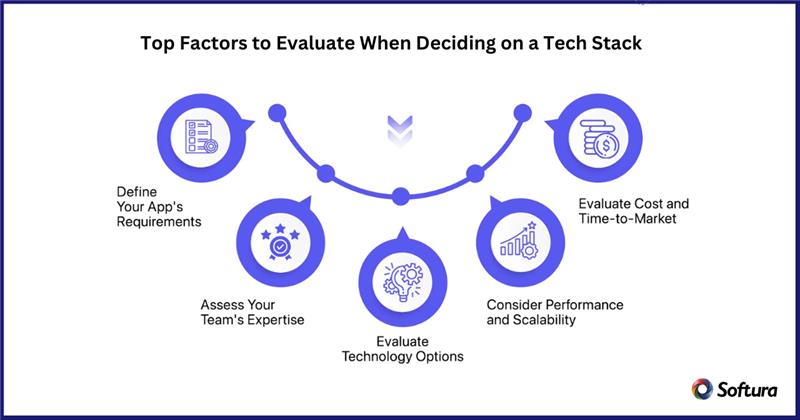
The best technology decision is not always the newest technology. It is the technology that your team can maintain, upgrade, secure, and scale over time.
A stack with strong community support, long-term support releases, stable documentation, and broad talent availability can reduce future risk. This is why support lifecycle matters in 2026. Business leaders should ask not only “Can this stack build the application?” but also “Can this stack support the business for the next five to ten years?”
"By analyzing the data from our connected lights, devices and systems, our goal is to create additional value for our customers through data-enabled services that unlock new capabilities and experiences."
- Harsh Chitale, leader of Philips Lighting’s Professional Business.
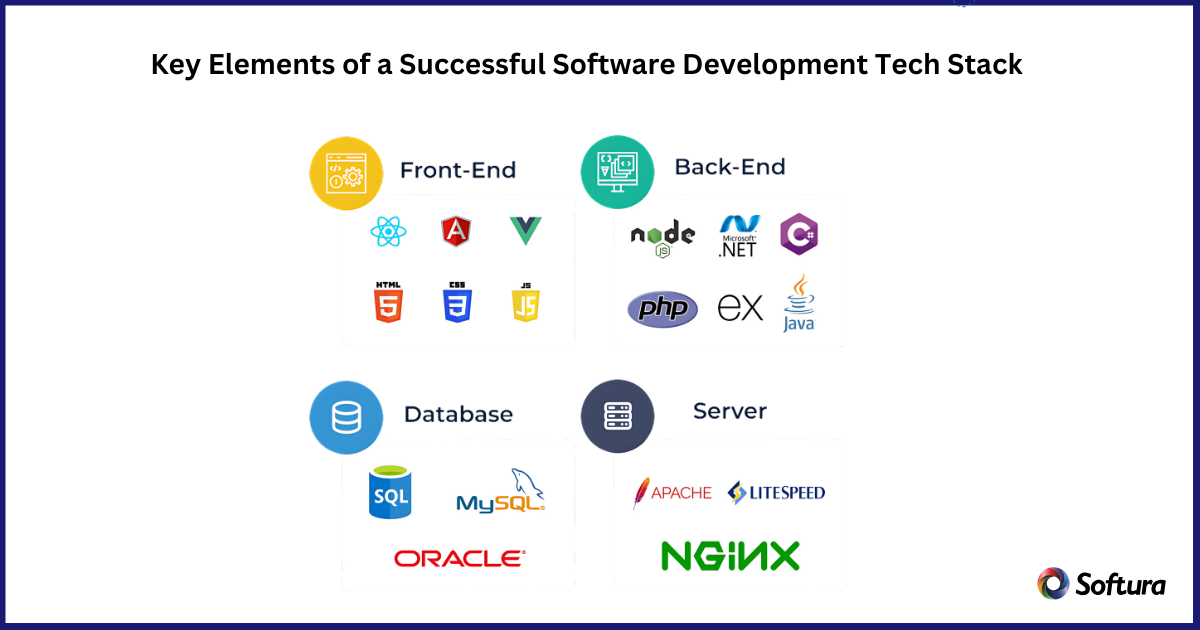
Before comparing the top software development tech stacks for 2026, it is useful to understand the major building blocks.
The frontend is the part of the application users see. It includes screens, buttons, forms, dashboards, navigation, charts, and interactive features.
For business leaders, frontend quality directly affects user adoption. A strong frontend can make a complex process feel simple. A weak frontend can make even a powerful application frustrating to use.
React is one of the most widely used frontend libraries for building modern web applications. It is especially strong for applications that need reusable components, fast user interfaces, and dynamic experiences.
In business terms, React helps teams build consistent interfaces faster. If your company is building a SaaS platform, customer portal, internal dashboard, or eCommerce experience, React is often a strong choice.
Next.js builds on React and adds important capabilities such as server-side rendering, routing, performance optimization, and full-stack development features.
This matters because many modern applications need both strong user experience and strong search performance. For customer-facing platforms, content-driven applications, and SaaS products, Next.js has become one of the most important web development frameworks for 2026.
Angular is a full-featured frontend framework often used for enterprise applications. It provides structure, consistency, and built-in patterns that help large teams manage complex software.
For business leaders, Angular is valuable when the project requires a disciplined development approach, long-term maintainability, and enterprise-grade architecture.
Vue.js is known for flexibility and ease of adoption. It is often used when teams want a lightweight but capable frontend framework.
Vue can be a good fit for smaller teams, progressive modernization efforts, and applications where simplicity and speed matter.
Astro is a modern web framework designed for content-heavy websites, marketing platforms, documentation hubs, and high-performance web experiences.
For businesses that depend on SEO, thought leadership, and fast-loading content, Astro can be a strong choice because it focuses on performance and content delivery.
The backend is the engine of the application. It handles business logic, workflows, data processing, integrations, permissions, and communication between systems.
If the frontend is what users see, the backend is what makes the application work.
Node.js allows developers to use JavaScript or TypeScript on the backend. This is useful because teams can use similar language skills across both frontend and backend development.
Node.js is especially useful for real-time applications, APIs, SaaS products, collaboration tools, and scalable web platforms.
.NET is Microsoft’s enterprise development platform. It is widely used for business applications, internal platforms, regulated environments, and organizations already invested in the Microsoft ecosystem.
For companies that use Microsoft Azure, Microsoft 365, Dynamics, or enterprise identity tools, .NET can provide strong alignment.
Python is one of the most important languages for AI, data, automation, and backend development. FastAPI is a modern Python framework used for building high-performance APIs.
For business leaders, this matters because many companies now want applications that can connect with AI models, analytics systems, and data pipelines. A React or Next.js frontend combined with a FastAPI backend is becoming a strong choice for AI-ready applications.
Django is a mature Python framework known for speed, security, and built-in features. It is often used for data-driven applications, admin-heavy platforms, and business systems that need secure development patterns.
Spring Boot is a Java-based backend framework widely used for enterprise applications. It is strong for organizations that need reliability, integration, maintainability, and large-scale backend systems.
Spring Boot is often preferred for complex enterprise environments, especially where Java skills and existing systems are already in place.
Databases store and organize application data. Choosing the right database is one of the most important decisions in software architecture.
PostgreSQL has become one of the strongest default choices for modern applications. It is a relational database, which means it is excellent at managing structured data and relationships between data points.
For example, customer records, invoices, orders, user permissions, financial transactions, and workflow histories often require structured relationships. PostgreSQL is a strong fit for these use cases.
In 2026, many modern web applications are moving toward PostgreSQL-first architectures because they provide reliability, flexibility, and strong performance.
MySQL remains a widely used relational database, especially for websites, CMS platforms, and traditional web applications. It is mature, stable, and supported by a large ecosystem.
MongoDB is a NoSQL database. It stores data in a more flexible format than traditional relational databases.
This can be useful when the data structure changes frequently or when the application handles varied data types. MongoDB is still relevant, especially for certain product development and real-time use cases. However, it should not be selected simply because it is part of a popular acronym like MERN. It should be selected when the data model truly fits.
Redis is often used for caching and real-time performance improvements. It helps applications respond faster by temporarily storing frequently used data.
For business users, this means faster dashboards, quicker page loads, and better user experience.
Modern software stacks are not complete without cloud and operational tooling.
A strong 2026 tech stack should consider:
DevSecOps means development, security, and operations working together from the beginning. Instead of checking security after development is complete, DevSecOps builds security into every stage of the software lifecycle.
For C-level leaders, this reduces risk, improves release confidence, and supports compliance.
Looking for Offshore Dedicated Developers?
Our skilled experts are ready to help. Let's discuss your automation needs.
"By analyzing the data from our connected lights, devices and systems, our goal is to create additional value for our customers through data-enabled services that unlock new capabilities and experiences."
- Harsh Chitale, leader of Philips Lighting’s Professional Business.
The best software development tech stacks for 2026 are not just the most popular ones. They are the stacks that best support real business use cases.
Below are the most relevant stacks for modern business applications.
SaaS platforms, customer portals, web applications, eCommerce platforms, dashboards, and modern digital products.
This is one of the strongest modern full-stack development options for businesses that need speed, scalability, and a strong user experience.
Next.js provides a powerful frontend and full-stack framework. Node.js supports scalable backend services. PostgreSQL provides a reliable database foundation.
This stack is especially useful when companies want to build applications that are fast, search-friendly, cloud-ready, and easier to maintain.
The biggest advantage of this stack is speed with structure. Development teams can move quickly because JavaScript or TypeScript can be used across the application. This reduces context switching and can improve delivery efficiency.
It also supports strong performance. Next.js helps applications load faster and supports better SEO for public-facing pages. PostgreSQL provides a mature and reliable data layer.
For companies building SaaS products or customer-facing applications, this combination is often more practical than the older MERN approach.
This stack works well when the business needs:
This stack still needs strong architecture discipline. If teams move too quickly without proper planning, the application can become difficult to maintain. Business leaders should ensure the team uses clear coding standards, strong API design, security practices, and cloud cost monitoring.
Enterprise applications, internal business systems, workflow platforms, Microsoft ecosystem applications, compliance-heavy environments, and long-lifecycle software.
Angular and .NET remain one of the strongest enterprise software development stacks. Angular provides a structured frontend framework. .NET provides a mature backend platform supported by Microsoft.
For organizations that value governance, stability, security, and support lifecycle, this stack is a strong choice.
This stack is especially valuable for companies that already use Microsoft technologies. It works well with Azure, Active Directory, Microsoft identity services, Microsoft 365, and enterprise security patterns.
The biggest advantage is predictability. Large teams can work with Angular because it provides structure. .NET is strong for enterprise-grade backend systems that require reliability and long-term support.
This stack works well for:
Angular and .NET can require more upfront planning than lighter frameworks. That is not necessarily a disadvantage. For enterprise systems, the added structure often reduces long-term maintenance risk. However, it may not be the fastest option for very small MVPs or lightweight websites.
AI-enabled applications, analytics platforms, data-heavy systems, internal copilots, automation platforms, and applications that need strong API performance.
AI is changing the way companies think about software. Many applications now need to connect with machine learning models, data pipelines, automation workflows, and intelligent recommendation engines.
Python is already strong in AI and data. FastAPI makes Python more suitable for modern API development. React provides a strong frontend experience. PostgreSQL provides a dependable database foundation.
Together, this stack is one of the best options for AI-ready software development in 2026.
This stack helps businesses build applications that can connect operational workflows with data intelligence.
For example, a company could use this stack to build:
The value is not just technical. It allows businesses to move from static applications to intelligent applications.
AI-ready does not mean every feature uses artificial intelligence. It means the application is designed so AI capabilities can be added without rebuilding the entire system.
An AI-ready stack should support clean APIs, secure data access, scalable processing, model integration, and strong observability. React + FastAPI + PostgreSQL is a practical foundation for that.
AI-ready applications need strong data governance. The stack alone is not enough. Companies must also consider data quality, privacy, security, model reliability, and compliance.
Large enterprise applications, integration-heavy platforms, financial systems, manufacturing systems, logistics platforms, and organizations with strong Java capabilities.
Spring Boot remains a powerful choice for enterprise backend development. React provides a flexible and modern frontend. Together, they create a strong stack for companies that need reliable backend services and high-quality user interfaces.
This stack is particularly relevant for organizations with complex business rules, many system integrations, and long-term application roadmaps.
Spring Boot is strong for building backend services that need to be stable, secure, and maintainable. It supports microservices architecture, which means large applications can be broken into smaller services that are easier to develop, deploy, and scale.
React adds a modern user experience layer on top of that strong backend foundation.
This combination works well when the business needs both enterprise reliability and strong usability.
This stack is a good fit for:
This stack may require experienced architects and developers. It is powerful, but it should be implemented with clear design standards. Without good architecture, microservices can become overly complex.
Marketing websites, resource centers, documentation hubs, SEO-heavy websites, blogs, and content-led B2B platforms.
Not every business application needs a heavy frontend framework. Some websites need speed, content flexibility, SEO performance, and simple publishing workflows.
Astro is designed for content-driven websites. When combined with a headless CMS, it allows marketing and content teams to manage content while developers maintain a fast and scalable frontend.
This stack is valuable for businesses that depend on search visibility, thought leadership, and lead generation.
It can help improve page speed, reduce unnecessary complexity, and create a better content experience. For companies investing in SEO, this can directly support organic growth.
A headless CMS is a content management system that separates content management from website presentation.
In simple terms, marketers can create and manage content in one system, while developers use modern frontend tools to display that content on the website. This gives both teams more flexibility.
Astro is excellent for content-led websites, but it may not be the best fit for highly interactive business applications. The stack should match the purpose of the platform.
Business websites, blogs, content platforms, small to mid-sized websites, and companies that need fast publishing with a mature CMS ecosystem.
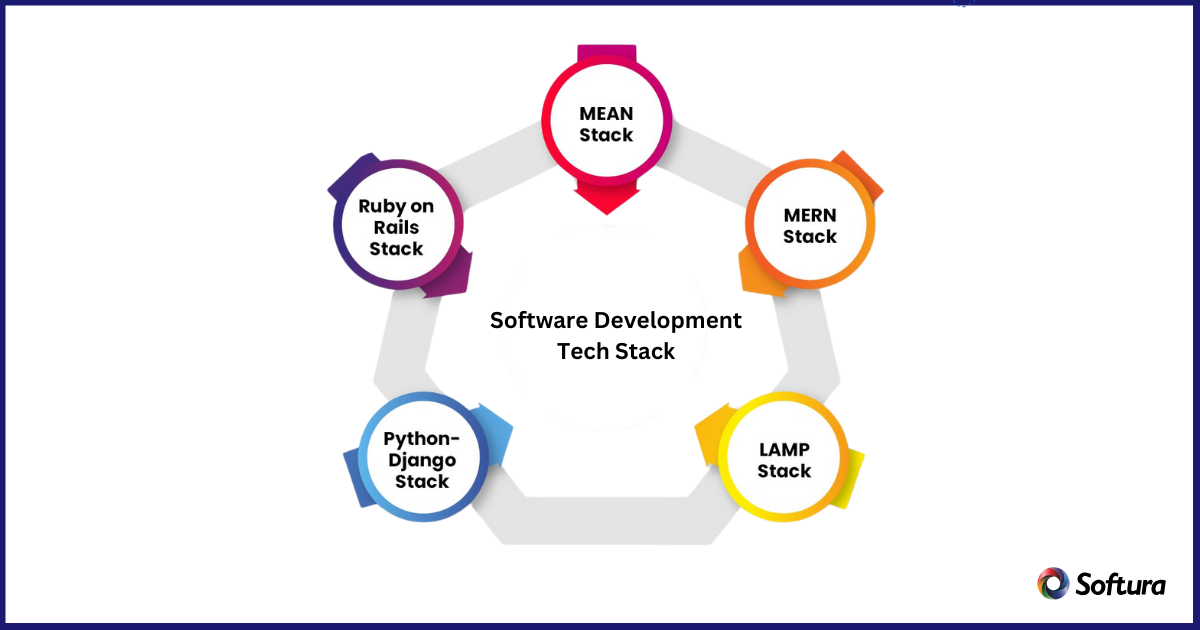
LAMP stands for Linux, Apache, MySQL, and PHP. It is one of the oldest and most widely used web development stacks. WordPress is commonly associated with this ecosystem.
Although newer stacks receive more attention, WordPress and LAMP are not obsolete. They remain practical for content-driven websites, publishing workflows, and businesses that need a familiar CMS.
The biggest advantage is speed to publish. WordPress has a large plugin ecosystem, a familiar admin interface, and broad market adoption.
For many businesses, this means lower training time and faster content operations.
This stack is useful for:
WordPress can become difficult to manage if too many plugins are used without governance. Security, performance, and maintenance must be handled carefully.
For complex enterprise software, a custom application stack may be a better fit.
Event-driven applications, background jobs, automation workflows, IoT applications, lightweight APIs, and applications with unpredictable traffic.
A serverless stack allows teams to run application logic without managing traditional servers. Cloud providers such as AWS and Microsoft Azure handle much of the infrastructure automatically.
This does not mean there are no servers. It means the business does not need to manage them directly.
Serverless architecture can reduce infrastructure management and improve cost efficiency for the right workloads.
For example, if an application only needs to process data when an event occurs, serverless can be more efficient than running servers all the time.
Serverless is a good fit for:
Serverless can reduce operational overhead, but it must be designed carefully. Costs can rise if workloads are not monitored properly. It may also create dependency on a specific cloud provider.
Startups, MVPs, real-time applications, social platforms, dashboards, and full-stack JavaScript development.
MERN stands for MongoDB, Express.js, React, and Node.js.
It became popular because it allows teams to use JavaScript across the full application. This can speed up development and simplify hiring for some teams.
Yes, MERN is still relevant, but it should be selected carefully.
For many modern applications, teams now choose React or Next.js with Node.js and PostgreSQL instead of MongoDB by default. This does not mean MongoDB is bad. It means the database should match the business data model.
If the application has highly flexible data structures, MongoDB may be a good choice. If the application depends on structured business data, PostgreSQL may be better.
MERN can support rapid product development, especially for startups and teams that want one language across the stack.
Do not choose MERN only because it is popular. Ask whether MongoDB is truly the right database for the application’s data requirements.
Structured enterprise web applications, dashboards, collaboration platforms, and teams that prefer Angular.
MEAN stands for MongoDB, Express.js, Angular, and Node.js.
It is similar to MERN but uses Angular instead of React.
MEAN is still useful, especially when teams want Angular’s structure and Node.js flexibility. However, like MERN, it should not be treated as a universal answer.
In enterprise settings, Angular is often paired with .NET or Java instead of Node.js. That may be a better choice when the company needs strong governance, compliance, and backend maturity.
MEAN can help teams build structured, dynamic applications using JavaScript-based technologies.
MEAN may not be the best fit when the business requires a relational database, deep Microsoft ecosystem integration, or highly regulated backend architecture.
"By analyzing the data from our connected lights, devices and systems, our goal is to create additional value for our customers through data-enabled services that unlock new capabilities and experiences."
- Harsh Chitale, leader of Philips Lighting’s Professional Business.
Technology decisions in 2026 are being shaped by several major trends. These trends should influence how businesses choose their software development stack.
AI is now influencing how software is designed, developed, tested, and maintained.
Development teams increasingly use AI-assisted coding tools, intelligent documentation, automated testing, and AI-powered workflows. This is increasing interest in typed languages, clean APIs, and structured development environments.
For business leaders, the takeaway is simple: the stack should support AI adoption without creating risk. That means clean architecture, secure data access, strong documentation, and maintainable code.
TypeScript adds structure to JavaScript by helping developers catch errors earlier. This is valuable for growing applications because it improves maintainability and reduces some types of defects.
For businesses, TypeScript can reduce long-term risk in large applications. It is especially useful in modern React, Next.js, Node.js, and enterprise web projects.
Cloud-native development means applications are designed to run effectively in cloud environments.
This includes containers, APIs, automated deployment, monitoring, scaling, and cloud-managed services.
For business leaders, cloud-native architecture supports flexibility. It allows applications to scale, integrate, and adapt faster than traditional deployment models.
Security is no longer only the responsibility of a security team. It must be part of the software development lifecycle.
DevSecOps helps companies identify vulnerabilities earlier, automate security checks, and release software with more confidence.
For industries with compliance requirements, DevSecOps is especially important.
Microservices architecture breaks large applications into smaller independent services.
This can improve scalability and team autonomy, but it also adds complexity. Not every application needs microservices.
For business leaders, the right question is not “Should we use microservices?” The right question is “Does our application complexity justify microservices?”
Serverless computing is valuable for event-driven and variable workloads. It can reduce infrastructure management and improve cost efficiency.
However, it should be used where it fits. It is not always the best architecture for every application.
Observability means the ability to understand what is happening inside an application by monitoring logs, metrics, traces, errors, and performance.
For business leaders, observability reduces downtime, improves customer experience, and helps teams resolve problems faster.
Modern applications often need to connect with CRMs, ERPs, payment systems, analytics platforms, mobile apps, AI tools, and third-party services.
An API-first approach makes integration easier and supports future flexibility.
For companies planning digital transformation or application modernization, API-first architecture is critical.
As companies adopt AI, analytics, and automation, data architecture becomes more important.
The database is no longer just a storage system. It is part of the business intelligence and AI-readiness strategy.
This is why PostgreSQL, data pipelines, caching systems, and secure data access patterns are increasingly important.
A popular technology is not always the right technology.
MERN, MEAN, serverless, microservices, and AI-native stacks all have value, but only when they match the business use case.
Some technologies help teams launch quickly but become harder to maintain later.
Before choosing a stack, consider future upgrades, security patches, developer availability, and support windows.
The database has a major impact on performance, reporting, scalability, and AI readiness.
Choosing between PostgreSQL, MySQL, MongoDB, or another database should be based on data structure and business requirements.
Microservices can be powerful, but they also add operational complexity.
For some applications, a well-structured modular architecture is better than jumping into microservices too soon.
Security should be part of the stack decision, not an afterthought.
Authentication, authorization, encryption, audit logging, vulnerability scanning, and DevSecOps should be considered from the beginning.
A stack may be technically scalable but financially inefficient if cloud usage is not designed and monitored properly.
Cloud cost optimization should be part of architecture planning.
The top software development tech stacks for 2026 are not just about popular frameworks or programming languages. They are about choosing the right technical foundation for business growth.
For many modern SaaS and web applications, Next.js + Node.js + PostgreSQL provides a strong balance of speed, scalability, and user experience. For enterprise applications, Angular + .NET and Spring Boot + React offer structure, security, and long-term maintainability. For AI-ready applications, React or Next.js + FastAPI + PostgreSQL provides a practical path toward intelligent software. For content-heavy websites, Astro or WordPress may deliver faster results with better content flexibility. For event-driven workloads, serverless architecture can reduce operational overhead when used correctly.
The most important takeaway is this: the right tech stack should match the business strategy, not just the development trend.
A strong stack helps your company launch faster, scale smarter, secure better, and modernize with confidence. A weak stack creates friction, technical debt, and avoidable cost.
If your organization is planning a new software product, application modernization initiative, AI-enabled platform, or cloud-native application, Softura can help evaluate the right technology stack and build a roadmap that connects architecture decisions to measurable business outcomes.
Are you ready for your next project?
Unlock your company's full potential with our comprehensive Software application development services. Contact our experts today to discuss how we can drive your success together.