
"Our integration with the Google Nest smart thermostats through Aidoo Pro represents an unprecedented leap forward for our industry."
- Antonio Mediato, founder and CEO of Airzone.
Offshore outsourcing helps businesses access skilled technology talent, scale delivery capacity, and control development costs. In Software Development Outsourcing, this model becomes especially valuable for companies that need to move faster without expanding every capability in-house. But when teams work from different countries, time zone differences can affect communication, decisions, and project speed.
For C-level leaders, this is not just a scheduling issue. Poor time zone management can delay releases, increase rework, and reduce confidence in the offshore model. When managed well, it can create extended work coverage and faster progress.
The key is to build a delivery rhythm where teams know when to meet live, when to communicate asynchronously, how to hand off work, and how to escalate urgent issues.
Time zone differences are common in global software delivery. For example, a U.S. business working with an offshore development team in India may only have a short overlap window each day.
The challenge is not the time gap itself. The real problem is the lack of structure around communication, ownership, and decision-making.
Without a clear process, teams may face:
With the right model, offshore teams can continue development, QA, documentation, and support while the onshore team is offline. This helps businesses maintain momentum without forcing everyone to work the same hours.
"Our integration with the Google Nest smart thermostats through Aidoo Pro represents an unprecedented leap forward for our industry."
- Antonio Mediato, founder and CEO of Airzone.
Most time zone issues happen because updates are unclear, decisions are not documented, or teams do not know who owns the next step.
A simple question can create a full-day delay when teams are several hours apart. If a developer needs clarification from a product owner who is offline, progress may stop.
These delays can affect development, QA, release approvals, and stakeholder reporting. To avoid this, every important request should have an owner, priority, and expected response time.
Offshore teams may share only one or two working hours with the client team. If that time is used only for status updates, valuable decision-making time is lost.
Overlap hours should be used for blocker resolution, priority alignment, requirement clarification, release readiness, and urgent decisions. Routine updates should be shared through the project management tool.
Urgent issues become harder when the right person is offline, especially for production defects, deployment failures, customer-impacting bugs, or security concerns.
Every offshore engagement should define severity levels, escalation channels, backup owners, and decision authority before problems occur.
"By analyzing the data from our connected lights, devices and systems, our goal is to create additional value for our customers through data-enabled services that unlock new capabilities and experiences."
- Harsh Chitale, leader of Philips Lighting’s Professional Business.
Managing offshore team time zones requires process discipline, not constant availability. The goal is predictable progress.
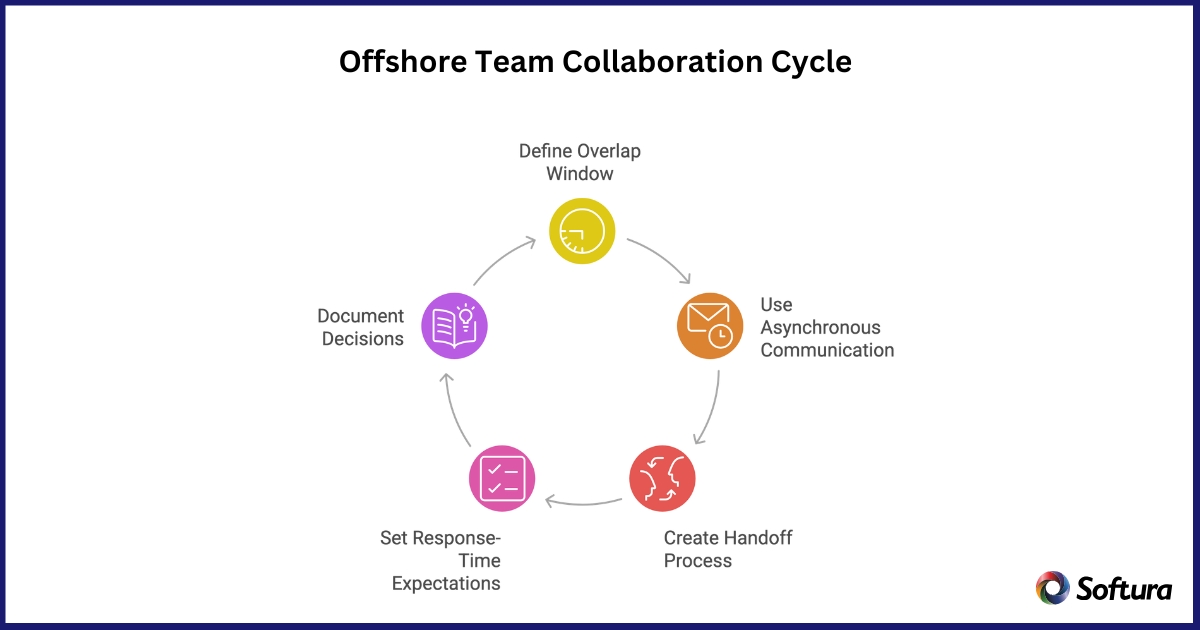
Identify the hours when onshore and offshore teams are both available. Even a short overlap window can work if it is focused on decisions and blockers.
Use this time to:
Avoid turning overlap meetings into long reporting calls. Status can be shared asynchronously.
Asynchronous communication allows teams to work without waiting for real-time replies. This is essential for offshore outsourcing because teams are not always online together.
A good async update should include context, status, expected action, owner, priority, deadline, and links. Instead of saying, “Please check this issue,” explain what failed, who is affected, and when a response is needed.
A handoff tells the next team what happened, what is pending, and what needs attention. This is a simple way to reduce offshore delivery delays.
Every handoff should include:
A strong handoff helps work continue while another team is offline.
Not every request has the same urgency. A production outage is different from a documentation update.
Use a simple priority model:
This helps teams focus on what truly needs immediate action.
Important decisions should not remain buried in chats or meetings. Use one source of truth for requirements, technical decisions, risks, approvals, and release notes.
This could be Jira, Azure DevOps, Confluence, Notion, SharePoint, or another agreed platform. The tool matters less than consistency.
"By analyzing the data from our connected lights, devices and systems, our goal is to create additional value for our customers through data-enabled services that unlock new capabilities and experiences."
- Harsh Chitale, leader of Philips Lighting’s Professional Business.
Tools cannot fix a weak process, but they can support a strong one.
Useful categories include:
AI can help distributed teams stay aligned, but it should not replace ownership. Teams still need accountability and documented decisions.
"By analyzing the data from our connected lights, devices and systems, our goal is to create additional value for our customers through data-enabled services that unlock new capabilities and experiences."
- Harsh Chitale, leader of Philips Lighting’s Professional Business.
The follow-the-sun model allows work to continue as one team ends its day and another begins. This can help accelerate development, QA, and support.
It works best when teams have clear task ownership, documented acceptance criteria, complete handoffs, visible blockers, escalation paths, and updated project boards.
Without these basics, follow-the-sun delivery can create confusion. With them, it creates structured continuity.
Executives do not need to monitor every message, but they should know whether offshore collaboration is working.
Useful metrics include blocker age, first-response time, handoff completeness, requirement-related rework, sprint predictability, missed dependencies, and meeting load.
These metrics show whether delays are caused by weak handoffs, unclear requirements, slow decisions, or poor escalation.
Softura supports businesses through an onshore-offshore engineering model designed to improve delivery speed, communication, and scalability.
Softura’s model supports offshore development teams, dedicated teams, staff augmentation, project-based outsourcing, hybrid delivery, Agile DevOps, application development, modernization, and ongoing support.
Time zone differences are not solved by tools alone. They require project leadership, communication standards, structured handoffs, and delivery discipline. A mature outsourcing partner helps turn offshore collaboration into a predictable business advantage.
Before starting an offshore engagement, leadership should ask:
Do not measure offshore success by how often teams meet. Measure it by how clearly work moves forward.
Time zone differences in offshore outsourcing can either slow projects down or help teams move faster. The outcome depends on the operating model.
Businesses that rely only on meetings and instant replies will struggle.
Businesses that use overlap hours, asynchronous communication, structured handoffs, documented decisions, and clear escalation paths can make offshore collaboration more predictable, especially when working with Dedicated Development Teams across regions. The goal is not to eliminate time zone differences. It is to build a delivery model that works because of them.
Looking for Offshore Dedicated Developers?
Our skilled experts are ready to help. Let's discuss your automation needs.