
"Our integration with the Google Nest smart thermostats through Aidoo Pro represents an unprecedented leap forward for our industry."
- Antonio Mediato, founder and CEO of Airzone.
Every major technology shift eventually reaches a moment when experimentation ends and structured implementation begins. AI has now reached that stage.
In discussions with enterprise technology leaders, a clear pattern is emerging. AI initiatives that were once small pilot programs are turning into long term enterprise programs. These programs require structured AI development services, experienced engineering teams, and strong data governance frameworks.
A CIO overseeing a manufacturing technology environment recently summarized the change clearly during an industry roundtable. AI is no longer treated as an innovation lab project. It is being placed alongside ERP modernization, cybersecurity programs, and enterprise data strategy.
The reason is simple. AI now touches almost every business function.
Customer support teams rely on AI powered chat systems. Supply chains depend on predictive analytics. Finance teams use machine learning models to detect anomalies in transactions. Even HR departments are using intelligent systems for talent analysis and workforce planning.
None of these systems appear overnight. They are built through structured AI development services that combine software engineering, machine learning models, and scalable infrastructure.
Industry research consistently shows that organizations integrating AI deeply into operations experience measurable improvements in productivity, decision speed, and operational visibility.
This is exactly why CIOs are moving AI initiatives from the edge of experimentation into the core technology roadmap.
"Our integration with the Google Nest smart thermostats through Aidoo Pro represents an unprecedented leap forward for our industry."
- Antonio Mediato, founder and CEO of Airzone.
Enterprise technology planning cycles are shifting rapidly. CIOs are balancing multiple priorities while deciding where AI fits within the broader digital ecosystem.
Several themes are shaping the 2026 roadmap discussions.
Many CIOs view AI development services as a way to automate repetitive operational processes. IT service management, infrastructure monitoring, and internal support systems can all benefit from AI driven automation.
When AI models monitor system behavior and predict issues before they occur, IT teams spend less time responding to incidents and more time focusing on innovation.
Enterprises generate massive volumes of operational data every day. Yet most of this data remains underutilized.
AI development services help transform raw data into insights through predictive analytics and machine learning algorithms. Instead of relying only on historical reports, executives gain forward looking intelligence.
Customer expectations continue to evolve. Modern consumers expect faster responses, personalization, and seamless digital interactions.
AI powered systems can analyze behavior patterns, personalize services, and automate support interactions. For CIOs, this capability directly impacts revenue growth and customer loyalty.
AI development services also enable organizations to test new ideas faster. Product teams can use machine learning models to analyze market signals, simulate scenarios, and launch new features with greater confidence.
These benefits explain why AI investments are becoming a central component of CIO planning cycles.
"By analyzing the data from our connected lights, devices and systems, our goal is to create additional value for our customers through data-enabled services that unlock new capabilities and experiences."
- Harsh Chitale, leader of Philips Lighting’s Professional Business.
Enterprise leaders rarely invest in technology simply for innovation headlines. Every investment must contribute to measurable business outcomes.
AI development services are increasingly seen as a strategic advantage because they enable organizations to move faster and make better decisions.
A technology leader from a logistics company described AI in simple terms during a recent executive forum. Traditional software tells systems what to do. AI helps systems understand what should happen next.
This difference changes how businesses operate.
Predictive systems can anticipate supply chain disruptions. Fraud detection models can identify suspicious activity instantly. Sales forecasting models can improve inventory planning.
Each of these capabilities is built through AI development services that combine data engineering, model training, and enterprise software integration.
Organizations that invest early in these capabilities are often able to respond to market shifts more quickly than competitors.
Modern enterprises are gradually evolving into intelligent platforms where software systems continuously learn from data.
Cloud infrastructure laid the foundation for this transformation. Now AI development services are adding the intelligence layer.
Instead of static business applications, organizations are building systems that can analyze patterns, automate tasks, and support decision making.
Examples of these intelligent enterprise systems include:
Each example reflects a broader trend. Businesses are embedding intelligence directly into operational workflows.
This shift is a key reason why CIOs are prioritizing AI development services in their 2026 roadmaps.
No AI initiative succeeds without strong data foundations.
Many CIOs learned this lesson during early AI experiments. Machine learning models are only as effective as the data they are trained on.
As a result, enterprise roadmaps now place heavy emphasis on building scalable data infrastructure before launching major AI initiatives.
Modern AI development services often begin with:
Once these foundations are in place, organizations can develop machine learning models that produce reliable outcomes.
Technology leaders increasingly recognize that AI projects are not simply software deployments. They are long term data driven programs that require governance, monitoring, and continuous improvement.
Enterprises rarely rely solely on off the shelf AI tools. Every organization has unique operational workflows, data structures, and customer needs.
This is why custom AI development services are gaining attention among CIOs.
Custom development allows organizations to build AI solutions tailored to their specific business challenges.
Examples include:
Custom AI development also allows deeper integration with existing enterprise systems such as ERP platforms, supply chain tools, and customer management systems.
For CIOs managing complex technology environments, this level of integration is essential.
Behind every successful AI initiative sits a combination of advanced technologies. CIOs evaluating AI development services typically look at several core components.
These technologies enable organizations to build systems capable of analyzing images, interpreting documents, predicting trends, and automating workflows.
However, technology alone is not enough. Skilled engineers and domain expertise remain essential to turning AI models into reliable enterprise solutions.
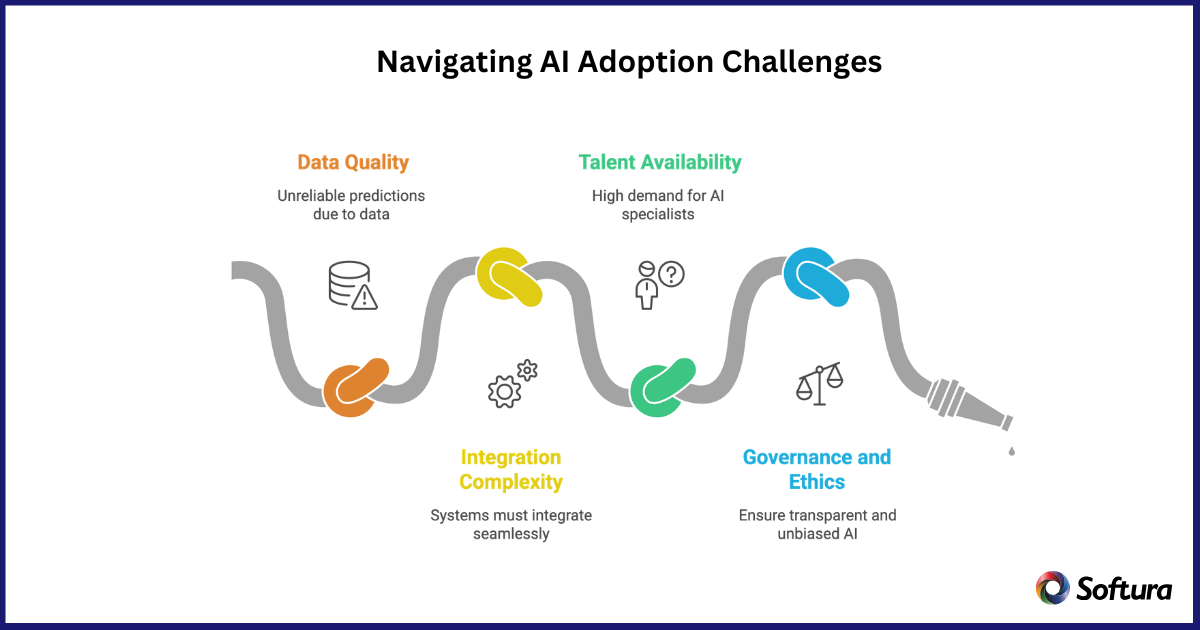
Despite its potential, AI adoption is not without challenges. CIOs must carefully navigate several critical issues while building AI strategies.
Inconsistent or incomplete data can lead to unreliable AI predictions. Strong data governance processes are essential.
AI systems must integrate with legacy applications, cloud platforms, and enterprise data sources.
AI engineers, machine learning specialists, and data scientists remain in high demand.
Organizations must ensure that AI models operate transparently and avoid biased outcomes.
CIOs addressing these challenges early often see faster and more successful AI adoption.
Technology roadmaps extending into 2026 reveal a clear trend. AI is becoming a core capability across nearly every industry.
Healthcare organizations are exploring AI assisted diagnostics. Financial institutions are building intelligent fraud detection platforms. Manufacturing companies are developing predictive maintenance systems for complex equipment fleets.
The common thread across these initiatives is structured AI development services supported by scalable cloud infrastructure and strong data strategies.
Industry analysts expect organizations investing in AI driven automation to see significant improvements in operational productivity and decision accuracy in the coming years.
For CIOs, this means AI is no longer a future technology. It is a present day requirement for competitive growth.
Before launching large AI programs, technology leaders typically evaluate several factors.
Successful AI programs begin with clearly defined use cases rather than broad experimentation.
Organizations that focus on specific operational problems often see faster results and stronger internal adoption.
AI adoption rarely happens in isolation. It often builds on earlier investments in digital transformation, cloud modernization, and enterprise data platforms.
For many organizations, AI development services represent the next stage of digital maturity.
Systems that once digitized processes are now evolving into systems that analyze, predict, and optimize operations.
This shift is creating new opportunities for innovation across industries. Enterprises can respond faster to market changes, optimize resource allocation, and deliver more personalized services.
CIOs responsible for guiding this transformation recognize that AI capabilities will shape technology leadership for the next decade.
The role of the CIO has evolved dramatically in recent years. Technology leaders are no longer focused only on infrastructure and system stability. They are now responsible for driving innovation, improving operational efficiency, and enabling data driven decision making.
Within this evolving responsibility, AI development services have become a central priority in 2026 technology roadmaps.
Organizations that build strong AI capabilities today will be better prepared to adapt to future market changes. Those that delay adoption may find themselves struggling to compete with faster, more intelligent digital ecosystems.
For CIOs, the focus is clear. Build strong data foundations, invest in reliable AI development services, and align intelligent technologies with real business outcomes.
The organizations that follow this path are already shaping the next generation of enterprise innovation.
Ready to explore how AI development services can support your technology roadmap? Connect with Softura’s experts to discuss practical AI solutions tailored to your business goals.