
"Our integration with the Google Nest smart thermostats through Aidoo Pro represents an unprecedented leap forward for our industry."
- Antonio Mediato, founder and CEO of Airzone.
"Our integration with the Google Nest smart thermostats through Aidoo Pro represents an unprecedented leap forward for our industry."
- Antonio Mediato, founder and CEO of Airzone.
Application Portfolio Rationalization is the structured process of reviewing enterprise applications and deciding the right future path for each one.
Some applications should be retained because they are still valuable. Some should be optimized because they are useful but inefficient. Some should be modernized because they support important processes but run on outdated technology. Others should be retired because they create more cost and risk than value.
Think of it like reviewing a large storage room before an office move. You do not carry everything forward just because it exists. You decide what is useful, what is duplicate, what is outdated, and what should be removed before it creates more work.
A strong APR initiative helps leaders identify business-critical applications, redundant tools, hidden risks, cloud-ready systems, and modernization priorities.
"By analyzing the data from our connected lights, devices and systems, our goal is to create additional value for our customers through data-enabled services that unlock new capabilities and experiences."
- Harsh Chitale, leader of Philips Lighting’s Professional Business.
Application sprawl is not just an IT issue. It affects how fast the business can move.
When applications grow without control, organizations face rising support costs, unclear ownership, duplicate platforms, scattered data, and slower modernization cycles. Teams spend more time maintaining complexity and less time creating new business value.
APR turns scattered application information into decision-grade portfolio intelligence across business criticality, technical health, cost, risk, and strategic alignment.
In simple terms, it helps leaders see what they have, what it costs, how risky it is, and what should happen next.
"By analyzing the data from our connected lights, devices and systems, our goal is to create additional value for our customers through data-enabled services that unlock new capabilities and experiences."
- Harsh Chitale, leader of Philips Lighting’s Professional Business.
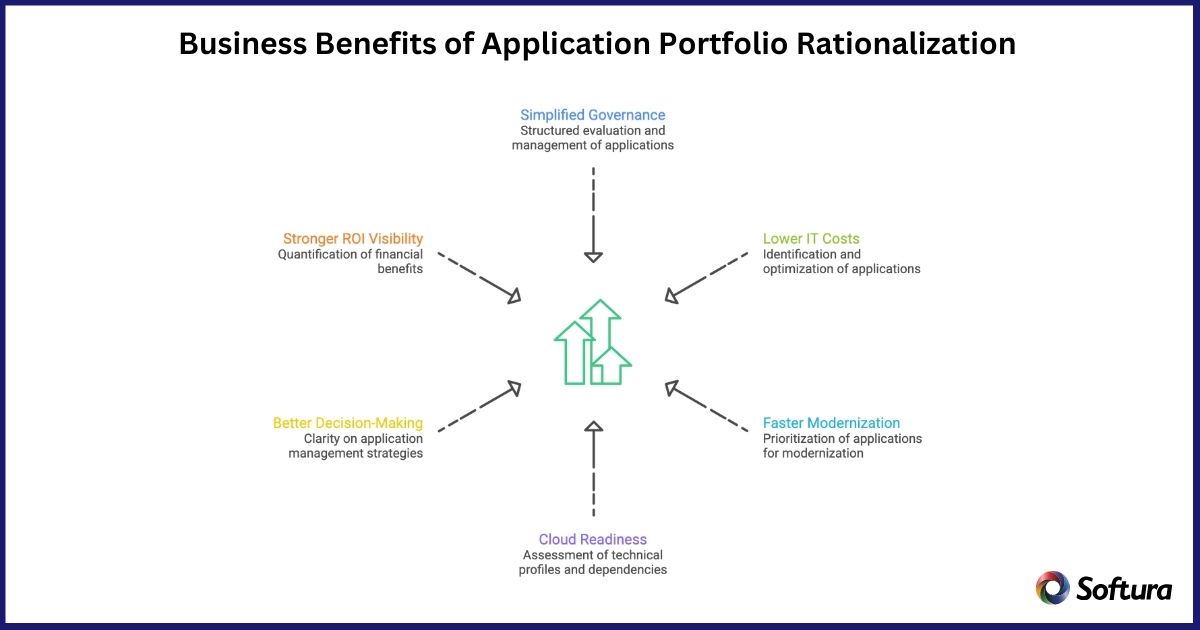
A well-planned APR effort can create measurable business impact. Softura’s APR approach focuses on outcomes that matter to enterprise leaders:
Softura’s APR page highlights that a focused rationalization effort can typically reduce application-related IT spend by 20–30%, while creating capacity for higher-value modernization investments.
That is powerful for executives because the value is not only cost reduction. The deeper value is funding clarity. When leaders know which systems deserve investment and which ones should be retired, modernization becomes easier to justify.
Many organizations already know their application portfolio is too large. The real challenge is creating a repeatable, objective way to evaluate applications and act on the findings.
Many internal APR efforts fall short because they rely on manual spreadsheets, static reports, and inconsistent evaluation methods. One group may judge an application by usage. Another may focus only on cost. Finance may look at savings, while architecture may focus on technical debt.
Without a shared decision model, the process becomes slow and subjective.
In my view, APR often fails not because teams lack data, but because they lack decision logic.
A stronger APR approach must standardize how applications are evaluated across business value, technical health, cost, risk, and strategic alignment.
Softura’s Application Portfolio Rationalization approach is built on proven 4R, 5R, and 7R models, along with custom frameworks when the enterprise needs a tailored decision structure.
These frameworks classify each application into a clear future-state recommendation. An application may be retained when it still supports business value, retired when it is obsolete or redundant, re-platformed when it needs a better technical environment, re-designed when it must support future needs, optimized for cost or performance, or consolidated to reduce duplication.
Softura’s APR approach is not a loose assessment exercise. It follows a clear, step-based process designed to produce measurable outcomes and executive-ready decisions.
Step 1: Discover and Inventory
Build a structured inventory that includes ownership, usage, dependencies, cost, and technical profile.
Step 2: Assess Business Value, Cost, and Risk
Evaluate applications across value, complexity, and strategic fit.
Step 3: Apply the Rationalization Framework
Determine whether applications should be retired, re-platformed, re-designed, retained, optimized, or consolidated.
Step 4: Validate with Stakeholders
Align decisions across IT, Finance, Architecture, and Business leadership.
Step 5: Prioritize and Sequence
Develop a roadmap based on value, risk, and readiness.
Step 6: Build the Business Case
Quantify savings, investment needs, expected ROI, payback, and modernization value.
C-level leaders need more than a technical report. They need a roadmap they can approve, fund, and execute.
One of the strongest parts of Softura’s APR offering is APR Navigator™.
APR Navigator™ is Softura’s decision intelligence platform that helps turn fragmented application data into clear, actionable insights. It supports faster and more confident portfolio decisions by aligning IT strategy with business priorities.
With APR Navigator™, organizations can evaluate applications using 4R, 5R, 7R, or custom frameworks. They can visualize priorities through dashboards and heatmaps, standardize decision logic across teams, maintain auditability through governance controls, and improve cloud migration readiness.
This matters because spreadsheets may help collect information, but they often struggle to support enterprise-scale decisions. APR Navigator™ helps leadership move from scattered data to structured action.
APR creates value across the leadership team. CIOs and CTOs gain a modernization roadmap aligned with business value. CFOs and IT finance leaders improve cost transparency and funding decisions. Digital transformation leaders move faster by reducing portfolio complexity.
M&A teams can rationalize inherited applications. Enterprise architects can standardize analysis and governance. PMO and portfolio leaders can prioritize investments with greater clarity.
Application Portfolio Rationalization does not need to begin as a long, heavy program.
Softura offers an APR Readout, a focused 3-week proof of concept for up to 100 applications. It gives organizations a practical starting point for understanding where to reduce cost, lower risk, and prioritize modernization.
The APR Readout includes disposition recommendations, cost and risk insights, and a prioritized modernization roadmap.
The goal of APR is not simply to reduce the number of applications. The real goal is to simplify governance, lower IT costs, improve cloud readiness, and create a future-ready application strategy.
Application Portfolio Rationalization gives enterprises a clearer way to make application decisions.
With Softura’s structured APR approach, APR Navigator™, and focused APR Readout, organizations can identify inefficiencies, reduce costs, and build a prioritized roadmap for modernization.
If your application landscape feels too complex, too costly, or too difficult to modernize, APR is the right place to start.
Ready to unlock value from your application portfolio? Connect with Softura’s experts to identify inefficiencies, reduce costs, and build a future-ready application strategy backed by 28+ years of proven success.