
"Our integration with the Google Nest smart thermostats through Aidoo Pro represents an unprecedented leap forward for our industry."
- Antonio Mediato, founder and CEO of Airzone.
"Our integration with the Google Nest smart thermostats through Aidoo Pro represents an unprecedented leap forward for our industry."
- Antonio Mediato, founder and CEO of Airzone.
Many organizations recognize the need for Application Portfolio Rationalization when application complexity begins to impact costs, operational efficiency, and business agility.
Over time, organizations accumulate hundreds of applications across departments, business units, and acquisitions. While some remain business-critical, others create unnecessary complexity and cost.
Common signs of application sprawl include:
Application Portfolio Rationalization (APR) helps organizations evaluate, optimize, and modernize their application landscape. The goal is not simply to reduce costs but to improve agility, strengthen governance, and create a foundation for future innovation.
"By analyzing the data from our connected lights, devices and systems, our goal is to create additional value for our customers through data-enabled services that unlock new capabilities and experiences."
- Harsh Chitale, leader of Philips Lighting’s Professional Business.
Successful APR follows a specific sequence. Organizations that start with inventory accumulation and assessment before defining business drivers often fail. The winning approach reverses this order:
Before you count a single application, you need clarity on why you're doing this. Is it cost reduction? Digital transformation? Regulatory compliance? Agility at scale? Faster time-to-market? The business driver shapes every downstream decision.
For most enterprises right now, the answer is: all of the above. But the weighting matters. A financial services firm optimizing for compliance will rationalize differently than a SaaS company prioritizing speed-to-market.
Action items:
Now gather intelligence. You need a complete, vetted inventory of every application in use, including department-owned systems and shadow IT. Most organizations discover hidden applications they didn't know existed.
For each application, score on consistent criteria:
A simple decision framework can help prioritize actions:
Don't rationalize your entire portfolio at once. Start with one business unit or application cluster. Prove the model. Refine. Then scale. A successful approach typically moves through phases, beginning with a pilot in a focused area, moving to quick-win execution, then scaling across the full portfolio while beginning modernization tracks.
This phased approach proves the business case, builds organizational confidence, and creates the budget and momentum for broader transformation.
"By analyzing the data from our connected lights, devices and systems, our goal is to create additional value for our customers through data-enabled services that unlock new capabilities and experiences."
- Harsh Chitale, leader of Philips Lighting’s Professional Business.
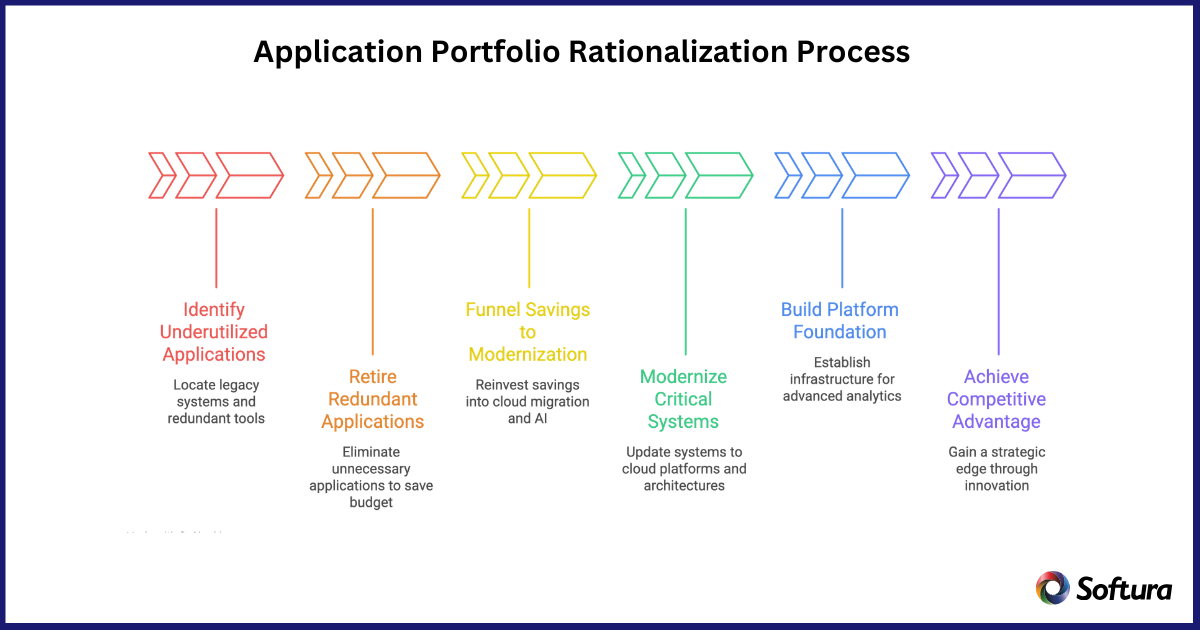
One of APR's most powerful attributes is that it funds itself. Retiring underutilized applications frees up significant budget. Organizations can save up to 20-30% of their IT budget by retiring redundant applications. Those savings don't disappear, smart organizations funnel them directly into modernization and innovation.
Quick wins typically appear early in rationalization:
The long-term play is modernization: moving critical systems to cloud, refactoring complex architectures, and building the platform foundation for advanced analytics and AI. This is where competitive advantage emerges.
When executed strategically, Application Portfolio Rationalization delivers benefits that extend beyond cost savings.
Organizations can:
The result is a leaner, more manageable application portfolio that better supports business growth and innovation.
Every failed APR initiative shares a common root cause: decisions made in a vacuum. The business side feels IT is making arbitrary choices. IT feels like they're carrying the burden alone. Applications that should have been retired get reprieves because a power user objects. Consolidation plans collapse when hidden dependencies surface.
The antidote is radical transparency:
Rationalization creates the clarity and capital. Modernization delivers the competitive advantage.
Once you've pruned the portfolio and freed up budget, the real work begins: migrating critical applications to cloud, refactoring complex architectures, integrating data pipelines, and building the API-first, cloud-native foundation that modern business demands.
The path typically unfolds in phases: first, audit and discovery to map dependencies and identify blockers. Second, establish your target architecture and cloud strategy. Third, execute parallel modernization tracks—migrate quick-win applications, pilot new platforms, and build reusable integration patterns. Fourth, scale and optimize.
The most successful modernizations combine custom development with platform consolidation. Not every legacy system needs to be rewritten. Some can migrate to cloud as-is. Others need refactoring. A few strategic systems require ground-up rebuilds. The key is tailoring the approach to each application's role and complexity.
Application Portfolio Rationalization is most successful when approached in phases. Rather than assessing the entire portfolio at once, start with a focused scope and build momentum through measurable outcomes.
Establish the primary goals for the initiative.
Common objectives include:
Develop a comprehensive view of the application landscape.
Include:
Evaluate each application based on:
Focus on applications that can deliver immediate value through:
Create a phased plan for:
Track outcomes and continuously refine the strategy.
Measure:
A phased, data-driven approach helps organizations reduce complexity, optimize technology investments, and build a stronger foundation for modernization and innovation.
Application Portfolio Rationalization is no longer just an IT optimization exercise. It is a strategic initiative that helps organizations reduce complexity, improve governance, and align technology investments with business priorities.
By taking a structured approach to evaluating, optimizing, and modernizing applications, enterprises can create a more agile, secure, and scalable technology environment.
Organizations that start today will be better positioned to accelerate modernization, support AI adoption, and drive long-term business growth.
Application Portfolio Rationalization requires more than identifying applications to retire. It demands a clear strategy, stakeholder alignment, and a roadmap that balances cost optimization with long-term business goals.
Softura helps enterprises assess application portfolios, identify rationalization opportunities, reduce technical debt, and create modernization roadmaps aligned with business priorities. From application assessment and portfolio analysis to cloud modernization and AI readiness initiatives, our experts help organizations transform complex technology environments into scalable, future-ready platforms.