
"Our integration with the Google Nest smart thermostats through Aidoo Pro represents an unprecedented leap forward for our industry."
- Antonio Mediato, founder and CEO of Airzone.
In today’s fast paced business environment, agile teams are under constant pressure to deliver faster, better, and more cost effectively. Many organizations turn to IT staff augmentation to fill skill gaps and scale quickly. But integrating new members into a Scrum team can feel like trying to fit a new gear into a moving machine. The key is to bring augmented staff into the fold from day one and make them a natural part of the agile process.
This blog explores how to achieve that, drawing insights from C level perspectives, competitor practices, and proven real world strategies.
Scrum thrives on collaboration and adaptability, but the reality is that internal teams often lack the capacity or skills to meet deadlines. IT staff augmentation solves this by providing:
CIOs and CTOs see augmented staff as more than a temporary fix. They view it as a way to align workforce flexibility with agile values. Unlike outsourcing entire projects, staff augmentation ensures control remains within the organization while adding the right expertise where it is needed most.
"Our integration with the Google Nest smart thermostats through Aidoo Pro represents an unprecedented leap forward for our industry."
- Antonio Mediato, founder and CEO of Airzone.
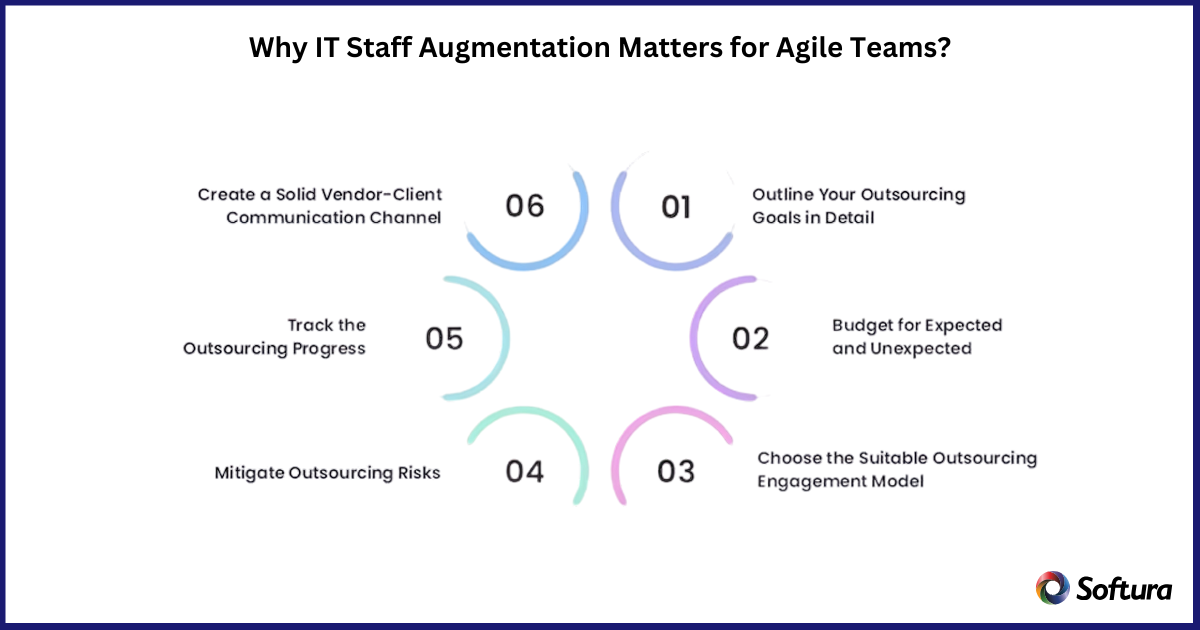
One of the most critical aspects of making IT staff augmentation work is early integration. Teams that delay involving augmented staff until midway through a sprint often face friction, rework, and misaligned expectations.
When new members are integrated from day one:
Early integration prevents the “outsider effect” and builds a sense of belonging. When augmented staff feel part of the team culture from the beginning, collaboration improves, and the team’s velocity stabilizes more quickly.
"By analyzing the data from our connected lights, devices and systems, our goal is to create additional value for our customers through data-enabled services that unlock new capabilities and experiences."
- Harsh Chitale, leader of Philips Lighting’s Professional Business.
From the first sprint:
Within the team culture:
This approach eliminates delays, builds trust, and ensures that augmented staff contribute value from the start.
Leaders emphasize that staff augmentation must align with long term goals, not just immediate project needs. This means:
CTOs often share that when augmented staff feel valued, they bring in fresh ideas and reduce innovation fatigue across the team.
Integration often fails when teams treat augmented staff as contractors rather than team members. This leads to:
The solution is to foster a one team mindset. Everyone, regardless of employment status, should share ownership of sprint outcomes.
Augmented staff bring unique advantages to Scrum practices:
Agile thrives on adaptability. Staff augmentation makes it easier for organizations to respond to changing demands without disrupting the cadence of delivery.
These strategies are not just theory. Organizations that apply them report smoother project delivery and higher retention of augmented talent.
A global software firm needed to scale its Scrum teams to meet a critical release deadline. By integrating augmented staff into sprint planning from day one, the firm avoided the common delays of late onboarding. Daily standups ensured continuous alignment, while retrospectives created space for feedback.
The result was a 25% faster release cycle without compromising quality. This approach also set the foundation for long term collaboration with the augmented staff.
The growing demand for hybrid teams suggests that IT staff augmentation will remain central to agile practices. As organizations embrace distributed and remote work, staff augmentation enables them to access talent globally while keeping agile values intact.
Future ready leaders will see augmentation not as a stopgap but as a core element of talent strategy.
Integrating augmented staff from the very first sprint ensures they are not just added resources but trusted collaborators. The difference lies in timing and approach:
The decision is not about whether to use IT staff augmentation—it’s about how you integrate it. CIOs focus on speed of value, CTOs on knowledge sharing, and boards on risk control. From day one, augmented staff should be woven into ceremonies, goals, and accountability structures, ensuring they drive outcomes, not just fill gaps.
At Softura, we’ve seen enterprises achieve the greatest benefits when integration is immediate and intentional. Success comes from treating every contributor as part of one agile unit, no matter where they come from.
Stabilize Operations with Agile Ready Talent
Shift delivery challenges into shared wins by onboarding augmented staff as core Scrum contributors from day one.