"Our integration with the Google Nest smart thermostats through Aidoo Pro represents an unprecedented leap forward for our industry."
- Antonio Mediato, founder and CEO of Airzone.
In the enterprise landscape, IT Staff Augmentation has emerged as one of the most effective models to scale engineering capacity, accelerate project timelines, and maintain control over quality. However, many organizations underestimate the governance and integration effort required to make augmented teams truly high performing.
When done right, augmented teams can reduce project turnaround by 30–40%, improve software quality metrics, and minimize rework cycles. They bring specialized skills, fill immediate gaps, and empower internal teams to focus on innovation instead of routine execution. The real challenge lies in aligning these external professionals with internal culture, tools, and workflows.
At Softura, our experience managing enterprise-scale augmentation programs shows that performance excellence starts with structured onboarding, transparent communication, and a governance framework built on measurable KPIs. Aligning augmented professionals with DORA metrics—such as deployment frequency, lead time, and mean time to restore—organizations achieve both speed and stability.
Simply put, augmented teams succeed when they are managed as an extension of your in-house culture, not as external resources.
A well-planned onboarding process is the foundation of high performance. It ensures that augmented professionals become productive contributors within days, not weeks.
Ambiguity in responsibilities leads to duplication, rework, and frustration. Before project kickoff, define every role clearly—who owns delivery, testing, and stakeholder communication. Use an onboarding matrix or discovery checklist to document responsibilities, dependencies, and communication protocols. When expectations are documented, augmented staff adapt faster and deliver with accountability.
Assigning a mentor or buddy accelerates cultural alignment and eliminates early confusion. This practice builds trust and creates psychological safety. According to governance research, companies that use a buddy system during onboarding achieve 50% faster productivity ramp-up compared to those that do not. Mentorship also ensures that tribal knowledge is shared consistently across internal and augmented members.
Preparation is critical. Ensure all credentials, software licenses, and repository access are ready before day one. Nothing demotivates new hires faster than waiting for permissions. Equipping augmented team members with everything they need—VPN access, CI/CD pipelines, Slack or Teams channels—signals that they are valued contributors and helps them start contributing code or deliverables immediately.
"Our integration with the Google Nest smart thermostats through Aidoo Pro represents an unprecedented leap forward for our industry."
- Antonio Mediato, founder and CEO of Airzone.
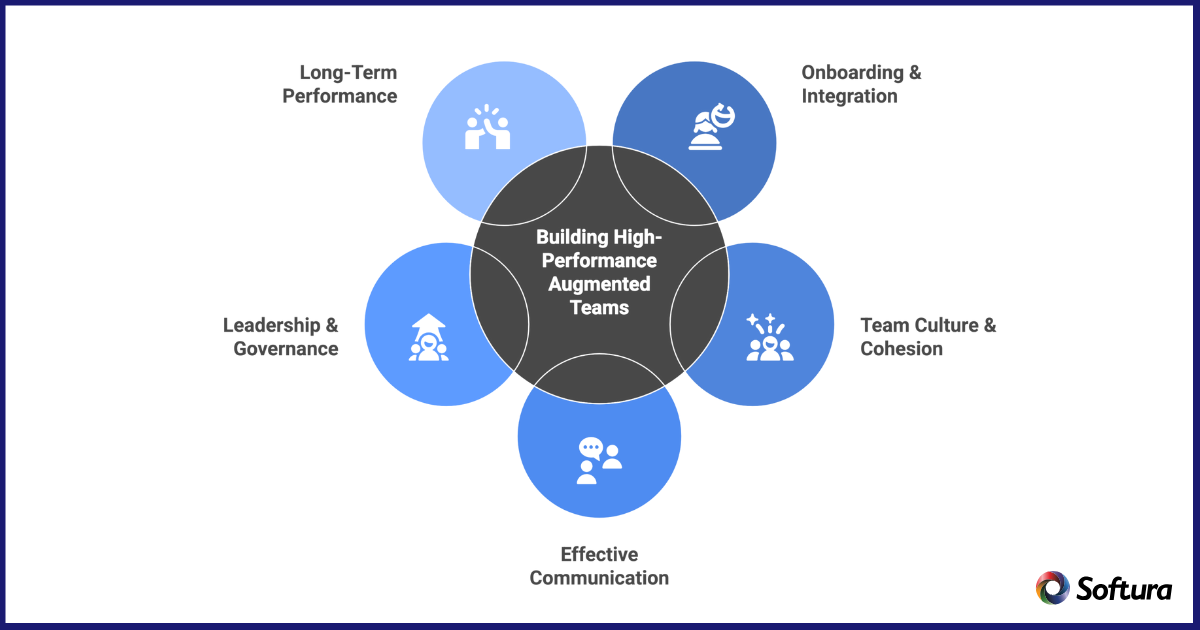
Culture is not built overnight, but it is the single most important factor that determines the long-term success of augmented teams. High-performing teams share trust, collaboration, and shared purposes.
Regular interaction drives accountability and visibility. Schedule daily stand-ups that include both internal and augmented members. Weekly sprint reviews and bi-weekly retrospectives reinforce team alignment. At Softura, we use a hybrid model: asynchronous updates in Slack for distributed teams combined with weekly live sprint demos. This balance reduces status-reporting overhead and keeps communication open across time zones.
Acknowledging contributions is key to sustaining motivation. Celebrate augmented members’ achievements—successful deployments, innovations, or bug fixes—just as you would for full-time employees. Invite them to social or virtual team events. Inclusive culture not only improves morale but also strengthens retention, reducing turnover and ensuring project stability.
When collaborating across regions, plan overlapping hours that ensure real-time interaction. Rotating meeting times shows respect for all time zones and prevents fatigue on one side. Over time, this approach leads to deeper engagement and fewer misunderstandings.
"By analyzing the data from our connected lights, devices and systems, our goal is to create additional value for our customers through data-enabled services that unlock new capabilities and experiences."
- Harsh Chitale, leader of Philips Lighting’s Professional Business.
Transparent communication is the engine of collaboration. Without it, even the most talented team members will struggle to perform consistently.
Use a shared ecosystem of tools for visibility and accountability. Platforms such as Jira, Confluence, and Microsoft Teams serve as unified sources of truth for project progress. Every augmented member should be able to see sprint goals, tickets, and blockers in real time. This transparency helps leaders track KPIs like velocity, code quality, and issue resolution rate effectively.
Transparency encourages trust. Share project roadmaps, sprint goals, and success metrics openly. When augmented staff understand the bigger business context—why deadlines matter or how a feature impacts end users—they make better decisions and take ownership of outcomes.
Language barriers and cultural differences can easily derail collaboration. Mitigate this by promoting empathy and context-sharing. Encourage team members to ask clarifying questions and share constructive feedback in retrospectives. Provide cultural training or quick primers to help everyone understand working styles and communication nuances.
Leadership is about providing clarity, not control. A strong governance framework ensures alignment without creating bottlenecks.
Every augmented engagement benefit from a clear leadership chain. Internal tech leads or project managers should act as guides who align augmented professionals with company goals and engineering standards. They ensure that coding conventions, testing practices, and documentation protocols are consistent across all contributors.
High-performing teams operate with measurable indicators. Define clear KPIs such as sprint velocity, defect density, SLA adherence, and code review turnaround time. Use DORA metrics—deployment frequency, lead time for changes, change failure rate, and mean time to restore—as quantitative measures of success. Monitoring these metrics weekly provides visibility into productivity and system reliability.
Retrospectives are not just rituals—they are the engine of continuous improvement. Encourage open discussion about what worked, what didn’t, and what needs adjustment. Include augmented staff in these sessions; their fresh perspectives often reveal hidden inefficiencies. Document improvements and assign owners to ensure accountability.
Performance sustainability requires attention beyond the initial engagement. Retention, motivation, and knowledge sharing are the cornerstones of longevity in IT Staff Augmentation programs.
Sustained motivation stems from recognition. Include augmented members in quarterly awards, performance shoutouts, and learning opportunities. When people feel valued, they invest emotionally in outcomes—even if they are not permanent employees. This human connection transforms transactional relationships into long-term partnerships.
Without a structured knowledge transfer process, organizations risk losing critical information when contracts end. Conduct final-week handover sessions that cover architecture, workflows, and decision logs. Create comprehensive documentation in shared repositories like Confluence or SharePoint. A well-documented knowledge base prevents project restarts and ensures that the next team can build upon previous progress.
Scaling too quickly can break communication and quality control. Maintain a balanced ratio between in-house and augmented members—ideally 60:40 for agile cohesion. Add team members gradually, ensuring each new hire completes onboarding before new roles are introduced. This deliberate scaling approach keeps culture intact while allowing operational flexibility.
Building a high-performing augmented team is not just about filling skill gaps—it’s about integrating people, process, and performance under a structured governance model. Success comes from deliberate design: clear onboarding, inclusive culture, continuous monitoring, and documented knowledge sharing.
At Softura, our IT Staff Augmentation framework empowers enterprises to build scalable, efficient, and resilient teams that perform consistently across borders and time zones. By combining governance maturity with agile adaptability, organizations can transform temporary staff engagements into enduring partnerships that deliver measurable business value.
Turn Staff Augmentation into a Strategic Advantage
Move beyond temporary scaling—create cohesive, agile, and performance-driven teams through Softura’s structured onboarding, culture alignment, and KPI-driven management models.