
"Our integration with the Google Nest smart thermostats through Aidoo Pro represents an unprecedented leap forward for our industry."
- Antonio Mediato, founder and CEO of Airzone.
Software development has become faster, but not always simpler. In 2026, businesses are using cloud platforms, AI tools, automation, APIs, and modern application architectures to improve speed and innovation. But as these technologies grow, so does the complexity behind them.
For many organizations, complexity in software application development is no longer just a technical challenge. It affects delivery timelines, software quality, security, customer experience, and long-term business agility. A small feature update may take weeks. A minor bug may impact multiple systems. A legacy application may block cloud adoption or AI integration. Over time, the software that was built to support growth can become the reason growth slows down.
This is why reducing software complexity must be treated as a strategic business priority. The goal is not to remove every layer of complexity. Some complexity is necessary because business operations, compliance needs, integrations, and customer expectations are naturally detailed. The real goal is to remove unnecessary complexity and build software that is easier to maintain, scale, modernize, and improve.
Complex software creates hidden costs. It increases the time required to build new features, fix issues, onboard developers, test releases, and modernize applications. For C-level leaders, the impact is seen in slower innovation, higher maintenance costs, delayed digital initiatives, and increased operational risk.
When software development complexity is not managed, organizations often face:
In simple terms, software complexity reduces business speed. If a company cannot change its software quickly and safely, it becomes harder to respond to market needs, customer expectations, and new technology opportunities.
"Our integration with the Google Nest smart thermostats through Aidoo Pro represents an unprecedented leap forward for our industry."
- Antonio Mediato, founder and CEO of Airzone.
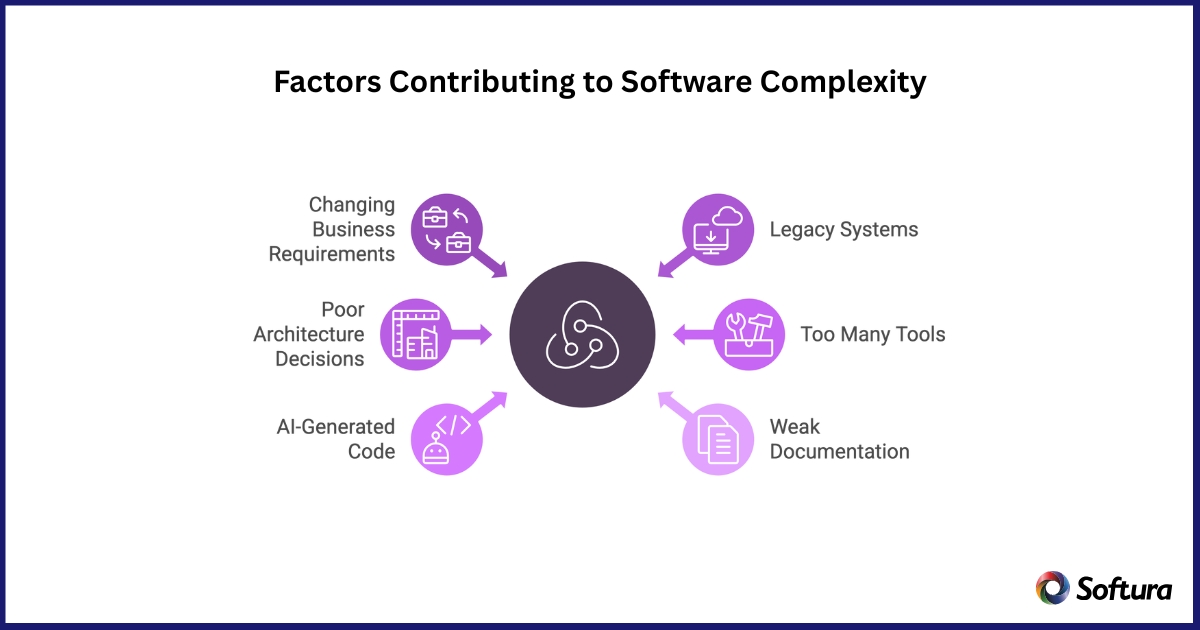
Software complexity usually builds over time. It rarely comes from one decision. It happens when business priorities change, systems grow, tools multiply, and teams keep adding new functionality without simplifying the foundation.
Some of the most common causes include:
"By analyzing the data from our connected lights, devices and systems, our goal is to create additional value for our customers through data-enabled services that unlock new capabilities and experiences."
- Harsh Chitale, leader of Philips Lighting’s Professional Business.
The first step to reducing complexity in software development is business clarity. Before starting a new application or modernizing an existing one, leaders should define the purpose of the software, the users it supports, the outcomes it must deliver, and the features that are truly necessary.
This avoids overengineering, where teams build more than the business actually needs. A useful question for every project is: “What is the simplest solution that can solve this business problem and still support future growth?”
Clear priorities help teams decide:
When business goals are clear, technology decisions become more focused and software becomes easier to manage.
"By analyzing the data from our connected lights, devices and systems, our goal is to create additional value for our customers through data-enabled services that unlock new capabilities and experiences."
- Harsh Chitale, leader of Philips Lighting’s Professional Business.
Simple design does not mean basic software. It means the application is structured in a way that teams can understand, maintain, and improve over time.
A simple design removes unnecessary features, avoids duplicate logic, and keeps workflows easy to follow. It also helps teams prevent unnecessary customization that may create long-term maintenance challenges.
To reduce complexity, teams should review every major feature and ask:
This approach helps organizations build software that is practical, scalable, and easier to support.
"By analyzing the data from our connected lights, devices and systems, our goal is to create additional value for our customers through data-enabled services that unlock new capabilities and experiences."
- Harsh Chitale, leader of Philips Lighting’s Professional Business.
Modular architecture is one of the most effective ways to reduce software development complexity. It divides an application into smaller, well-defined parts, where each part performs a specific function.
For business leaders, the value is clear. If one part of the system needs to change, the entire application does not need to be rebuilt. This improves flexibility, reduces risk, and makes future modernization easier.
Microservices can also help when teams need independent services that can be developed, deployed, or scaled separately. However, microservices should be used carefully. Without strong DevOps practices, monitoring, API governance, and team ownership, microservices can create more complexity instead of reducing it.
For many businesses, the best approach is not always a full move to microservices. A well-planned modular architecture can often provide the right balance between simplicity, scalability, and control.
"By analyzing the data from our connected lights, devices and systems, our goal is to create additional value for our customers through data-enabled services that unlock new capabilities and experiences."
- Harsh Chitale, leader of Philips Lighting’s Professional Business.
Legacy systems are one of the biggest sources of software complexity. Many older applications still support critical business operations, but they were not designed for today’s cloud, AI, security, and integration needs.
Replacing a legacy system all at once can be risky and expensive. A better approach is gradual modernization. This allows the business to improve systems step by step without disrupting daily operations.
Common modernization actions include:
This approach helps businesses reduce risk while improving long-term agility.
"By analyzing the data from our connected lights, devices and systems, our goal is to create additional value for our customers through data-enabled services that unlock new capabilities and experiences."
- Harsh Chitale, leader of Philips Lighting’s Professional Business.
Manual testing, manual deployment, and late-stage security reviews increase complexity. Automation helps teams find issues earlier and release software with more confidence.
Continuous integration and continuous deployment, often called CI/CD, allow teams to test and prepare code for release through automated pipelines. This reduces human error, improves quality, and shortens release cycles.
DevSecOps adds security into every stage of software development instead of treating it as a final step. This helps teams identify vulnerabilities earlier, protect sensitive data, and reduce expensive rework before launch.
For executives, automation and DevSecOps provide three major benefits:
"By analyzing the data from our connected lights, devices and systems, our goal is to create additional value for our customers through data-enabled services that unlock new capabilities and experiences."
- Harsh Chitale, leader of Philips Lighting’s Professional Business.
Technical debt is the future cost of shortcuts taken today. It can come from rushed development, outdated frameworks, weak testing, poor documentation, or temporary fixes that become permanent.
In 2026, AI-generated code adds a new layer to technical debt. AI can help developers write code faster, create tests, summarize documentation, and identify improvement areas. But if AI-generated code is accepted without review, it can create systems that teams do not fully understand.
To reduce this risk, organizations should create clear governance for AI-assisted development. Teams should define how AI tools can be used, how generated code will be reviewed, how security checks will be completed, and how documentation will be maintained.
AI should improve productivity, not create hidden complexity.
"By analyzing the data from our connected lights, devices and systems, our goal is to create additional value for our customers through data-enabled services that unlock new capabilities and experiences."
- Harsh Chitale, leader of Philips Lighting’s Professional Business.
Organizations can reduce complexity by following a simple framework:
This framework helps prospects move from problem awareness to practical action.
"By analyzing the data from our connected lights, devices and systems, our goal is to create additional value for our customers through data-enabled services that unlock new capabilities and experiences."
- Harsh Chitale, leader of Philips Lighting’s Professional Business.
Complexity in software application development will continue to grow with AI, cloud platforms, automation, and connected systems. But with clear business goals, modular architecture, modernization, automation, DevSecOps, and responsible AI governance, organizations can build software that is easier to maintain, scale, and improve.
Softura helps businesses reduce software complexity through custom software development, application modernization, cloud-enabled architecture, and scalable engineering support.
Ready to simplify your software application development journey? Talk to a Softura expert today.
"By analyzing the data from our connected lights, devices and systems, our goal is to create additional value for our customers through data-enabled services that unlock new capabilities and experiences."
- Harsh Chitale, leader of Philips Lighting’s Professional Business.
Are you ready to simplify your next software project?
Reduce complexity in software application development with a clear modernization strategy, scalable architecture, automation, and expert engineering support. Softura helps businesses build and improve applications that are easier to maintain, secure, and scale.