"Our integration with the Google Nest smart thermostats through Aidoo Pro represents an unprecedented leap forward for our industry."
- Antonio Mediato, founder and CEO of Airzone.
"Our integration with the Google Nest smart thermostats through Aidoo Pro represents an unprecedented leap forward for our industry."
- Antonio Mediato, founder and CEO of Airzone.
Custom software development services for legacy modernization help organizations upgrade aging applications and software systems without disrupting critical business operations. Instead of replacing existing systems entirely, these services modernize underlying technologies, improve performance, and extend application lifespan while preserving valuable business logic and workflows.
Legacy modernization through custom software development services typically includes:
This approach enables organizations to reduce technical debt, improve scalability, strengthen security, and accelerate innovation while minimizing operational risk.
"By analyzing the data from our connected lights, devices and systems, our goal is to create additional value for our customers through data-enabled services that unlock new capabilities and experiences."
- Harsh Chitale, leader of Philips Lighting’s Professional Business.
Off-the-shelf (COTS) software can be effective for standardized business processes. However, organizations with complex workflows, legacy systems, regulatory requirements, or unique business models often require a more flexible approach. legacy modernization services enable enterprises to modernize existing systems while preserving critical business logic, reducing disruption, and supporting long-term growth.
"By analyzing the data from our connected lights, devices and systems, our goal is to create additional value for our customers through data-enabled services that unlock new capabilities and experiences."
- Harsh Chitale, leader of Philips Lighting’s Professional Business.
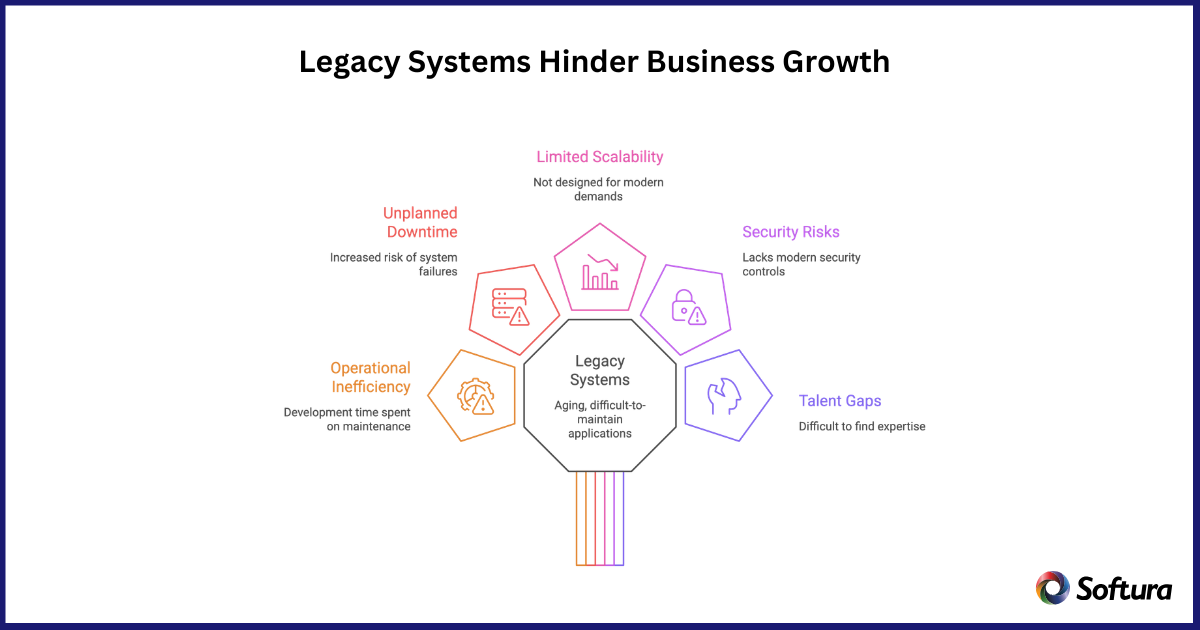
Legacy systems often create hidden costs that impact productivity, innovation, and long-term business growth. While they may continue to support day-to-day operations, aging applications can become increasingly expensive and difficult to maintain over time.
Development teams spend significant time maintaining outdated systems instead of building new capabilities that support business growth and innovation.
Aging infrastructure and unsupported technologies increase the risk of system failures, service disruptions, and productivity losses.
Legacy applications were not designed for modern data volumes, user demands, cloud environments, or API-driven integrations, making growth more difficult and costly.
Older systems may lack modern security controls, making it harder to meet evolving compliance requirements and protect sensitive business data.
Finding professionals with expertise in legacy technologies becomes increasingly difficult, creating long-term maintenance and support challenges.
Legacy modernization helps organizations reduce technical debt, improve operational efficiency, strengthen security, and create a foundation for future innovation. By shifting resources from maintenance to strategic initiatives, businesses can accelerate digital transformation and respond more effectively to changing market demands.
Many organizations underestimate the true cost of legacy systems because expenses are often spread across multiple teams, processes, and budgets. Beyond maintenance costs, legacy applications can impact productivity, innovation, scalability, security, and business agility.
As maintenance demands increase, organizations often have fewer resources available for innovation, digital transformation, and strategic growth initiatives. Legacy modernization helps reduce technical debt and create a stronger foundation for future business needs.
Organizations evaluating legacy modernization often face a critical decision: modernize existing systems through application modernization services or replace them with a commercial off-the-shelf (COTS) solution.
When COTS Solutions Make Sense
COTS solutions may be a good fit when:
Custom software development services are often the preferred choice when organizations need to:
Unlike a complete system replacement, custom modernization allows organizations to retain valuable business logic while upgrading architecture, improving performance, and reducing technical debt.
Successful legacy modernization rarely happens through a complete "rip-and-replace" initiative. Instead, many organizations adopt an incremental modernization strategy that reduces risk and minimizes operational disruption.
Evaluate existing applications, identify dependencies, assess technical debt, and define a modernization roadmap aligned with business objectives.
Modernize applications in phases, prioritizing high-impact modules and validating performance throughout the transition process.
Enhance system performance, improve scalability, strengthen security, and continue evolving applications to support future business requirements.
Benefits of an Incremental Modernization Approach
Legacy environments often require organizations to dedicate a significant portion of IT resources to maintaining aging applications, managing technical debt, and resolving operational issues. As modernization progresses, resources can be redirected toward innovation, customer experience improvements, and strategic business initiatives.
Business Benefits of Modernization
By reducing the burden of legacy maintenance, organizations can allocate more resources to digital transformation initiatives that drive growth, operational efficiency, and competitive advantage.
Many organizations have shifted away from large-scale "rip-and-replace" modernization initiatives in favor of an incremental approach. Modernizing applications in phases helps reduce risk, maintain operational continuity, and deliver value throughout the transformation process.
Incremental modernization enables organizations to modernize critical applications while maintaining operational stability.
Successful legacy modernization initiatives should deliver measurable business outcomes. To evaluate the impact of modernization efforts, organizations should track key performance indicators across operational efficiency, cost optimization, business agility, and risk reduction.
Measure how quickly development teams can deliver new features, enhancements, and business capabilities after modernization.
Track the time required to launch new products, services, or application enhancements.
Evaluate reductions in manual processes, duplicate work, and operational bottlenecks through automation and system integration.
Monitor changes in the resources required to maintain and support legacy applications and infrastructure.
Assess improvements in scalability, resource utilization, and cloud adoption.
Track reductions in support tickets, system incidents, and unplanned downtime.
Business Capability Metrics
Measure the speed and ease of connecting applications, data sources, and third-party systems.
Evaluate the organization's ability to support business growth, increasing user demands, and evolving technology requirements.
Track how modernization supports new business initiatives, digital products, and customer experiences.
Measure application availability, performance, and service continuity.
Track improvements in security posture, compliance readiness, and audit outcomes.
Talent Retention
Assess the organization's ability to attract and retain skilled professionals by reducing reliance on outdated technologies.
By measuring outcomes across efficiency, cost, business capability, and risk, organizations can build a clearer business case for modernization and demonstrate the long-term value of their technology investments.
Legacy modernization is not a one-time technology initiative. It is a long-term investment that improves operational efficiency, strengthens security, reduces technical debt, and creates a foundation for future innovation. Organizations that modernize strategically can unlock greater business agility while reducing the risks associated with aging systems.
Selecting the right custom software development partner is critical to the success of any legacy modernization initiative. During vendor evaluations, consider asking the following questions to assess experience, risk management capabilities, and long-term support commitments.
Organizations should look for partners with proven modernization experience, strong governance processes, industry expertise, and a structured approach to risk management and long-term support.
Softura helps organizations modernize legacy applications through a structured, risk-managed approach that prioritizes business continuity and long-term value. Our teams work closely with stakeholders to assess existing systems, identify modernization opportunities, and create phased roadmaps aligned with business objectives.
By combining application modernization expertise, cloud-native architectures, agile delivery methodologies, and deep industry experience, we help organizations reduce technical debt, improve operational efficiency, and accelerate innovation while minimizing disruption to ongoing operations.
Legacy modernization is no longer just a technology initiative—it is a business strategy that enables organizations to improve operational efficiency, reduce technical debt, strengthen security, and support future growth. Custom software development services provide a structured approach to modernization by helping organizations preserve critical business processes while upgrading the underlying technology. Rather than relying on disruptive system replacements, enterprises can modernize incrementally, reduce risk, and realize value throughout the transformation journey.
Organizations that succeed with legacy modernization typically focus on three priorities:
As business demands continue to evolve, modernizing legacy systems can help organizations improve agility, accelerate innovation, and build a stronger foundation for long-term success.
Ready to Evaluate Your Legacy Modernization Strategy?
Discover how a structured modernization approach can help your organization reduce risk, improve efficiency, and support future growth.
Custom software development services for legacy modernization help organizations upgrade aging applications, infrastructure, and technology platforms while preserving critical business processes and functionality. The goal is to improve performance, scalability, security, and maintainability without disrupting business operations.
Custom software development creates applications tailored to an organization's unique business requirements, workflows, and integrations. Commercial off-the-shelf solutions provide standardized functionality designed for a broad audience and often require organizations to adapt their processes to fit the software.
Organizations modernize legacy systems to reduce technical debt, improve operational efficiency, strengthen security, support business growth, enhance user experiences, and enable faster innovation. Modernization also helps organizations meet evolving compliance and integration requirements.
An incremental modernization approach is often considered the lowest-risk strategy. Rather than replacing an entire system at once, organizations modernize applications in phases, allowing them to validate outcomes, reduce disruption, and maintain business continuity throughout the process.
Project timelines vary based on application complexity, integrations, data requirements, and business objectives. Many organizations adopt a phased modernization strategy that delivers value incrementally while reducing implementation risk.
Common metrics include development velocity, time-to-market, operational efficiency, infrastructure costs, application reliability, security improvements, scalability, and reductions in technical debt. Measuring these outcomes helps organizations evaluate the business impact of modernization efforts.
Common risks include data migration challenges, integration complexities, business disruption, scope expansion, and inadequate change management. These risks can be reduced through careful planning, phased implementation, testing, and strong governance practices.
Organizations should look for proven modernization experience, industry expertise, a structured delivery methodology, strong risk management practices, and long-term support capabilities. Reviewing case studies, client references, and modernization approaches can help evaluate potential partners.