
"Our integration with the Google Nest smart thermostats through Aidoo Pro represents an unprecedented leap forward for our industry."
- Antonio Mediato, founder and CEO of Airzone.
Technology and time wait for no one. Businesses must evolve their systems and processes to stay competitive, but making the leap to a new technology stack is rarely transparent. These transitions are often compared to rebuilding a house while still living in it, the operations must continue even as critical foundations are replaced.
A dedicated software development team can help organizations navigate this complexity with precision and minimize risks. At the same time, they accelerate progress by ensuring that transitions are handled efficiently and with long-term stability in mind.
In this blog, we will explore why these transitions are so complex, the unique value that dedicated teams bring to the process, the business benefits they create, and the best practices that ensure success.
A technology stack transition involves replacing or upgrading the core tools and frameworks a business relies on—whether it’s moving to the cloud, shifting to microservices, introducing new databases, or modernizing front-end frameworks.
Common challenges include:
Without the right planning and execution, these transitions can stall or fail which costs both time and opportunity.
"Our integration with the Google Nest smart thermostats through Aidoo Pro represents an unprecedented leap forward for our industry."
- Antonio Mediato, founder and CEO of Airzone.
A dedicated software development team works as an extension of your organization, focused entirely on delivering the transition smoothly. Unlike traditional outsourcing, this model offers both exclusivity and alignment with business priorities.
Here’s how they manage complexity effectively:
The team begins with a detailed audit of current systems—identifying dependencies, risks, and opportunities. From there, they build a clear roadmap that balances innovation with operational continuity.
Rather than switching everything at once, dedicated teams often use a phased approach—transitioning services step by step. This reduces risk, limits downtime, and allows lessons learned in early phases to inform later ones.
Experienced in multiple platforms and frameworks, these teams ensure that new technologies integrate seamlessly into existing processes, avoiding unnecessary disruption.
Security is built into the process, from encrypted data transfers to ongoing vulnerability assessments. Compliance requirements are monitored closely to ensure transitions meet industry standards.
Working as part of your ecosystem, the team maintains ongoing communication through regular updates, checkpoints, and progress reviews—ensuring alignment at every stage.
Even after migration, the work continues. Dedicated teams provide performance tuning, monitoring, and long-term support to ensure the new stack delivers maximum value.
"By analyzing the data from our connected lights, devices and systems, our goal is to create additional value for our customers through data-enabled services that unlock new capabilities and experiences."
- Harsh Chitale, leader of Philips Lighting’s Professional Business.
Transition Your Tech Stack with Confidence
Partner with Softura’s dedicated software development teams to ensure seamless migrations, zero downtime, and long-term stability.
Relying on a dedicated software development team for stack transitions creates measurable advantages:
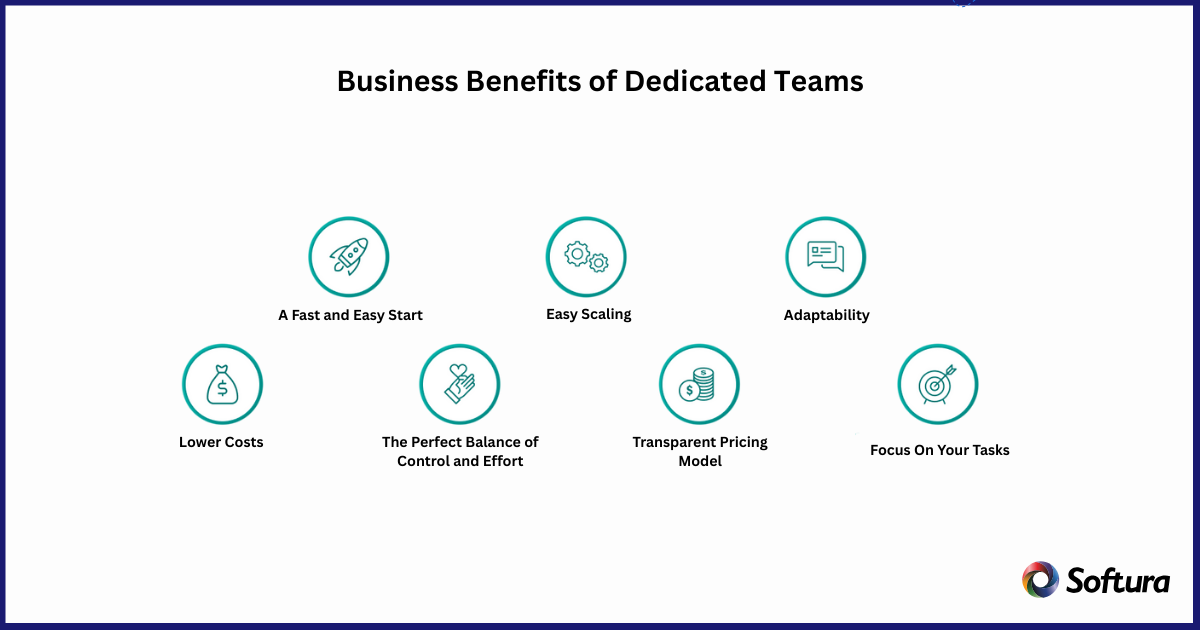
Dedicated teams follow established practices to ensure smooth outcomes:
As technology cycles continue to shorten, organizations will find themselves managing more frequent and more challenging transitions than ever before. Emerging innovations such as artificial intelligence (AI), machine learning, low-code development platforms, edge computing, and advanced cloud-native architectures are swiftly changing the digital landscape. What was once considered a once-in-a-decade system overhaul is now becoming an ongoing responsibility that requires continuous adaptation and reinvention.
These shifts are not just mere options. Companies that fail to evolve risk falling behind competitors who embrace modern frameworks, scalable infrastructure, and smarter automation tools. Yet with increased frequency comes increased pressure: leaders must balance stability with innovation, ensuring that critical operations remain unaffected while new capabilities are introduced. This delicate balancing act can overwhelm internal teams that are already managing day-to-day business demands.
A dedicated software development team addresses this challenge by serving as a constant, reliable partner for modernization efforts. With a flexible structure, the team can quickly scale to meet the pace of change, introducing specialized knowledge where needed and guiding transitions from planning through optimization. They provide focus by working exclusively on modernization initiatives, ensuring that deadlines are met and risks are controlled. Just as importantly, they preserve business continuity by embedding best practices in security, compliance, and integration at every stage.
Looking ahead, the ability to manage quick, repeated transitions will become a defining competitive advantage. Organizations that embrace dedicated teams will be better positioned to leverage emerging technologies confidently, innovate faster, and maintain operational resilience without sacrificing stability.
Managing a complex tech stack transition requires more than technical know-how—it demands structured planning, risk management, and sustained support. A dedicated software development team offers all of these in one integrated model, helping organizations modernize efficiently while safeguarding business continuity.
By combining strategic oversight with technical execution, dedicated teams turn what could be disruptive shifts into opportunities for long-term growth.
Accelerate Complex Transitions Without Disruption
Leverage specialized expertise and flexible dedicated teams to modernize faster, integrate smarter, and scale confidently.