"Our integration with the Google Nest smart thermostats through Aidoo Pro represents an unprecedented leap forward for our industry."
- Antonio Mediato, founder and CEO of Airzone.
"Our integration with the Google Nest smart thermostats through Aidoo Pro represents an unprecedented leap forward for our industry."
- Antonio Mediato, founder and CEO of Airzone.
Legacy software costs far more than maintenance alone. Beyond licensing and support, enterprises incur expenses from security risks, downtime, compliance efforts, manual processes, and reduced productivity. These hidden costs often consume 60–80% of IT budgets, leaving less investment for innovation and digital transformation.
The true cost of legacy software isn't limited to IT spending. It impacts business agility, security, employee productivity, and long-term competitiveness. Modernizing critical applications enables organizations to reduce operational costs while accelerating digital transformation.
"By analyzing the data from our connected lights, devices and systems, our goal is to create additional value for our customers through data-enabled services that unlock new capabilities and experiences."
- Harsh Chitale, leader of Philips Lighting’s Professional Business.
Legacy systems increase cybersecurity risk because they often rely on outdated software, unsupported operating systems, and unpatched applications. These vulnerabilities create opportunities for cybercriminals to exploit known security gaps, leading to data breaches, operational disruption, regulatory scrutiny, and reputational damage. As cyber threats continue to evolve, aging applications become increasingly difficult to secure and maintain.
Organizations operating legacy systems may experience:
In early 2024, attackers exploited a legacy test environment within Microsoft's infrastructure to gain unauthorized access to executive, legal, and cybersecurity email accounts. The incident demonstrated that even highly mature organizations can be exposed when outdated systems or accounts are not properly secured.
"By analyzing the data from our connected lights, devices and systems, our goal is to create additional value for our customers through data-enabled services that unlock new capabilities and experiences."
- Harsh Chitale, leader of Philips Lighting’s Professional Business.
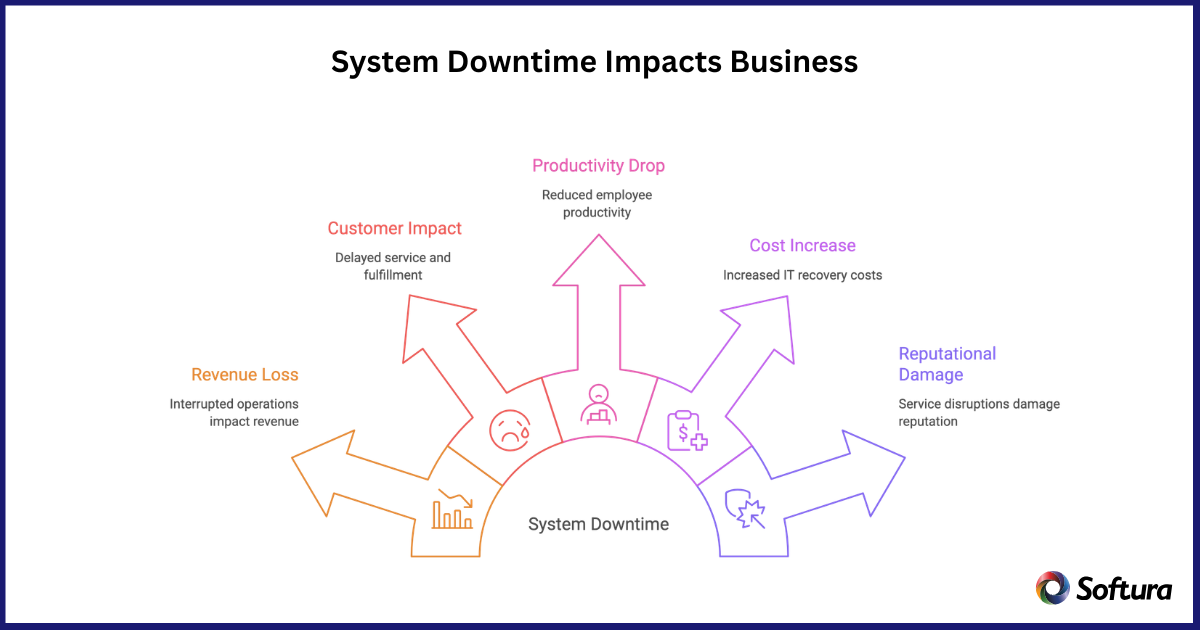
System downtime doesn't just interrupt operations—it impacts revenue, customer experience, and employee productivity. Legacy applications are more susceptible to outages because they rely on aging infrastructure, outdated technologies, and manual recovery processes. As systems become more complex and difficult to maintain, even minor failures can escalate into prolonged business disruptions.
One well-known example is the Maersk cyberattack in 2017. The attack disrupted operations across its global shipping network, forcing the company to rebuild thousands of systems and resulting in an estimated $300 million in recovery costs and operational losses.
Organizations running modern, cloud-native applications can often recover quickly through automated failover, redundancy, and disaster recovery capabilities. Legacy systems rarely offer the same level of resilience, making every outage longer, more disruptive, and more expensive.
Maintaining legacy systems has become increasingly challenging as the professionals who built and supported them retire. Many older applications rely on programming languages, platforms, and architectures that are no longer widely taught or used, making it difficult for organizations to find skilled developers and transfer critical system knowledge.
Legacy software reduces productivity by forcing employees to spend more time navigating outdated systems, completing manual tasks, and working around technical limitations. Instead of focusing on innovation and customer value, teams often spend valuable time maintaining inefficient processes and resolving recurring system issues.
Productivity challenges extend beyond IT teams. Business users often experience slower workflows, duplicate data entry, and limited visibility across systems, making it harder to respond quickly to customer needs and changing market conditions.
Legacy systems were designed to operate independently, making it difficult to integrate with modern cloud platforms, enterprise applications, analytics solutions, and AI technologies. As a result, organizations often struggle with data silos, fragmented workflows, and inconsistent information across business functions.
Disconnected systems prevent finance, operations, and leadership teams from accessing real-time data. Without a unified view of business performance, planning, forecasting, and decision-making become slower and less accurate.
When customer, inventory, and operational data are spread across multiple systems, sales and service teams lack the information they need to deliver timely, personalized experiences.
Employees spend valuable time reconciling data, switching between applications, and performing duplicate data entry. These manual processes increase operational costs and reduce overall productivity.
Artificial intelligence and advanced analytics depend on clean, connected, and accessible data. Data silos limit an organization's ability to generate meaningful insights, automate processes, and scale AI initiatives.
Many organizations rely on temporary fixes such as custom integrations, manual data transfers, and disconnected workflows to keep legacy systems operational. While these workarounds address immediate challenges, they also increase operational complexity and slow digital transformation.
Modern application modernization and custom software development help eliminate data silos, improve interoperability, and create a connected technology ecosystem that supports real-time insights, automation, and AI-driven innovation.
Legacy software may seem reliable because it's familiar, but familiarity doesn't equal sustainability. As applications age, technical debt grows, security risks increase, maintenance becomes more complex, and innovation slows. Over time, these challenges make it harder for organizations to adapt to changing customer expectations and market demands.
Today's leading enterprises are taking a different approach. Instead of treating modernization as an IT expense, they're viewing custom software development as a long-term investment that improves agility, strengthens resilience, and supports business growth.
Modernizing legacy software doesn't require replacing every application at once. A phased, strategic approach helps organizations reduce risk, deliver value faster, and minimize business disruption.
Identify legacy applications, evaluate maintenance costs, security risks, business criticality, and integration challenges to determine where modernization will deliver the greatest value.
Focus on applications that have the greatest impact on business operations, customer experience, compliance, and long-term growth.
Modernize one application or business capability at a time. A phased approach enables organizations to validate outcomes, reduce implementation risk, and build momentum for future initiatives.
Choose a technology partner with proven expertise in application modernization, enterprise integration, cloud transformation, and custom software development to ensure successful delivery and long-term scalability.
Legacy software should not hold your business back. Whether you want to reduce technical debt, improve operational efficiency, strengthen security, or prepare for AI-driven innovation, a well-planned modernization strategy can help you achieve measurable business outcomes with minimal disruption.
With 28+ years of enterprise technology experience, 600+ global engineering professionals, and 2,500+ successful enterprise engagements, Softura helps organizations modernize legacy applications through tailored Custom Software Development Services and application modernization solutions. Our experts assess your existing technology landscape, identify modernization opportunities, and develop a practical roadmap aligned with your business goals.
Ready to transform your legacy systems into a competitive advantage?
Contact Softura today to schedule a strategic application modernization consultation.
The timeline depends on factors such as application complexity, business requirements, and the modernization approach. Many organizations adopt a phased strategy, modernizing high-priority applications first to deliver business value while minimizing operational disruption.
No. A phased modernization approach is typically the most effective. Organizations can modernize critical applications incrementally while keeping existing systems operational, reducing risk and ensuring business continuity throughout the transition.
Custom software development enables organizations to replace or enhance legacy applications with solutions tailored to their business needs. Benefits include improved scalability, stronger security, better system integration, enhanced user experiences, and a technology foundation that supports cloud, AI, and future innovation.
Success can be measured through improvements in operational efficiency, application performance, security, user experience, system reliability, and the ability to deliver new business capabilities faster. Organizations should also evaluate reductions in maintenance effort and improvements in business agility.
A well-planned modernization strategy incorporates security throughout the project lifecycle. This includes data assessment, secure migration, validation, compliance alignment, access controls, and comprehensive testing to protect business-critical information and minimize risk during implementation.