
"Our integration with the Google Nest smart thermostats through Aidoo Pro represents an unprecedented leap forward for our industry."
- Antonio Mediato, founder and CEO of Airzone.
Why do some IT Staff Augmentation partnerships thrive while others stall? The answer often lies in one key factor, the contract model. Today, businesses use IT Staff Augmentation to scale fast, fill critical skill gaps, and accelerate delivery without adding full-time hires.
Yet, many overlook how the contract model—defining scope, accountability, and risk—determines whether the engagement succeeds or struggles.
A clear engagement structure drives collaboration, transparency, and trust. Without it, even experienced teams' risk scope creep and cost overruns. At Softura, we’ve seen how aligning the right contract model with project needs ensures smoother execution, better communication, and faster results. Let’s explore the main IT Staff Augmentation models—Time & Materials (T&M), Fixed-Price, Dedicated Team, Build-Operate-Transfer (BOT), and Contract-to-Hire—and when to use each.
Under the Time & Materials (T&M) approach, the client pays for the actual time spent and resources used. Rates are pre-agreed (hourly, daily, or monthly), and billing occurs based on verified work logs. It’s the preferred model for Agile environments, where scope may evolve with each sprint or feedback cycle.
T&M is ideal for R&D projects, iterative product builds, modernization initiatives, and MVPs. It allows for learning and pivoting during development. To protect against budget risk, include a Not-to-Exceed (NTE) clause—this creates financial boundaries while maintaining flexibility.
Expert Insight: At Softura, we recommend weekly progress and spend reviews in T&M contracts. This helps clients maintain accountability while enabling agility.
"Our integration with the Google Nest smart thermostats through Aidoo Pro represents an unprecedented leap forward for our industry."
- Antonio Mediato, founder and CEO of Airzone.
In a Fixed-Price contract, the scope, timeline, and budget are defined in advance. Vendors agree to deliver specific outcomes for a predetermined cost, usually broken down into milestones. Any scope changes trigger a change order and new pricing discussion.
This model fits short-term, well-scoped engagements such as feature upgrades, UX redesigns, or pilot modules. However, it’s less suitable for large or evolving projects typical in staff augmentation, where deliverables change over time.
Softura Observation: We’ve found Fixed-Price models work best when preceded by a paid discovery phase—a short T&M engagement to define scope, followed by fixed delivery.
"By analyzing the data from our connected lights, devices and systems, our goal is to create additional value for our customers through data-enabled services that unlock new capabilities and experiences."
- Harsh Chitale, leader of Philips Lighting’s Professional Business.
A Dedicated Team model gives clients direct control over a remote team that works exclusively for them. The vendor handles hiring, HR, payroll, and infrastructure while the client manages day-to-day priorities.
Best suited for enterprise transformation, SaaS development, and continuous product evolution. The model fosters ownership, shared vision, and ongoing innovation.
The BOT model allows a vendor to establish and manage an offshore or nearshore development center on behalf of the client. After a predefined period—typically 12–36 months—the vendor transfers full ownership, including staff, infrastructure, and IP rights.
Commonly adopted by enterprises expanding internationally or those establishing a permanent offshore base without upfront investment. It blends the flexibility of outsourcing with the permanence of internal operations.
In a Contract-to-Hire setup, companies onboard professionals via an augmentation contract with the potential for full-time conversion after a performance review period.
Best for key technical roles or leadership positions where finding the right fit matters more than filling the role fast.
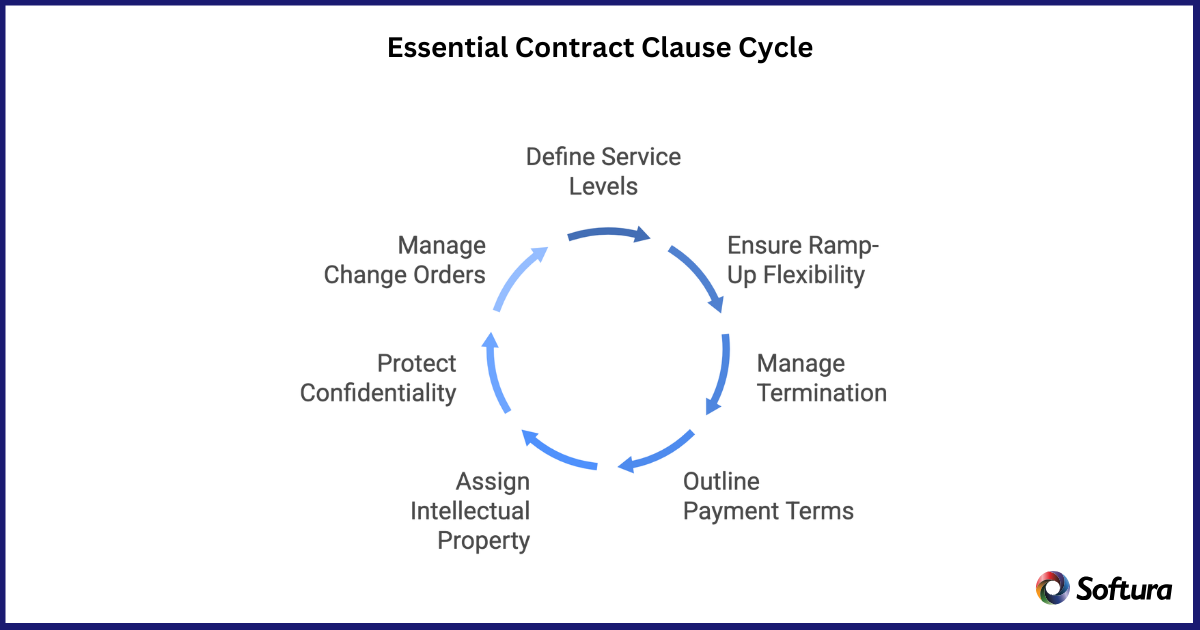
Regardless of which model you select, your contract should include these non-negotiable elements:
Pro Tip from Softura: Detailed Statements of Work (SOWs) reduce disputes by up to 40%. Pair your SOW with a Master Service Agreement (MSA) to establish governance and streamline future projects.
If your scope is defined and unlikely to change, go for a Fixed-Price. For evolving or exploratory projects, T&M offers more flexibility.
Organizations with strong internal PMs thrive with T&M or Dedicated Teams. If management bandwidth is limited, consider vendor-led or outcome-based contracts.
If you have a strict budget cap, Fixed-Price or capped T&M are ideal. If innovation and adaptability are key, Dedicated or hybrid models deliver better value.
Your engagement type should complement your long-term roadmap. For example, product companies may benefit from Dedicated Teams, while enterprises modernizing systems may prefer T&M flexibility.
Selecting the right contract model is more than a procurement exercise—it’s a strategic decision that impacts speed, innovation, and financial performance. The right model balances clarity, flexibility, and control, empowering organizations to maximize the value of external talent.
At Softura, we guide our clients through this decision process with a focus on transparency, measurable outcomes, and partnership integrity. Whether you choose T&M, Fixed-Price, Dedicated Team, BOT, or Contract-to-Hire, our structured approach ensures that every engagement is designed for performance and long-term success.
A well-structured contract doesn’t just govern your IT engagement—it safeguards your investment, accelerates innovation, and sets the foundation for scalable digital growth.
Align Cost, Control, and Collaboration the Smart Way
Simplify your decision-making with Softura’s proven frameworks for building agile, outcome-driven IT Staff Augmentation partnerships—backed by transparency, accountability, and measurable ROI.