
"Our integration with the Google Nest smart thermostats through Aidoo Pro represents an unprecedented leap forward for our industry."
- Antonio Mediato, founder and CEO of Airzone.
Across industries, executive technology discussions increasingly focus on modernization. Boards expect faster innovation. Business teams want digital tools that support real time decision making. Customers expect seamless digital experiences.
Legacy systems were not built for this environment.
Many older applications operate in isolated environments, rely on outdated programming frameworks, and lack the flexibility needed to support modern APIs or cloud platforms.
CIOs often describe legacy environments as strong foundations that were never designed for the digital speed modern businesses require.
One technology leader in the manufacturing sector summarized it well during an executive strategy session. Legacy systems still perform the work they were designed to do. The challenge is that the business around them has changed dramatically.
This gap between legacy capabilities and modern business expectations is what drives legacy application modernization initiatives.
"Our integration with the Google Nest smart thermostats through Aidoo Pro represents an unprecedented leap forward for our industry."
- Antonio Mediato, founder and CEO of Airzone.
The term legacy often creates confusion. Not every older system needs to be replaced. Some legacy systems continue to operate efficiently and deliver stable business value.
A system becomes truly legacy when it begins limiting growth, innovation, or integration.
Examples include applications that cannot connect easily with cloud services, systems that require specialized skills no longer widely available, or platforms that create security risks because they cannot support modern protection standards.
CIOs responsible for enterprise architecture often evaluate legacy applications through several lenses including technical stability, scalability, integration flexibility, and operational cost.
When weaknesses appear across several of these areas, modernization becomes a strategic discussion rather than a technical one.
"By analyzing the data from our connected lights, devices and systems, our goal is to create additional value for our customers through data-enabled services that unlock new capabilities and experiences."
- Harsh Chitale, leader of Philips Lighting’s Professional Business.
Modernization projects sometimes fail not because of technology but because of planning gaps.
Some organizations jump directly into rewriting code or migrating systems to the cloud without clearly defining business objectives. Others underestimate integration complexity or data migration challenges.
Experienced CIOs approach legacy application modernization differently. They treat modernization as a long term transformation program rather than a quick technology upgrade.
Before any code is rewritten or infrastructure is migrated, strategic questions guide the process.
These questions help leaders understand the true purpose of modernization, identify operational risks, and ensure that investments align with business priorities.
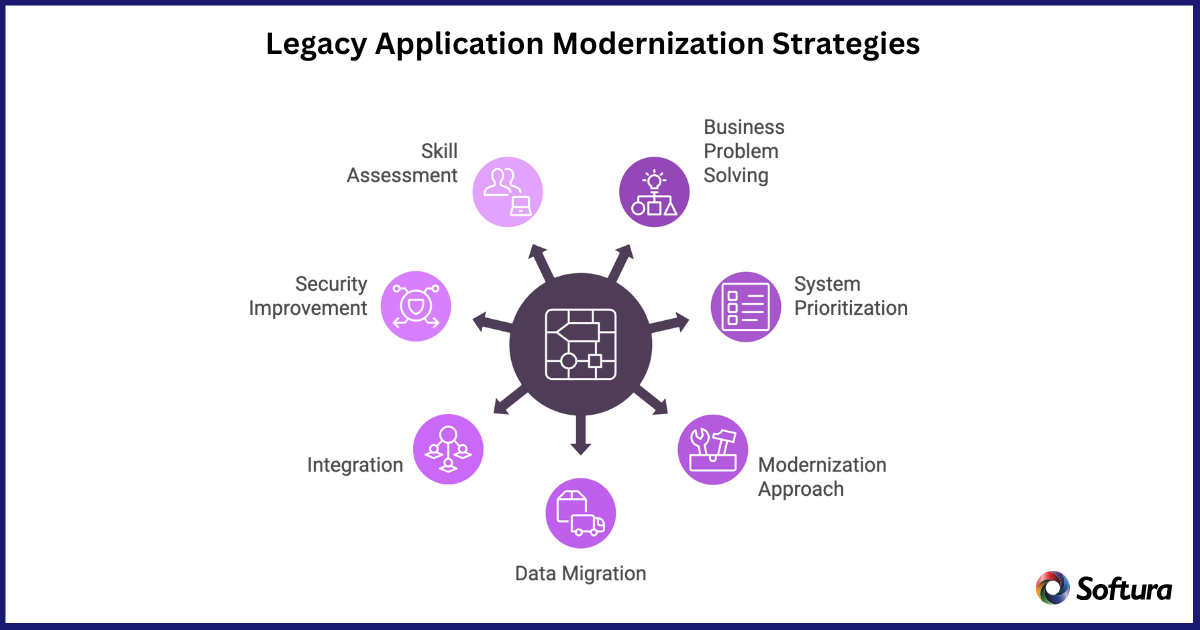
Modernization success often depends on asking the right strategic questions early in the planning phase.
The following questions frequently guide enterprise technology leaders when evaluating legacy application modernization initiatives.
Modernization should always begin with business outcomes rather than technical goals.
Technology leaders often ask a simple but powerful question. What problems will modernization actually solve for the business.
For example, a legacy customer management platform might limit the ability to deliver personalized digital experiences. A legacy logistics system may prevent real time supply chain visibility.
When modernization focuses on solving specific operational challenges, the initiative gains stronger executive support and measurable success metrics.
Large enterprises often operate hundreds of applications. Not every system requires modernization at the same time.
CIOs usually conduct a detailed application portfolio assessment before launching modernization initiatives.
This evaluation identifies systems that create operational bottlenecks, security risks, or high maintenance costs.
Prioritization ensures that legacy application modernization investments focus first on systems with the greatest business impact.
Not every legacy system requires a complete rebuild. Several modernization approaches exist, each designed for different situations.
Common approaches include application rehosting, refactoring, replatforming, or rebuilding systems entirely.
Selecting the correct approach requires careful analysis of system architecture, code complexity, integration requirements, and business importance.
A thoughtful modernization strategy often combines multiple approaches across different applications.
Legacy systems often store years of operational data. Migrating that information safely is one of the most complex aspects of modernization.
CIOs must consider data quality, migration timelines, compliance requirements, and system downtime risks.
A structured data migration strategy ensures that legacy application modernization does not interrupt critical business processes.
Enterprise applications rarely operate independently. Legacy systems often connect with finance platforms, supply chain systems, customer portals, and analytics tools.
Modernization must maintain these connections or replace them with modern integration frameworks such as APIs or cloud based services.
Ignoring integration complexity can create serious operational disruption.
Older systems sometimes rely on outdated authentication methods or security frameworks.
Modernization provides an opportunity to strengthen identity management, data protection, and compliance capabilities.
CIOs often treat legacy application modernization as an opportunity to rebuild security architecture for the entire technology environment.
Modern platforms often use technologies very different from those used in legacy systems.
Organizations must evaluate whether internal teams possess the necessary skills to execute modernization initiatives.
In many cases, external modernization specialists support enterprise teams during complex transformations.
When modernization is carefully planned and executed, organizations often experience significant operational improvements.
Common benefits include:
These outcomes explain why many CIOs treat legacy application modernization as a strategic investment rather than a technical upgrade.
Modernization programs increasingly rely on several technology platforms that support scalable and flexible system architecture.
Cloud infrastructure plays a major role. Cloud platforms allow organizations to run applications in environments that scale automatically based on demand.
Container technologies also support modernization by allowing applications to run consistently across development and production environments.
API based architecture enables systems to communicate easily with other applications, improving integration flexibility.
Together these technologies create an environment where modern applications can evolve quickly while maintaining operational stability.
Despite its advantages, legacy application modernization is rarely simple. Technology leaders must prepare for several common challenges.
Legacy documentation may be incomplete. Knowledge about older systems may exist only within a small group of experienced engineers.
Data quality issues sometimes appear when older systems contain inconsistent records or outdated structures.
Integration dependencies can also create complexity when multiple systems rely on a legacy application for critical processes.
CIOs who anticipate these challenges early often build stronger modernization roadmaps.
Executive technology forums often reveal practical insights from organizations that have already modernized legacy systems.
One recurring lesson is the importance of phased modernization rather than large scale system replacement.
Breaking modernization into manageable stages allows organizations to test new platforms, train teams, and reduce operational risk.
Another lesson involves strong collaboration between technology and business leaders. When business teams actively participate in modernization planning, the resulting systems align better with real operational needs.
Finally, many CIOs emphasize the importance of measurable outcomes. Modernization programs should include clear performance metrics that demonstrate progress and business value.
Modernization rarely exists as an isolated technology project. It usually supports broader digital transformation initiatives.
Modern systems allow organizations to adopt advanced analytics, artificial intelligence, and automation technologies more easily.
They also improve customer experience platforms, mobile applications, and real time data capabilities.
Because of this connection, legacy application modernization often becomes the foundation for future innovation.
Organizations that modernize successfully create technology environments capable of adapting to new business models and emerging technologies.
Before launching modernization initiatives, technology leaders often reflect on several guiding principles.
These principles help organizations avoid common pitfalls and ensure that modernization delivers long term value.
Legacy systems tell the story of an organization’s technological journey. Many of them supported growth, innovation, and operational stability for years.
Yet the pace of digital transformation now requires systems that are more flexible, scalable, and intelligent.
This is why legacy application modernization has become a central priority for CIOs across industries.
Successful modernization begins not with code changes but with strategic thinking. Asking the right questions helps technology leaders design modernization programs that reduce risk and support long term business growth.
Organizations that approach modernization thoughtfully often discover something important. Modern systems do more than replace aging technology. They create a foundation for innovation, agility, and competitive advantage in a rapidly evolving digital world.
Looking to modernize legacy systems and build a future ready technology environment? Connect with Softura to explore practical legacy application modernization strategies tailored for your enterprise.