"Our integration with the Google Nest smart thermostats through Aidoo Pro represents an unprecedented leap forward for our industry."
- Antonio Mediato, founder and CEO of Airzone.
Nearshore IT staff augmentation is becoming a strategic way for companies to close delivery gaps without slowing business priorities. In 2026, modernization, AI integration, cloud migration, QA, cybersecurity, and product engineering all require specialized skills, but local hiring often cannot move fast enough.
For CIOs, CTOs, COOs, and CFOs, the challenge is not just finding talent. It is adding the right capacity while keeping control over quality, security, cost, and outcomes.
That is where nearshore IT staff augmentation makes sense. By bringing skilled professionals from nearby time zones into the existing delivery model, companies can scale faster, collaborate more easily, and reduce hiring pressure without losing governance.
This guide explains when nearshore IT staff augmentation makes business sense, how the collaboration model should work, what cost factors to evaluate, and how to choose the right provider.
Nearshore staff augmentation makes sense when the business needs speed, flexibility, and control at the same time. It is especially useful when internal teams are capable but overloaded.
Use this model when:
For C-level leaders, the value is faster execution without handing over full project control. That makes nearshore IT staff augmentation a strong fit for application modernization, product engineering, data initiatives, and digital transformation programs where business context must stay close to the internal team.
"Our integration with the Google Nest smart thermostats through Aidoo Pro represents an unprecedented leap forward for our industry."
- Antonio Mediato, founder and CEO of Airzone.
The right model depends on the work, not just the hourly rate.
Nearshore works best when collaboration speed matters. Offshore may still be useful for well-defined tasks, but nearshore is stronger for work that requires daily alignment, quick feedback, and shared accountability.
"By analyzing the data from our connected lights, devices and systems, our goal is to create additional value for our customers through data-enabled services that unlock new capabilities and experiences."
- Harsh Chitale, leader of Philips Lighting’s Professional Business.
The benefits should be measured in business terms, not staffing terms. A strong nearshore model should improve capacity, reduce hiring pressure, and maintain delivery visibility.
Key benefits include:
The most important benefit is momentum. Nearshore IT staff augmentation helps prevent critical projects from slowing down because the right skill was not available at the right time.
Collaboration is where nearshore either succeeds or fails. Adding talent is not enough. The team must be integrated into the operating rhythm of the business.
A strong collaboration model should include:
For non-technical leaders, this means the nearshore team should not feel separate. They should work inside the same communication flow, follow the same delivery standards, and be measured against the same outcomes as the internal team.
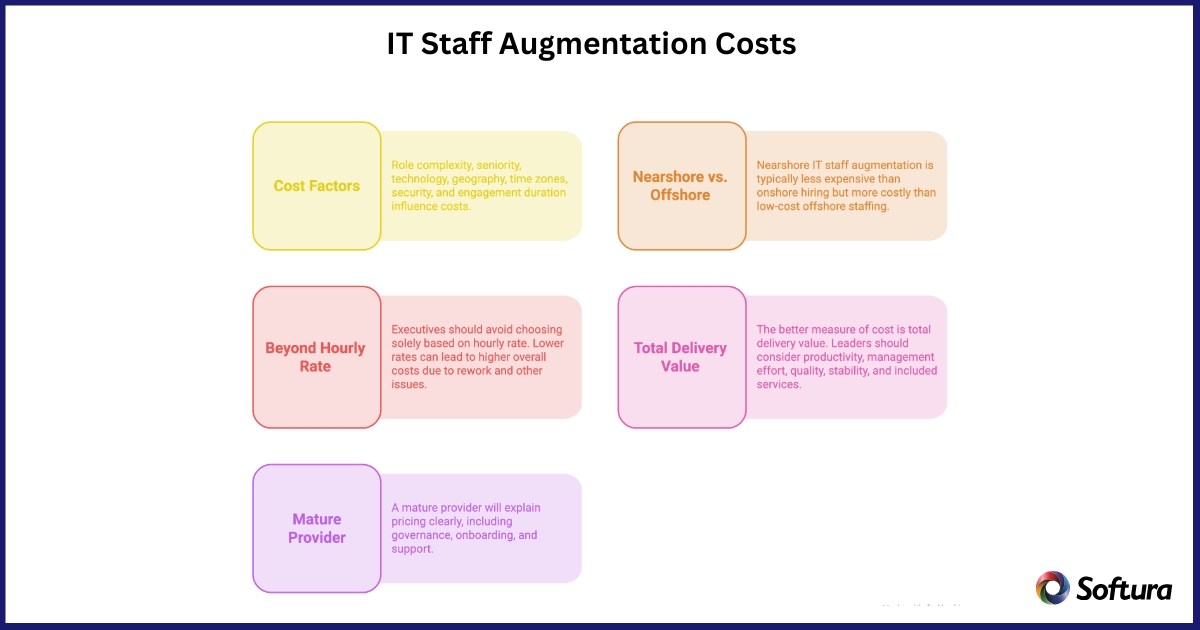
Costs vary based on several factors, including:
In general, nearshore IT staff augmentation usually costs less than onshore hiring but more than low-cost offshore staffing.
However, executives should avoid choosing only by hourly rate. A lower rate can become expensive if it leads to rework, missed deadlines, weak communication, high turnover, or security gaps.
When comparing cost, the better measure is total delivery value. Leaders should ask:
A mature provider should explain pricing clearly. If the proposal only shows a rate card without explaining governance, onboarding, quality control, and escalation support, it may not be the lowest-risk option.
A good nearshore staff augmentation provider should do more than send resumes. They should show how their talent, governance, security practices, and collaboration model will improve delivery outcomes.
Use these evaluation questions:
The strongest nearshore partners make the engagement feel structured from day one. They clarify communication, reporting, quality expectations, accountability, and risk controls before work begins.
Nearshore IT staff augmentation can reduce collaboration challenges, but it still needs proper risk management. The concern is not only whether the provider can supply talent, but whether the engagement can protect delivery timelines, budget, quality, and business continuity.
Watch for these red flags:
In 2026, AI governance matters more than before. If nearshore professionals use AI-assisted development tools, leaders need rules for data privacy, source code protection, testing, and review. Without those controls, the risk is not just technical; it can affect compliance, customer trust, and business continuity.
Most companies should begin with a focused pilot. Start with one to three professionals tied to a measurable business outcome. That could be reducing backlog, improving test automation, supporting a cloud migration, or delivering a modernization sprint.
A practical pilot should define:
If the pilot proves strong communication, quality, and productivity, the company can expand gradually into QA, DevOps, cloud, data, AI, or support roles. This approach reduces risk while giving leaders evidence before making a larger commitment.
Nearshore IT staff augmentation is not just a staffing shortcut. For 2026, it is a strategic way to extend delivery capacity, access specialized skills, and protect business momentum without losing control.
The best results come when leaders treat nearshore as part of the delivery model, not as a temporary external fix. That means clear goals, strong onboarding, secure access, measurable outcomes, and a provider that understands collaboration as much as staffing.
For organizations evaluating nearshore IT staff augmentation, the right partner should bring more than technical resources. They should offer delivery discipline, secure collaboration, and talent aligned with business priorities.
Softura supports teams across custom software development, application modernization, cloud, QA, DevOps, AI integration, and secure delivery, helping businesses expand capacity and move critical initiatives forward with confidence.
Scale Smarter with the Right Nearshore Model
Nearshore IT staff augmentation can help your teams move faster without losing control over delivery, security, or quality. Softura helps you align the right talent, collaboration model, and governance approach to your business goals.