
"Our integration with the Google Nest smart thermostats through Aidoo Pro represents an unprecedented leap forward for our industry."
- Antonio Mediato, founder and CEO of Airzone.
Quality assurance (QA) is often the hidden choke point in software delivery pipelines. While developers push code faster, QA teams frequently lack the bandwidth or specialization to keep pace. The result? Delayed releases, missed defects, and unhappy customers. At Softura, we address this by providing IT staff augmentation that gives organizations immediate access to skilled QA professionals who integrate with existing teams and boost testing capacity without long-term overhead.
QA augmentation proves valuable exactly when IT staff augmentation is the right call—for example, during a product launch crunch, when backlogs are growing and timelines are non-negotiable.
QA augmentation is most effective when:
A release date is immovable, but QA backlog is piling up.
In-house expertise in automation, performance, or security testing is limited.
Seasonal or compliance-driven workloads demand temporary QA scaling.
Organizations need measurable quality improvements without expanding full-time headcount.
The payoff is real: faster release cycles, fewer critical bugs in production, and stronger confidence in every deployment. This aligns closely with the broader advantages of IT staff augmentation—speed, flexibility, risk reduction, and access to niche expertise that benefit the entire business, not just QA.
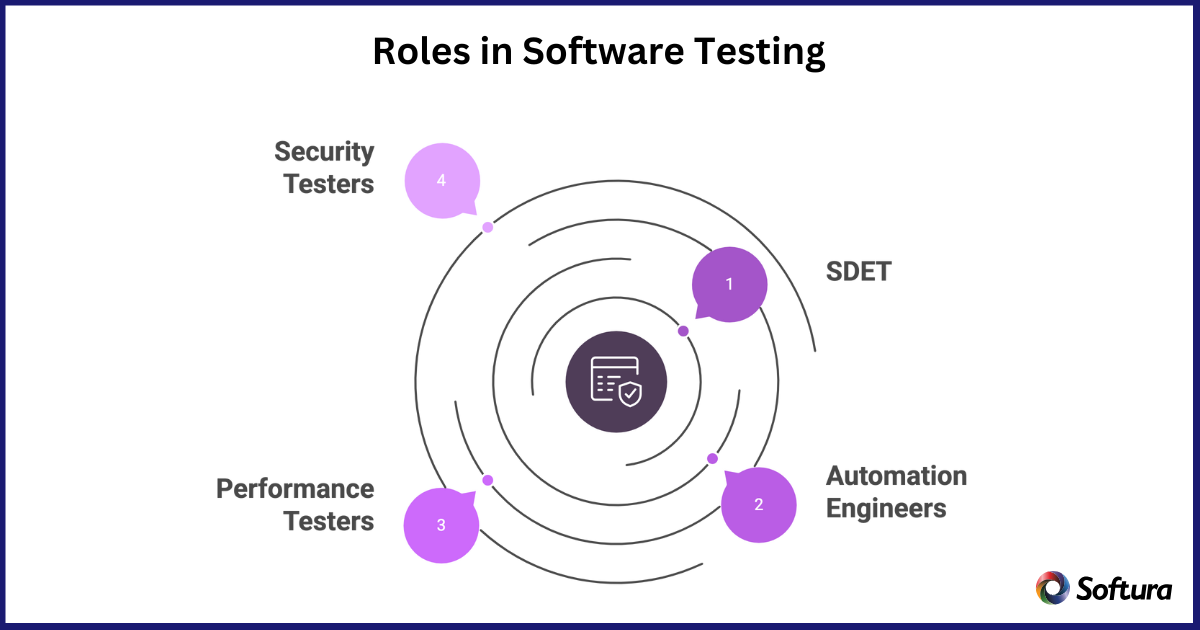
The real strength of IT staff augmentation lies in its role flexibility. Instead of filling generic tester seats, we bring in exactly the skills your project demands.
SDET (Software Development Engineer in Test): Hybrid developers and testers who build test frameworks, write test code, and ensure automation becomes a natural extension of development. Their work accelerates velocity by embedding testing at the code level.
Automation Engineers: Focused on tools like Selenium, Cypress, Playwright, and TestComplete. They design and maintain automated test suites that can reduce regression timelines by up to 80%, freeing internal QA teams to focus on exploratory testing.
Performance Testers: Specialists in load and stress testing with tools such as JMeter, LoadRunner, or Gatling. They validate scalability, assess response times, and identify bottlenecks before users encounter them.
Security Testers: Experts in penetration testing, API validation, and DevSecOps. In regulated industries such as banking, healthcare, or insurance, they are critical to passing audits and avoiding fines.
Softura Insight: In one client engagement, adding three of our automation engineers increased test automation coverage from 20% to nearly 65% in a single quarter. That improvement cut regression cycles from three weeks to just four days. We’ve repeated this pattern across multiple industries, proving that targeted augmentation of QA roles makes a measurable impact on outcomes.
"Our integration with the Google Nest smart thermostats through Aidoo Pro represents an unprecedented leap forward for our industry."
- Antonio Mediato, founder and CEO of Airzone.
In today’s agile world, waiting until the end of the cycle for testing is a recipe for disaster. Shift-left testing moves QA earlier in the lifecycle, embedding it directly into development. Our augmentation services support this approach by:
Deploying SDETs who build tests as features are developed.
Integrating automated regression tests into CI/CD pipelines.
Using service virtualization and contract testing to validate APIs and microservices before integration.
Ensuring continuous regression coverage so testing isn’t crammed into the final sprint.
Softura Example: During a mobile banking app rollout, our augmented QA engineers introduced automated contract testing into the pipeline. This reduced integration defects by 40% and allowed the product team to ship updates twice as fast with zero rollbacks.
Shift-left is not just about tools; it’s about culture. Our QA professionals accelerate this cultural adoption by embedding best practices directly into client teams. They coach development squads on test-driven development and build awareness that quality must be a shared responsibility.
"By analyzing the data from our connected lights, devices and systems, our goal is to create additional value for our customers through data-enabled services that unlock new capabilities and experiences."
- Harsh Chitale, leader of Philips Lighting’s Professional Business.
QA success depends on people, processes, and platforms. When we provide QA augmentation, we ensure testers have the right tools, data, and secure environments to succeed.
Tool Access: Our augmented testers work with client-provided licenses for automation, performance, and device testing platforms such as Selenium, JMeter, and BrowserStack. We also advise on tool selection if gaps exist.
Test Data Management: We help establish masked or anonymized datasets to balance realism with compliance under GDPR, HIPAA, or SOX. This ensures testers have realistic scenarios without exposing sensitive information.
Secure Environments: Our testers operate through Virtual Desktop Infrastructure (VDI) with least-privilege access and multi-factor authentication, aligned to SOC 2 and ISO 27001 standards.
Softura Perspective: In one healthcare project, we established a masked test data environment for augmented staff to ensure HIPAA compliance. This not only eliminated risk but also built trust with auditors who approved the solution without findings. Across other industries, we have helped clients set up similar secure QA environments that satisfy both business and compliance requirements.
Clear Your QA Backlog Fast
Add automation engineers, SDETs, or surge squads within days and accelerate testing without delaying releases.
At Softura, we know adding QA talent without measurement leads nowhere. Every QA augmentation engagement we deliver includes SLAs and KPIs tied to business outcomes.
Key QA Metrics We Track:
Defect Detection Rate (DDR): Percentage of defects caught before release. Improved DDR is a sign of effective QA augmentation.
Defect Escape Rate: Bugs that slip into production — trending consistently down with our teams.
Automation Coverage: The percentage of regression test cases automated. We aim for 70–80% in mature QA organizations, ensuring repeatability and reliability.
Mean Time to Resolution (MTTR): How quickly critical defects are resolved. Faster resolution times reduce downtime and business impact.
Velocity Alignment: QA throughput aligned with sprint cadence, ensuring testing is never the blocker.
Our Reporting Practices:
Real-time dashboards accessible to leadership.
Weekly reports mapping defects to business risk, not just technical categories.
SLA commitments such as “All critical defects resolved within 24 hours.”
Executives aren’t interested in raw test case counts — they want assurance that releases won’t derail customer experience. We provide that assurance through transparent, metric-driven reporting that makes QA results clear, business-relevant, and actionable.
Different projects call for different engagement models. At Softura, we offer flexible approaches to match organizational needs.
Embedded Testers: Individual QA specialists integrated into agile squads for continuous development. They adopt sprint rituals and ensure testing aligns directly with development output.
QA Pods: Cross-functional pods including automation engineers, performance testers, and manual testers. Ideal for large modernization or ERP projects that need depth and variety of QA expertise.
Surge Squads: High-intensity QA teams deployed on short notice. Perfect for pre-release crunch periods when deadlines are non-negotiable or when compliance audits require clearing massive backlogs quickly.
Softura Example: A healthcare client facing a compliance deadline engaged a surge squad of four of our testers. In less than two months, we cleared a backlog of 1,200 test cases and helped them achieve audit approval with zero compliance issues. In other engagements, our pods have supported ERP rollouts where embedded testers alone would not have provided enough depth or speed.
In today’s market, software quality isn’t optional — it’s a competitive differentiator. Customers expect seamless experiences, regulators enforce strict compliance, and leadership demands speed without compromise. IT Staff Augmentation from Softura provides the capability, flexibility, and specialization organizations need to elevate QA from a bottleneck to a business enabler.
With our QA-focused staff augmentation:
We fill immediate skill gaps with specialized QA roles.
We embed testing earlier in development cycles with shift-left practices.
We secure test environments and ensure compliance with strict data handling standards.
We adapt engagement models — pods, embedded testers, or surge squads — to align with client needs.
We provide clear metrics and reporting that link QA performance directly to business outcomes.
At Softura, we’ve consistently seen our clients succeed when QA is treated not as a checkpoint but as a continuous capability. Our staff augmentation services provide the confidence to release software faster, with fewer defects, stronger compliance, and higher customer trust. For organizations striving to align IT delivery with business goals, augmenting QA teams is one of the smartest moves they can make.
Strengthen QA Without Expanding Headcount
Leverage staff augmentation for security, performance, and compliance testing with measurable SLAs and audit-ready practices.