
"Our integration with the Google Nest smart thermostats through Aidoo Pro represents an unprecedented leap forward for our industry."
- Antonio Mediato, founder and CEO of Airzone.
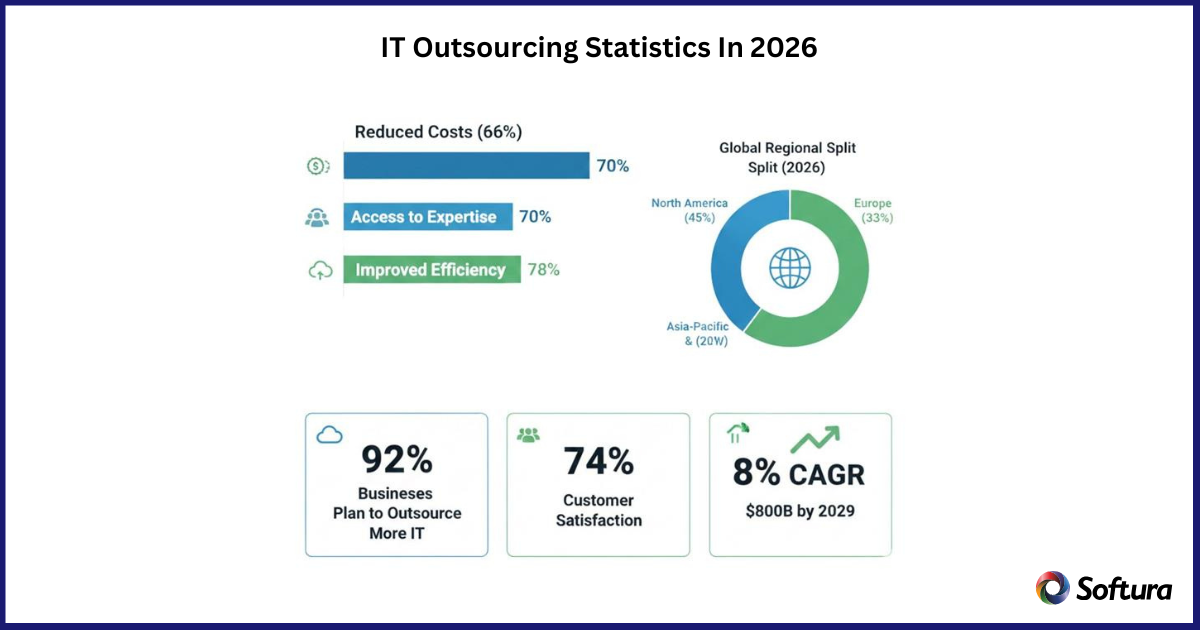
In 2026, IT outsourcing adoption is widespread, with most enterprises outsourcing at least one IT function and a growing number increasing their outsourcing investments year over year.
Outsourcing is no longer limited to large enterprises alone. Small and mid-sized businesses are increasingly turning to outsourcing to access specialized skills, improve efficiency, and reduce operational overhead. Across regions, organizations report strong satisfaction with outsourcing partnerships, particularly when aligned with long-term digital objectives.
"Our integration with the Google Nest smart thermostats through Aidoo Pro represents an unprecedented leap forward for our industry."
- Antonio Mediato, founder and CEO of Airzone.
The global IT services outsourcing market is on track to surpass USD 1 trillion before the end of the decade, reflecting sustained enterprise demand for digital and managed services.
Market growth is driven by increasing reliance on technology platforms, cloud-native architectures, and cybersecurity operations. While North America continues to dominate total spend, Asia-Pacific is emerging as the fastest-growing region due to its expanding talent pool and cost advantages.
Two segments, Information Technology Outsourcing (ITO) and Business Process Outsourcing (BPO)—continue to form the backbone of the global outsourcing economy, with ITO leading due to rising technology complexity.
"By analyzing the data from our connected lights, devices and systems, our goal is to create additional value for our customers through data-enabled services that unlock new capabilities and experiences."
- Harsh Chitale, leader of Philips Lighting’s Professional Business.
Outsourcing has become a standard operating model for enterprises, with most large organizations relying on external partners to support scale, innovation, and resilience.
Business Process Outsourcing (BPO) continues to support non-core functions such as HR, payroll, logistics, and customer support, while IT outsourcing dominates mission-critical technology operations. Although cost reduction remains a benefit, organizations increasingly prioritize access to talent, innovation, and scalability.

The IT outsourcing market has matured into a core enterprise strategy, supporting cloud adoption, cybersecurity, and digital transformation initiatives worldwide.
More than 70% of companies globally outsource at least one business function, reflecting outsourcing’s shift from tactical cost savings to strategic enablement. While cost reduction still matters, innovation and talent access have become stronger motivators especially for advanced technologies like AI and cloud-native development.
The global shortage of skilled IT professionals is one of the strongest drivers of IT outsourcing growth in 2026.
Demand for specialists in AI, cloud, cybersecurity, and modern software engineering continues to outpace supply, particularly in North America and Western Europe. As wages rise and hiring timelines extend, organizations increasingly rely on outsourcing partners to access talent at scale.

AI and automation are rapidly reshaping IT outsourcing, shifting engagements from labor-driven delivery models to intelligent, outcome-focused partnerships.
As enterprises scale digital operations, outsourcing providers are increasingly expected to embed AI capabilities across application development, infrastructure management, and service delivery. Automation maturity, measurable efficiency gains, and AI-enabled workflows now play a central role in outsourcing partner evaluation, especially for organizations pursuing long-term digital transformation.
Outsourcing adoption varies by industry, with technology intensity, regulatory pressure, and speed-to-market demands strongly influencing how organizations engage external IT partners.
Industries such as financial services, retail, SaaS, and manufacturing rely heavily on outsourcing to support modernization, scalability, and operational resilience. In contrast, regulated sectors like healthcare adopt outsourcing more cautiously, particularly for application development, due to compliance and data security considerations.
Geography plays a critical role in IT outsourcing, with different regions specializing in distinct service strengths, delivery models, and cost structures.
Organizations increasingly adopt multi-country sourcing strategies to balance talent availability, cost efficiency, time-zone alignment, and geopolitical risk. This has led to the rise of diversified delivery models combining offshore, nearshore, and onshore resources.
Geographic-Specific driven statistics:

Cloud computing has become a foundational driver of IT outsourcing, fueling demand for managed cloud services, cloud-native development, and cybersecurity operations.
As enterprises migrate from on-premises systems to cloud-based architectures, outsourcing partners play a critical role in managing complexity, ensuring security, and enabling continuous innovation. Cloud adoption is no longer optional; it is tightly linked to scalability and digital agility.
AI-powered automation, including RPA and chatbots, is transforming how enterprises deliver support, optimize processes, and scale operations through outsourcing.
Following the rapid adoption of generative AI, organizations increasingly rely on intelligent automation to improve service quality while controlling costs. Outsourcing partners are expected to integrate RPA and AI-driven support across customer service, IT operations, and business workflows.
The rise of remote and hybrid work has increased reliance on IT outsourcing, particularly for cybersecurity, infrastructure management, and distributed workforce enablement.
As organizations adapt to flexible work models, securing systems, data, and access has become more complex. Outsourcing cybersecurity operations helps enterprises address skills shortages, manage risk, and maintain compliance in a distributed environment.

These cross-cutting outsourcing statistics highlight how IT outsourcing is evolving in 2026—from contract structures and budget allocation to remote work enablement, vendor consolidation, and outcome-based delivery.
Rather than being driven purely by cost reduction, outsourcing decisions are increasingly shaped by performance, resilience, governance, and long-term scalability. These numbers also reinforce a major shift: enterprises now want outsourcing partners who can deliver measurable business outcomes, not just staffing support.
Ready to turn outsourcing into a competitive advantage? Talk to Softura to explore the right engagement model for your roadmap.