
"Our integration with the Google Nest smart thermostats through Aidoo Pro represents an unprecedented leap forward for our industry."
- Antonio Mediato, founder and CEO of Airzone.
Every CIO and technology leader knows about the frustration: projects slow down; internal teams hit bandwidth limits, and hiring full-time talent takes months. Deadlines start slipping, budgets tighten, and yet the demand for innovation never stops.
This tension between speed, quality, and cost leaves many wondering how to scale effectively without draining resources. The answer often lies in one crucial choice, selecting the right IT Staff Augmentation pricing model that aligns with both financial goals and delivery realities.
This 2026 guide by Softura explores in-depth how different pricing structures influence your budget, project success, and long-term ROI. You’ll learn how to evaluate costs, avoid hidden expenses, and align pricing models with your project’s goals, risk profile, and delivery expectations.
Your pricing model isn’t just a billing mechanism — it’s a reflection of how you plan, manage, and deliver projects. The structure you choose determines your financial flexibility, risk distribution, and overall project efficiency.
From a leadership perspective, CIOs and CTOs in 2026 are focusing less on hourly rates and more on strategic total cost of ownership (TCO) — considering elements like onboarding speed, governance maturity, and vendor accountability. Poorly chosen pricing models often result in project overruns, stalled timelines, or poor ROI visibility.
Why it matters:
C-level Insight: “Budget predictability isn’t achieved by choosing the cheapest model — it’s achieved by aligning the pricing structure with your project’s uncertainty curve.”
"Our integration with the Google Nest smart thermostats through Aidoo Pro represents an unprecedented leap forward for our industry."
- Antonio Mediato, founder and CEO of Airzone.
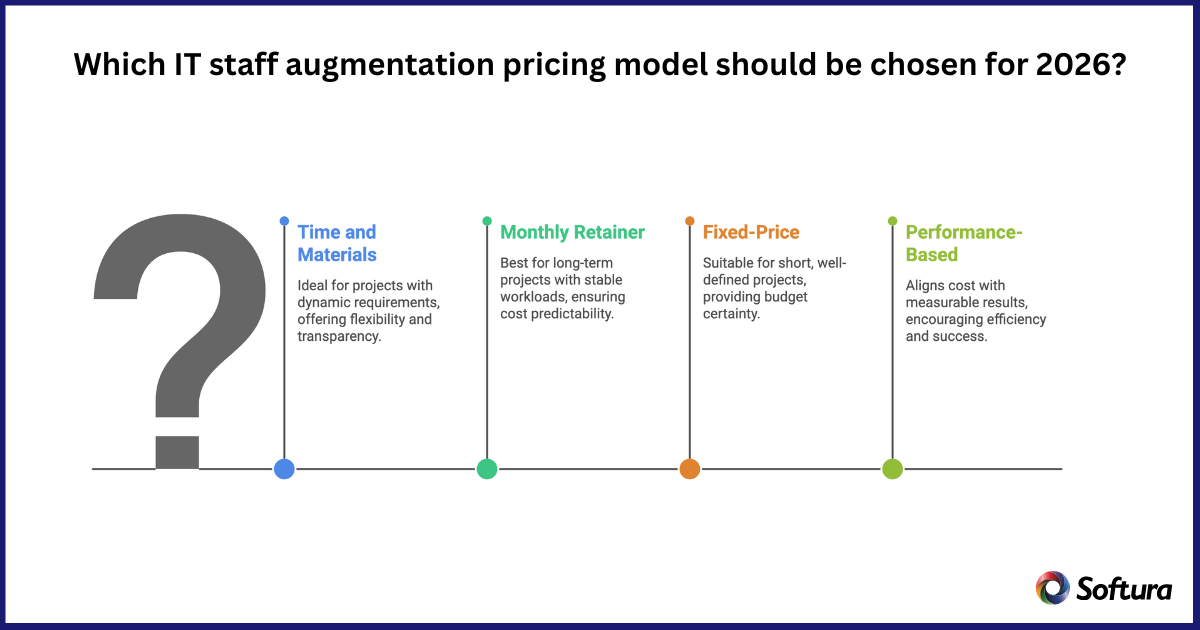
Every organization has unique operational rhythms and risk thresholds. Let’s break down the four most common models and how they align with different types of IT projects.
This model charges based on actual hours worked. It’s ideal for projects with dynamic requirements, such as AI prototypes, MVPs, or modernization initiatives. You gain control over how the team allocates time and budget.
Example: A nearshore AI team at $70/hr can achieve 50% faster iteration than an onshore team locked into fixed contracts.
Best Fit: Product innovation, agile development, and exploratory or R&D-heavy projects.
This model offers dedicated or shared resources at a fixed monthly rate, ensuring ongoing support without constant contract renegotiation. It’s perfect for projects with stable workloads, like maintenance, DevOps, or continuous delivery.
Example: A healthcare client running continuous software updates uses a retainer team with a stable monthly cost, saving 20% annually compared to hourly billing.
Best Fit: 6+ month engagements, continuous delivery programs, and managed DevOps operations.
With a predefined scope, timeline, and deliverables, this model offers budget certainty. The vendor assumes risk for overruns, making it suitable for short, well-documented projects like UI overhauls or compliance integrations.
Example: A logistics company used a fixed-price contract for migrating to a new ERP module, achieving predictable cost outcomes within four months.
Best Fit: Short-term, clear-scope projects with little risk of mid-course requirement changes.
A rising trend in 2026, performance-based contracts link payment directly to KPIs — such as uptime, speed of delivery, or SLA compliance. Hybrid models blend T&M, Fixed, and Retainer structures for different project phases.
Example: For a DevOps engagement, Softura designed a retainer-based model with uptime-linked bonuses. This structure improved incident resolution speed by 22% within three months.
Best Fit: SLA-driven engagements, modernization programs, and transformation projects.
"By analyzing the data from our connected lights, devices and systems, our goal is to create additional value for our customers through data-enabled services that unlock new capabilities and experiences."
- Harsh Chitale, leader of Philips Lighting’s Professional Business.
Understanding the underlying cost factors helps leaders make informed decisions beyond the base rate.
Regional Note: Nearshore models are gaining popularity due to cultural alignment and 3–4 hour time overlaps.
Senior engineers deliver greater efficiency and quality control, reducing rework costs. While a junior resource may cost 40% less, it can extend delivery timelines by 30–40% if not paired with proper oversight.
Demand for AI, ML, cloud, and cybersecurity experts is pushing costs up 30–50%. Offshore ML engineers cost around $50–70/hr versus $120–150/hr in the US.
Pro Insight: “A smaller team of senior engineers often achieves more than a larger junior team — especially in modernization and data-driven projects.”
Ignoring hidden costs can distort your ROI calculation. Here’s what to consider:
Softura’s Approach: Leveraging ISO 27001-certified environments and AI-based onboarding optimization, we minimize ramp-up time and compliance cost impact.
For projects with frozen requirements and well-documented deliverables, a fixed-price contract ensures maximum cost predictability. It’s ideal when you have full clarity and minimal likelihood of scope changes.
For continuous innovation, modernization, or agile product development, T&M and Retainer models enable real-time adaptability. These allow scaling up or down without renegotiating scope — perfect for dynamic environments.
In 2026, hybrid models dominate enterprise strategies. Many leaders begin with a T&M discovery phase, switch to Fixed-Price for implementation, and finally adopt a Retainer for post-launch support. Adding performance-based elements ties vendor motivation to measurable KPIs.
C-level View: “Hybrid pricing signals maturity — it combines predictability with adaptability.”
ROI in augmentation is more than rate comparison — it’s about measurable value creation.
Key Metrics for Evaluating ROI:
Avoid Low-Price Traps: Extremely low hourly rates often hide inefficiencies — poor communication, delays, or rework can inflate actual costs by 30–50%. Prioritize transparency, proven delivery frameworks, and measurable outcomes.
IT Staff Augmentation in 2026 is no longer just a cost-saving tool — it’s a strategic partnership model that helps enterprises scale with precision. The success of your engagement depends on how well your pricing model aligns with your project’s evolution, governance maturity, and desired ROI.
Quick Recap:
At Softura, we help enterprises design right-fit augmentation strategies backed by governance frameworks, pre-vetted global talent, and measurable ROI tracking. The right pricing model isn’t just about saving money — it’s about achieving predictable, sustainable growth.
Key Takeaway: The most successful companies don’t just negotiate hourly rates, they engineer pricing models that align with their goals, risks, and innovation velocity. When cost and strategy align, your IT augmentation becomes not just affordable, but unstoppable.
Turn IT Spend into Strategic Growth
Align cost models with business goals through Softura’s governance-driven staff augmentation frameworks—built for predictability, performance, and sustainable scaling.